

 By
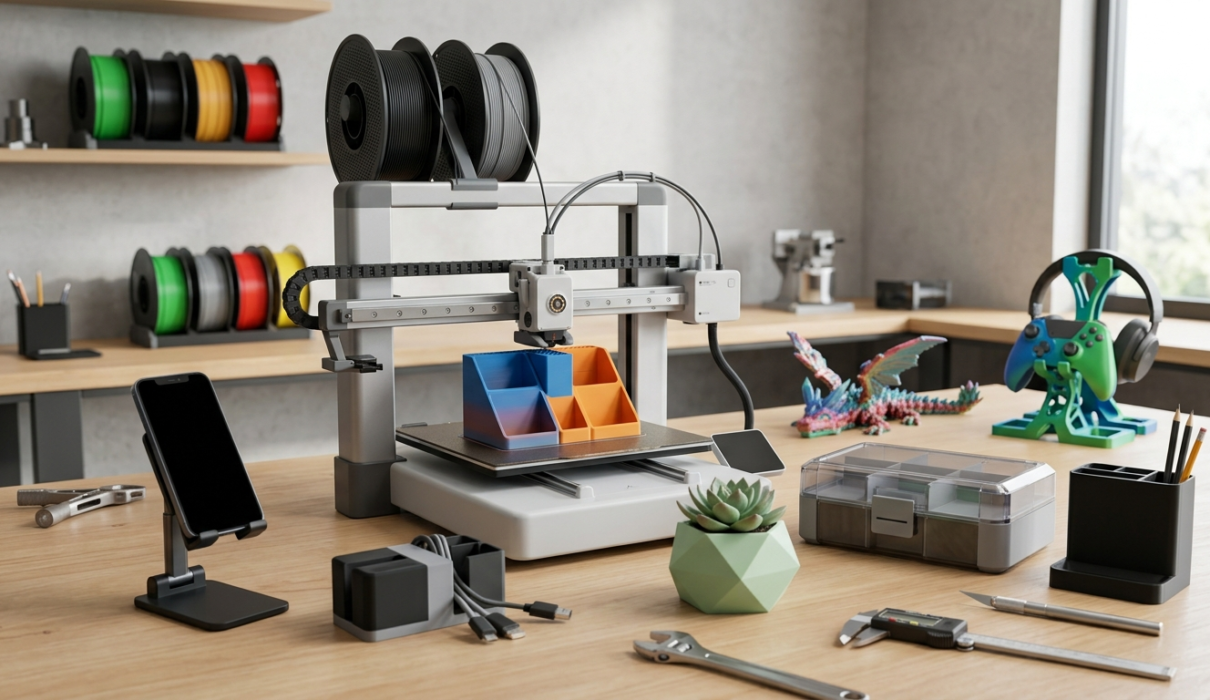
By There’s a familiar moment for a lot of new 3D printer owners: the novelty of a benchy or a keychain wears off after a week or two, and the question shifts from “look what this thing can do” to “okay, what is this actually for.” That’s usually when people start searching for the best things to 3D print, and it’s a fair question. The best things to 3D print depend on what you need, your printer, and the material you’re using
If you’re looking for fun things to 3D print, these projects are a good place to start because they don’t need to serve a practical purpose. A 3D printer is a genuinely useful tool, but only if you know what to point it at.
This guide is organized around actual categories — things for a desk, a kitchen, a garage, a game night — because that’s closer to how people actually decide what to print. Nobody wakes up wanting “a 3D printed object.” They wake up wanting their cables to stop tangling, or a way to keep the dice from rolling off the table during game night.
It’s worth being upfront about where 3D printing genuinely shines and where it doesn’t. Not every idea here works well in every material, and some of the more fun things to print aren’t things you’d want to rely on structurally. That gets flagged where it matters.
What Makes a Good Things to 3D Print?
At its core, a thing to 3D print is any object you can design or download as a 3D model, slice into printable layers, and produce on an FDM or resin printer. That’s a broad definition, covering everything from a five-minute keychain to a multi-day cosplay helmet.
What separates a good project from a frustrating one usually comes down to three things: whether the design is printable without heavy supports or intervention, whether the material suits the object’s job, and whether your printer is capable of the size and detail the model calls for. A lot of “why did this fail” moments trace back to one of those three, not bad luck.
Best Things to 3D Print for Beginners
If you’re new to this, the temptation is to jump straight to something impressive. Resist that for a print or two. Start with objects that are small, mostly flat-bottomed, and don’t require supports.
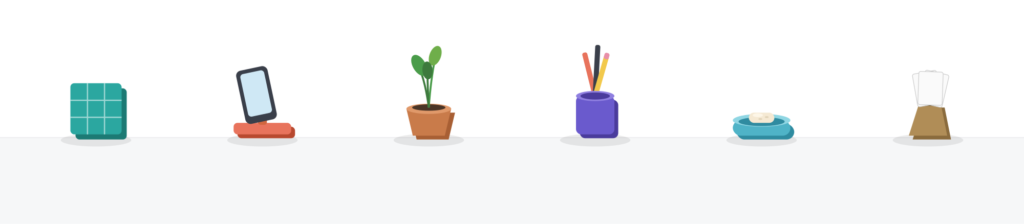
A calibration cube or small test print isn’t exciting, but it’s one of the best things to 3D print when you’re learning how your printer behaves, but it tells you a lot about your printer’s current state before you commit filament to something bigger. A simple phone stand is a good next step — functional, quick, and forgiving if the first layer isn’t perfect. A small planter or pot teaches you about printing without top layers and gives you a genuinely useful object at the end.
A pencil or pen holder cup is about as forgiving as prints get, since it’s essentially a hollow cylinder. A simple soap dish introduces basic drainage-hole design without much complexity. A business card holder is small, quick, and genuinely useful once it’s done.
These are best for anyone who just unboxed a printer and wants low-stakes wins before tackling overhangs or multi-part designs. PLA is the natural choice here — it’s the easiest material to print reliably, and beginner mistakes are cheaper in PLA than in more finicky filaments.
Useful Things to 3D Print for Everyday Life
Not every thing to 3D print needs to be impressive — a lot of the genuine value shows up in small, unglamorous fixes.
Cable organizers and clips solve a problem almost everyone has, and printing your own means sizing them exactly to your cable thickness instead of hoping a store-bought clip fits. Wall hooks are similarly practical — a few printed hooks near an entryway or in a closet cost almost nothing in material and solve a real storage problem.
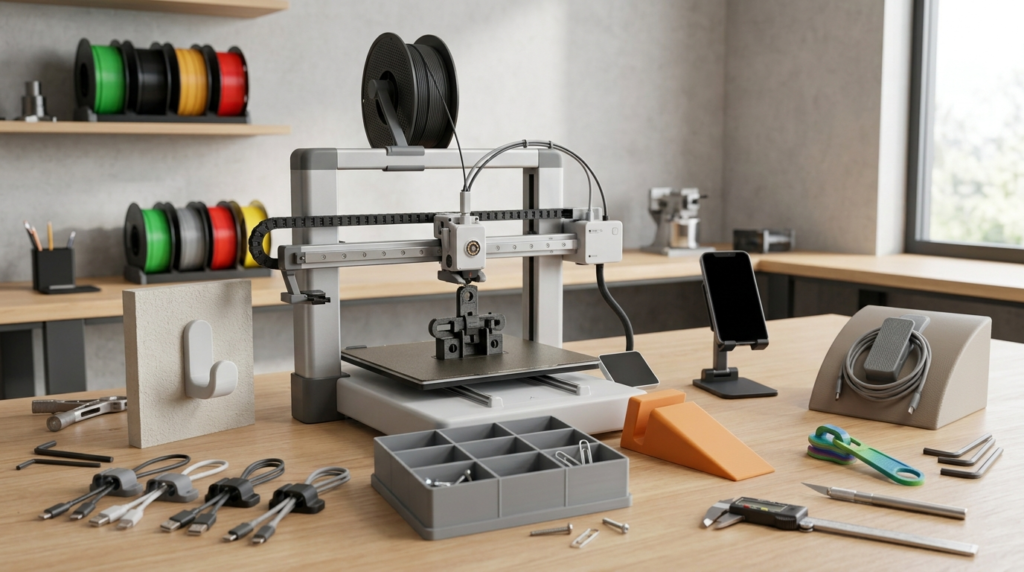
Drawer dividers let you customize compartment sizes to whatever you’re actually storing, which off-the-shelf dividers rarely match well. A door stopper is a small, solid print that solves an annoyingly common household problem. A car phone or cable mount clip keeps a phone or charging cable in a fixed spot on a dashboard or vent. A zipper pull replacement fixes a broken jacket or bag zipper cheaply, without needing to buy a whole new item.
Best suited for anyone tired of buying organizational products that almost-but-not-quite fit their space. PLA works for indoor, low-stress use; PETG if the item sees more handling or slight temperature exposure. The main printing consideration is orientation — most of these small utility prints benefit from being printed flat-side-down to avoid needing supports at all.
These are some of the most useful things to 3D print because they solve small problems you deal with every day.
Cool and Fun Things to 3D Print
Not every thing to 3D print needs to solve a problem. Some prints are just satisfying to make.
Articulated figures — the kind that print fully assembled with moving joints, no glue required — are a favorite in the community because they show what additive manufacturing can do that injection molding can’t. Gyroscopes and fidget toys print without supports and are oddly satisfying to hand someone who’s never seen a 3D printer work. Simple puzzle boxes combine mechanical design with a fun unboxing moment.
A fidget spinner is a classic beginner-friendly novelty print that still gets requested often. A small decorative vase is a nice way to experiment with vase-mode printing, which uses a single continuous wall. A mini catapult toy combines a bit of mechanical design with genuine play value.
Best for hobbyists who enjoy the “wait, you can print that?” reaction, or for printing gifts for kids and curious friends. PLA works fine since these are decorative or lightly handled rather than load-bearing. The main consideration is print orientation for articulated parts — too tight a tolerance and joints fuse together; too loose and they’re wobbly, so it’s worth testing a small joint sample first.
Things to 3D Print for Home Organization
Beyond individual gadgets, home organization systems are some of the most useful things to 3D print since you can design around your actual space rather than a generic product size.
Modular storage boxes — often stackable or interlocking — can be sized to fit the dimensions of a shelf or drawer exactly. Closet and pantry organizers, like spice rack inserts or shelf dividers, solve the “almost fits” problem that plagues store-bought organizers. Key holders and mail organizers near an entryway are small prints with an outsized daily impact, since they get used constantly.
A closet rod end bracket can replace a broken or missing bracket without needing to buy a whole new rod system. A sock or drawer tray organizer keeps small items from sliding around inside a drawer. A shoe rack riser adds a second usable level to existing shelving without buying new furniture.
Suits people setting up a new space, or anyone who’s given up finding a commercial product that fits an oddly-shaped cabinet or drawer. PLA is generally fine indoors; PETG if the storage will hold real weight or sit somewhere with temperature swings. Larger organizational pieces often benefit from being split into smaller printed sections and assembled, rather than risking one large piece warping or failing partway through.
Things to 3D Print for a Desk or Workspace
The desk is probably the single most common place people use things to 3D print partly because it’s right next to the printer.
A cable management tray that runs under your desk keeps cords from becoming a tangled mess. A monitor stand or riser raises your screen while adding storage underneath. A headphone stand keeps your headphones off the desk and looks nicer than a pile of cords.
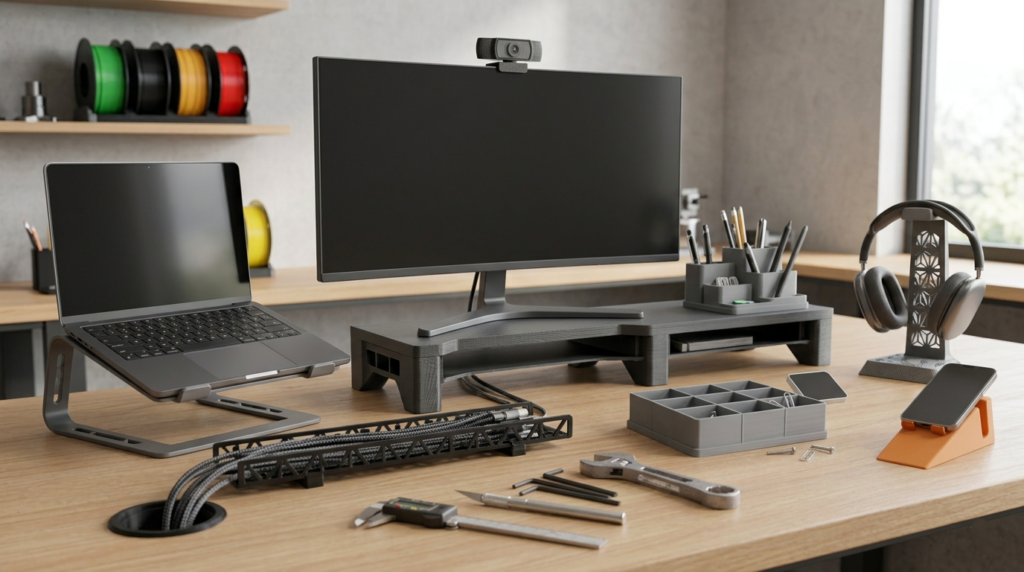
A pen and desk organizer consolidates the small stuff that otherwise ends up scattered. A laptop stand improves typing angle and airflow underneath the machine. A webcam mount attaches a webcam to a monitor edge instead of leaving it propped against something.
A cable grommet cover neatens the hole where cords pass through a desk surface.
Fits almost anyone who works at a desk regularly. PLA is fine for anything not bearing real weight; for a monitor stand or anything holding actual load, PETG or a filled filament is worth considering, since PLA can slowly deform under sustained stress in some situations. Load-bearing desk items should be printed with adequate wall thickness and infill — not the place to minimize settings just to save filament.
Things to 3D Print for Hobbies and Gaming
Tabletop gaming and things to 3D print turned out to be a natural pair and it shows in how much of the hobby community centers around this category.
Miniatures and terrain pieces for tabletop RPGs are probably the single most searched category here, largely because commercial minis are expensive and printed ones can be customized. Dice towers and trays contain the chaos of rolling dice at a crowded table. Controller stands keep gaming controllers organized and off the couch cushions.
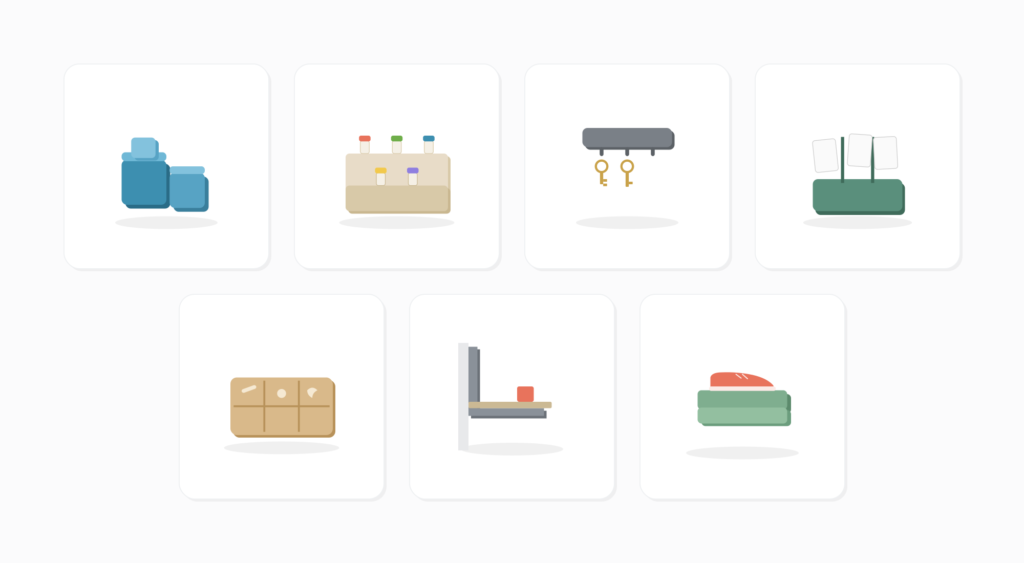
Board game organizers — custom inserts sized to a specific game’s components — solve the universal problem of board game boxes never quite fitting everything back in. A card game tray or holder keeps a hand of cards upright and organized during play. A dice vault or small dice box gives a collection of dice a dedicated home instead of a loose pile. A miniature display case protects painted miniatures from dust once they’re finished.
Best for tabletop gamers, board game collectors, and anyone running a regular game night. Resin printing is popular for high-detail miniatures because of the finer resolution, though FDM with PLA works fine for terrain and larger accessories where fine facial detail matters less. Resin prints require more careful post-processing (washing and curing) and the resin itself needs more careful handling than filament, so it’s a bigger step up in complexity than the finished product suggests.
Things to 3D Print for the Kitchen
This is a category worth approaching carefully, since it’s also where people most often assume more than they should.
Useful, generally safe things to 3D print for the kitchen include cabinet organizers, jar and lid holders, spice rack inserts, and utensil holders — objects near food but not in direct, sustained contact with it. A sponge holder keeps a sink sponge off the counter and lets it dry between uses. A bag clip reseals snack or bread bags without buying disposable clips. A cabinet door bumper or silencer quiets cabinets that slam shut. These are fine in standard PLA or PETG for most households.
One important caution: don’t assume a 3D printed object is safe for direct, repeated food contact, hot liquids, or the dishwasher unless it’s been made with a filament and process specifically documented as food-safe — and even then, the layered nature of FDM prints creates tiny grooves that can harbor bacteria in ways smooth injection-molded plastic doesn’t. A cookie cutter used occasionally and washed by hand is a different risk profile than a mixing bowl meant for daily food prep. If food contact matters, look into specific food-safe filament guidance rather than assuming any PLA or PETG spool is automatically fine.
Things to 3D Print for Makers and DIY Projects
For people who already tinker — electronics, woodworking, home repair — things to 3D print become another useful tool in the shop rather than a novelty.
Custom enclosures for electronics projects, sized exactly to your circuit board or components, are one of the more genuinely transformative uses of home 3D printing, since custom enclosures used to require real fabrication skill. Jigs and fixtures for repetitive tasks — a drilling guide, an alignment jig — save time on projects you do more than once.
Replacement parts, like a broken clip or knob for an appliance that’s otherwise fine, extend the life of things you’d otherwise throw away. A cable strain relief clip protects a cord where it enters an enclosure from repeated bending. A soldering iron stand keeps a hot iron safely off the workbench between uses. A filament spool holder is a common first upgrade project for the printer itself.
Aimed squarely at people already doing hands-on projects who want a printer as a supporting tool. Material depends heavily on the job — PETG or nylon for mechanical stress, PLA for enclosures that just need to hold shape. The main consideration is dimensional accuracy; if a part needs to fit precisely, test-fit a small section before committing to a full print, since real-world tolerances often differ slightly from the CAD model.
Most Useful Things to 3D Print
It’s worth pulling this thread out separately, because “useful” gets thrown around loosely in this hobby. A genuinely useful print is one you’ll actually use repeatedly, not one that’s impressive once and then sits on a shelf.
Cable clips, drawer organizers, wall hooks, phone stands, and tool holders are some of the most useful things to 3D print because they solve a small, recurring annoyance. Decorative items and novelty prints are fun, but they’re a different category of value — enjoyment rather than function — and it’s worth being clear about which one a given project is going for before spending hours of print time.
Small and Quick 3D Printing Projects
If you’re short on time or filament, small things to 3D print are the way to go. Phone stands, simple hooks, small planters, cable clips, and keychains all fall here — items that print in a relatively short window and don’t demand much filament or babysitting. Ideal for testing new filament colors, dialing in a new printer, or getting a quick, satisfying result between bigger projects.
Larger and More Advanced 3D Printing Projects
On the other end, larger things to 3D print — storage bins, multi-part cosplay pieces, large planters, or anything requiring assembly — take real planning. A cosplay armor piece printed in multiple sections and assembled afterward is a common advanced project once someone’s comfortable with basic prints. An articulated robot arm model combines multiple moving joints into one larger assembly. An RC vehicle body or chassis shell is a good example of a functional advanced print, since it needs to actually fit hardware underneath it. Bed adhesion becomes more critical as objects get bigger, warping risk increases, and a failure partway through a long print is a much bigger loss than a failed 20-minute print.
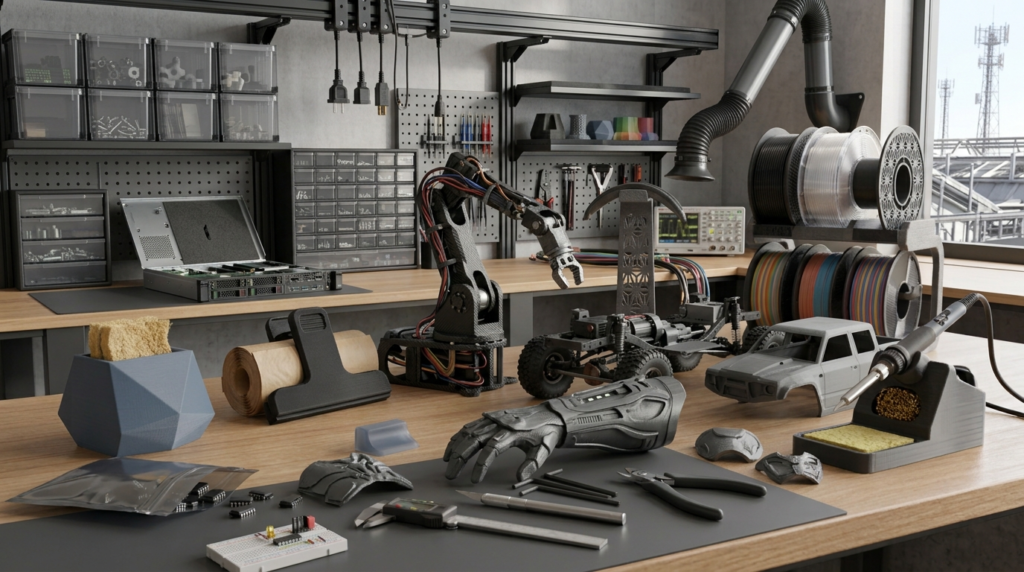
These suit people with some printing experience and a reasonably well-calibrated printer. It’s often smarter to split a large design into sections that print separately and get joined afterward, rather than pushing a printer to its absolute build volume limit in one piece.
Things to Consider Before Choosing a Model
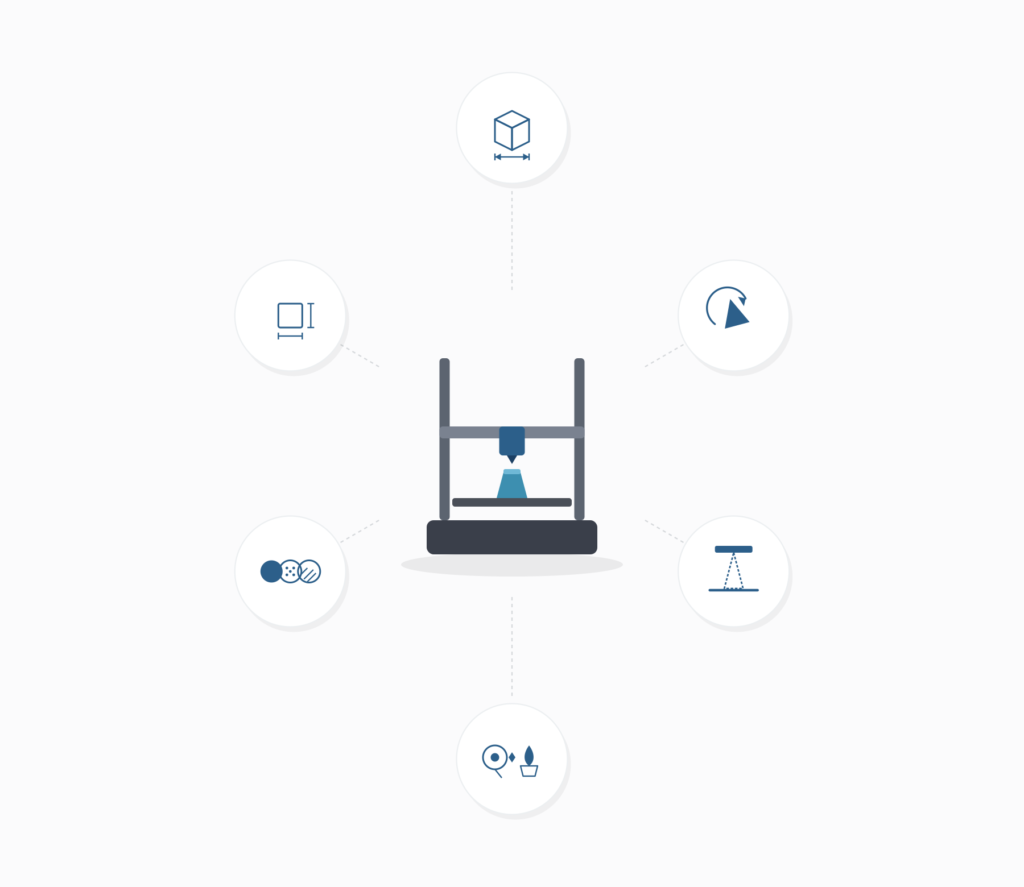
Before choosing things to 3D print, a few practical questions can save wasted filament. Does the model fit your printer’s build volume? Does it require supports, and if so, are they easy to remove without damaging fine details? Is the model intended for FDM or resin printing — some highly detailed designs really are better suited to resin’s resolution. And does the object’s actual use match what the material can realistically handle?
How to Choose the Right Filament for Different Projects
PLA remains the default for a reason: easy to print, low-odor, and fine for most decorative and light-use objects. PETG steps up toughness and heat resistance, useful for anything handled often or exposed to warmth, like a car dashboard mount. ABS offers more heat resistance and durability but is fussier to print, prone to warping without an enclosure. Nylon and specialty filaments suit mechanical parts under real stress, though they’re generally harder to print well.
The honest rule of thumb when choosing things to 3D print: match the material to the object’s actual job, not to whatever spool happens to be loaded. A decorative dice tower doesn’t need PETG’s toughness; a functional tool holder that gets bumped around probably shouldn’t be printed in bargain-bin PLA.
How Much Filament Common 3D Prints Use
This varies a lot based on model size, wall thickness, and infill percentage, so treat any number as a rough starting point rather than a guarantee. Small items like keychains or simple phone stands tend to use a modest amount of filament — often well under a full spool. Medium projects like organizers or desk accessories use more, particularly with higher infill for strength. Larger prints, like storage bins or multi-part designs, can use significantly more material, and it’s worth checking your slicer’s filament estimate before starting rather than guessing.
Recommended Drone Battery Gear
Disclosure: This article may contain affiliate links. If you buy through these links, I may earn a small commission at no extra cost to you.
| Product | Type | Best For | Check Price |
|---|---|---|---|
| Protopasta Copper Composite Filament | Copper-filled PLA/HTPLA | Copper-look prints | Check Amazon |
| Protopasta Stainless Steel Filament | Stainless-steel-filled filament | Metallic finishes | Check Amazon |
| Gizmo Dorks 1.75mm Metal Copper Fill Filament | Copper-filled filament | Polishing & patina | Check Amazon |
| CC3D Silk Copper PLA 3D Printer Filament | Metal-filled filament | Budget projects | Check Amazon |
| Hardened Steel MK8/V6 Nozzle | Hardened nozzle | Abrasive filament | Check Amazon |
Where to Find and How to Prepare 3D Printing Files
For anyone not designing their own models, downloadable file repositories are the usual starting point for finding things to 3D print, with several well-known sites covering everything from functional parts to miniatures to prop work. Before downloading anything, it’s worth checking a few things so the file prints the way it’s supposed to.
Model quality and printability matter more than how good a render looks. A polished preview image doesn’t guarantee a model prints cleanly — models shared with real print photos, not just renders, are a better signal of what actually comes off a printer.
FDM vs. resin compatibility is worth checking explicitly. Some models are designed with fine detail that assumes resin’s higher resolution and won’t hold together structurally printed on an FDM machine, and the reverse is true for models designed around FDM’s strengths, like thicker walls and functional tolerances.
Printer build volume is easy to overlook. A model that looks reasonably sized in a preview can turn out larger than a given printer’s bed once scaled, so it’s worth checking listed dimensions against the printer’s actual build volume before starting.
Required supports should be checked before printing, not discovered mid-print. Some models print support-free with the right orientation; others genuinely need supports for overhangs, and it helps to know in advance whether those supports will be easy or difficult to remove without damaging fine detail.
User comments, makes, and photos — where a repository allows other users to post their own completed prints — are one of the more reliable ways to judge whether a file actually works as designed. A model with several successful print photos and helpful comments about settings is a safer bet than one with no print history at all.
Model license and personal vs. commercial use rights deserve a look, especially if a print is intended for gifting, selling, or any use beyond personal enjoyment. Many models are shared under licenses that restrict commercial use or require attribution, and ignoring that disregards the terms the designer actually set for their work.
Remixes and modified versions of a model are common and can be genuinely useful — a remix might fix a printability issue with the original — but it’s worth noting who created the original design and whether the remix carries forward the same license terms.
File formats are usually straightforward. STL is the most common format for 3D printing and stores geometry without color or material information. 3MF is a newer format that can carry more information, including some printer-specific settings. OBJ shows up occasionally, often from design software rather than dedicated 3D printing sources, and may need conversion or extra care to slice correctly.
Once you’ve found the right things to 3D print, preparing the files properly makes the difference between a clean print and a frustrating one. Check the file in a slicer before printing blind: look at wall thickness, whether the model needs supports, and whether the scale is actually what’s expected — a model listed in the wrong units can print at 25 times the intended size, which is a classic beginner mistake.
Common Mistakes Beginners Should Avoid
A few habits trip up almost everyone early on when choosing things to 3D print. Printing a model at default settings without checking scale or orientation is one — always preview before committing. Choosing a material based on what’s cheapest rather than what the object’s job calls for is another; a phone stand is probably fine in basic PLA, but a hook meant to hold real weight deserves more thought.
Skipping supports on overhangs that clearly need them leads to sagging, stringy failures that a quick model preview would catch. And attempting a large, ambitious project as a first print, rather than working up to it, is a common way to waste filament on a failure that a simpler test could have caught earlier.
Ideas for Turning 3D Prints into Useful Projects or Gifts
A handful of things to 3D print work well as either practical additions to a space or as gifts: a phone stand, cable organizer, headphone stand, desk organizer, wall hooks, plant pots, storage boxes, tool organizers, controller stands, board-game accessories, key holders, kitchen organizers, replacement knobs or handles, measuring or workshop aids, and custom gift ideas like a personalized nameplate or a small keepsake box.
A photo frame sized for a specific print can make a fairly generic gift feel more considered. A personalized ornament works well for a seasonal or occasion-based gift. A personalized coaster set is a small, practical gift that’s easy to customize with initials or a simple design.
What makes these good gift candidates is that they’re personal without being generic — a cable organizer can be sized to someone’s exact desk, or a nameplate printed with their actual name. It’s worth being realistic about expectations, though; a 3D printed gift reads as thoughtful and handmade, not as a replacement for a polished retail product, and that’s usually exactly the appeal.
Comparison Table: Things to 3D Print Worth Trying
The table below pulls together 50 things to 3D print across different categories, along with rough difficulty and material guidance for each.
| Thing to 3D Print | Category | Difficulty | Suggested Filament | Approx. Print Time | Best For | Why It’s Useful |
|---|---|---|---|---|---|---|
| Phone stand | Desk | Beginner | PLA | Short (varies by model and settings) | Beginners, desk setups | Quick, functional first project |
| Cable clips/organizer | Everyday life | Beginner | PLA or PETG | Short | Anyone with messy cords | Solves a near-universal annoyance |
| Headphone stand | Desk | Beginner–Intermediate | PLA or PETG | Short–Medium | Desk workers, gamers | Keeps headphones off the desk |
| Desk organizer | Desk | Beginner–Intermediate | PLA | Medium | Anyone at a cluttered desk | Consolidates small items |
| Wall hooks | Home organization | Beginner | PLA or PETG | Short | Entryways, closets | Cheap, practical storage fix |
| Plant pot | Home/decor | Beginner | PLA | Medium (varies by size) | Plant owners | Custom-sized planters |
| Storage box (modular) | Home organization | Intermediate | PLA or PETG | Medium–Long | Organizing shelves/drawers | Fits exact space needs |
| Tool organizer | Maker/DIY | Intermediate | PETG | Medium | Garage, workshop use | Keeps tools accessible and sorted |
| Controller stand | Gaming | Beginner–Intermediate | PLA | Short–Medium | Gamers | Keeps controllers off furniture |
| Board-game accessory/insert | Gaming | Intermediate | PLA | Medium (varies by game) | Board game collectors | Fixes poor stock box organization |
| Key holder | Home organization | Beginner | PLA | Short | Entryway organization | Small daily-use convenience |
| Kitchen organizer (non-food-contact) | Kitchen | Beginner–Intermediate | PLA or PETG | Medium | Cabinet/pantry storage | Custom fit for cabinets |
| Replacement knob/handle | Maker/DIY | Intermediate | PETG or nylon | Short | Fixing broken appliances/furniture | Extends life of existing items |
| Measuring/workshop aid (jig) | Maker/DIY | Intermediate–Advanced | PETG | Short–Medium | Repeated workshop tasks | Saves time on repetitive jobs |
| Custom nameplate/gift item | Gifts | Beginner–Intermediate | PLA | Short–Medium | Personalized gifts | Feels handmade and specific |
| Cable management tray | Desk | Intermediate | PLA or PETG | Medium | Desk setups | Hides and routes cords |
| Miniature/terrain (tabletop) | Hobby/gaming | Beginner (FDM) to Advanced (resin) | PLA or resin | Short (varies by detail level) | Tabletop gamers | Custom, affordable minis |
| Drawer divider | Home organization | Beginner | PLA | Short–Medium | Custom drawer storage | Fits contents better than store-bought |
| Custom enclosure (electronics) | Maker/DIY | Advanced | PLA or PETG | Medium | Electronics hobbyists | Protects and houses components precisely |
| Puzzle box or fidget toy | Fun/novelty | Intermediate | PLA | Short–Medium | Gifts, curious kids and adults | Demonstrates what 3D printing can do |
| Pencil/pen holder cup | Beginner | Beginner | PLA | Short | First-time printers | Simple, forgiving cylinder shape |
| Simple soap dish | Beginner | Beginner | PLA or PETG | Short | First-time printers | Introduces basic drainage-hole design |
| Business card holder | Beginner | Beginner | PLA | Short | First-time printers | Small, quick, genuinely useful |
| Door stopper | Everyday life | Beginner | PLA or PETG | Short | Households with door issues | Solves a common annoyance cheaply |
| Car phone/cable mount clip | Everyday life | Beginner–Intermediate | PETG | Short | Drivers | Keeps a phone or cable fixed in place |
| Zipper pull replacement | Everyday life | Beginner | PLA or PETG | Short (varies by model and settings) | Anyone with a broken zipper | Cheap fix instead of replacing the item |
| Closet rod end bracket | Home organization | Beginner–Intermediate | PETG | Short | Closet repairs | Replaces a broken bracket cheaply |
| Sock/drawer tray organizer | Home organization | Beginner | PLA | Short–Medium | Dresser and drawer organizing | Keeps small items from sliding around |
| Shoe rack riser | Home organization | Beginner–Intermediate | PLA or PETG | Medium | Closets, entryways | Adds usable shelf space |
| Laptop stand | Desk | Intermediate | PLA or PETG | Medium | Laptop users | Improves typing angle and airflow |
| Webcam mount | Desk | Beginner–Intermediate | PLA | Short | Streamers, remote workers | Frees up desk space near a monitor |
| Cable grommet cover | Desk | Beginner | PLA | Short | Desks with cord pass-throughs | Neatens a cluttered cord hole |
| Card game tray/holder | Gaming | Beginner–Intermediate | PLA | Short–Medium | Card game players | Keeps a hand of cards organized |
| Dice vault/box | Gaming | Intermediate | PLA or resin | Medium (varies by design) | Dice collectors | Gives dice a dedicated storage spot |
| Miniature display case | Gaming | Intermediate | PLA or PETG | Medium | Painted miniature collectors | Protects finished minis from dust |
| Sponge holder | Kitchen | Beginner | PLA or PETG | Short | Kitchen sinks | Keeps a sponge off the counter to dry |
| Bag clip | Kitchen | Beginner | PLA or PETG | Short | Anyone resealing food bags | Reusable alternative to disposable clips |
| Cabinet door bumper/silencer | Kitchen | Beginner | PLA or PETG | Short | Noisy cabinets | Quiets cabinets that slam shut |
| Cable strain relief clip | Maker/DIY | Intermediate | PETG or nylon | Short | Electronics projects | Protects cords from repeated bending |
| Soldering iron stand | Maker/DIY | Intermediate | PETG or nylon (heat-adjacent use) | Short–Medium | Hobby electronics work | Keeps a hot iron off the workbench safely |
| Filament spool holder | Maker/DIY | Intermediate | PLA or PETG | Medium | Printer owners | Common, practical printer upgrade |
| Fidget spinner | Fun/novelty | Beginner | PLA | Short | Casual novelty prints | Classic, simple, satisfying to make |
| Small decorative vase | Fun/novelty | Beginner–Intermediate | PLA | Short–Medium | Decor, vase-mode practice | Good introduction to vase-mode printing |
| Mini catapult toy | Fun/novelty | Intermediate | PLA | Medium | Kids, curious adults | Combines mechanical design with play value |
| Photo frame | Gifts | Beginner–Intermediate | PLA | Short–Medium | Personalized gifts | Feels considered rather than generic |
| Personalized ornament | Gifts | Beginner | PLA | Short | Seasonal/occasion gifts | Small, easy to customize |
| Personalized coaster set | Gifts | Beginner–Intermediate | PLA or PETG | Short–Medium | Practical personalized gifts | Custom and genuinely usable |
| Cosplay armor piece (multi-part) | Advanced | Advanced | PLA or ABS | Long (varies by size and detail) | Experienced cosplayers/makers | Achievable scale via multi-part assembly |
| Articulated robot arm model | Advanced | Advanced | PLA or PETG | Medium–Long | Experienced hobbyists | Demonstrates complex assembled mechanics |
| RC vehicle body/chassis shell | Advanced | Advanced | PETG or nylon | Medium–Long | RC hobbyists | Functional part that must fit real hardware |
Print times above vary based on model size, layer height, infill, and printer speed, so treat this table as a planning starting point rather than a precise estimate.
You Might Also Like
- 3D Printing Innovations: What’s Actually Changing and Why It Matters
- How to Calibrate a 3D Printer: A Practical, No-Nonsense Guide
- Metal 3D Printer: A Practical Guide to How They Work, What They Cost, and Whether You Actually Need One
- Beginner’s Guide to Mini RC Drift Cars (Real Experience After 3 Years)
- Drone with Thermal Camera — My Real 6-Month Experience (Mistakes Included)
- How to Become a Drone Pilot — What Actually Happened When I Tried It
- Agricultural Drone — What Actually Happened My First Season – 2026
Conclusion
Choosing the best things to 3D print isn’t really about finding the most popular file online — it’s about matching a project to your actual skill level, your printer’s capabilities, the filament you’re comfortable working with, and how much time you’re willing to spend. A beginner with limited time is better off with a phone stand than a multi-part cosplay helmet, not because the helmet isn’t a great project, but because it isn’t the right project yet.
It also helps to be honest about what you actually want out of a print. Sometimes you want something useful — a cable organizer that fixes a real annoyance. Sometimes you just want something fun to make, and that’s a completely legitimate reason too. Things to 3D print don’t need to justify themselves purely on utility.
Start small, pay attention to what fails and why, and let your projects grow in complexity as your printer, your filament choices, and your own skills catch up with your ambitions. That’s a more sustainable path than jumping straight to the most impressive thing you found online.