

 By
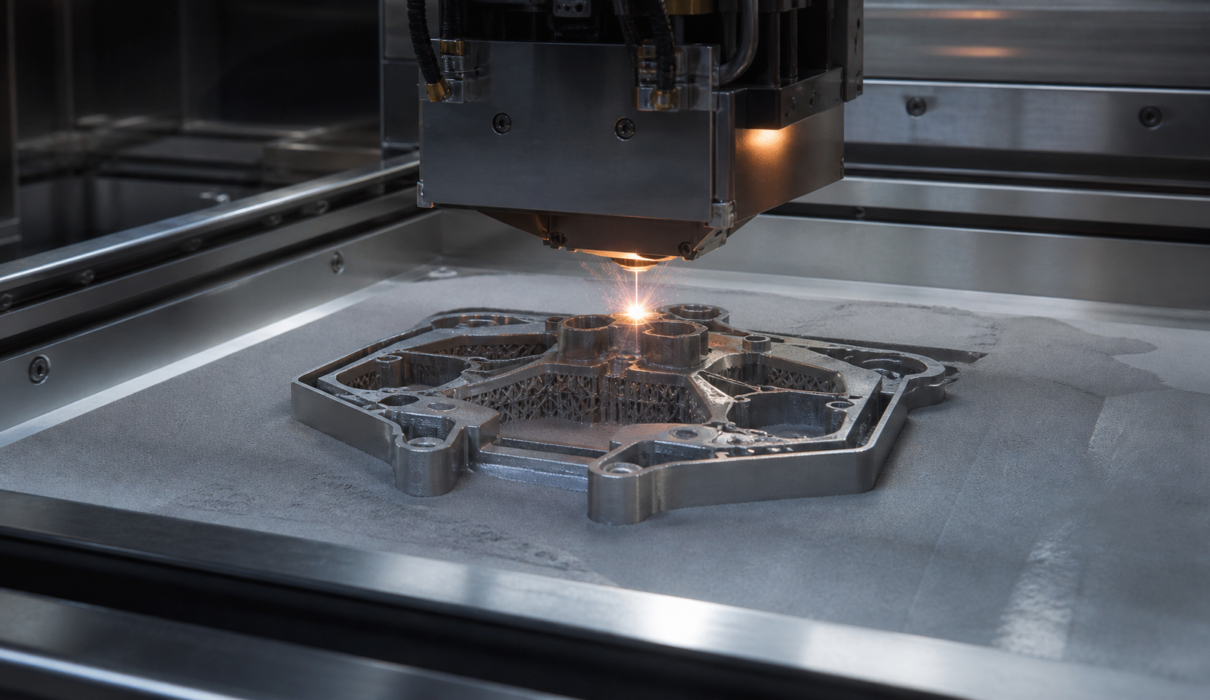
By The first time I really understood what a metal 3D printer does, it wasn’t from a spec sheet. It was from watching footage of a laser tracing across a bed of fine metal powder, fusing it layer by layer into something that started out looking like nothing and slowly became a recognizable bracket. No cutting, no milling, no chips flying off a lathe. Just powder, light, and a shape emerging out of what looked like dust.
That’s the strange appeal of metal 3D printing. It takes a manufacturing process most of us associate with plastic hobby projects and applies it to a material that’s supposed to be tough, expensive, and hard to shape. And it works — with real caveats, real costs, and real limitations that don’t always make it into the more enthusiastic corners of the internet.
This article walks through what a metal 3D printer actually is, how the different technologies behind them work, what they can realistically produce, and what someone would need to know before spending money on one — whether that’s a small desktop unit or something closer to an industrial machine. I’m not going to pretend every option is a good fit for every person reading this. Metal 3D printing is genuinely useful, but it’s also a category where the gap between marketing and reality is wider than it is for plastic printers.
What Is a Metal 3D Printer?
A metal 3D printer is a machine that builds solid metal objects layer by layer from a digital 3D model, using processes broadly grouped under metal additive manufacturing. Unlike plastic FDM printers, which mostly melt filament through a nozzle, most metal 3D printers work with metal powder, wire, or metal-infused filament, using heat sources like lasers, electron beams, or sintering ovens to fuse that material into a solid part.
The output is functional metal — not a metal-coated plastic, not a resin cast of a metal shape, but an object made of actual metal with real mechanical properties, assuming the process and post-processing are done correctly. That last part matters more than people expect going in. A raw print straight off a metal 3D printer often isn’t the finished part; it usually needs additional steps before it behaves the way a machined or cast metal part would.
How Metal 3D Printing Works
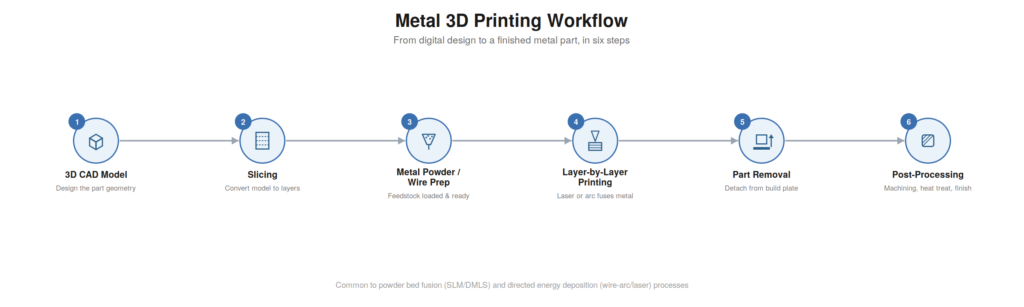
At a basic level, most metal 3D printing follows a similar overall workflow, even though the specific technology varies.
A design is created or imported as a 3D model, then sliced into thin layers by specialized software. The printer builds the object layer by layer — either by fusing metal powder with a heat source, depositing metal wire and melting it, or binding metal powder together chemically before a separate sintering step solidifies it fully. Once printing finishes, the part usually goes through post-processing: removing support structures, cleaning off excess powder, and often heat treatment or machining to reach final mechanical properties and surface finish.
This is one of those areas where “3D printing” undersells what’s actually happening. It’s not like printing a document. It’s closer to a controlled, automated version of traditional metal fabrication, just built up rather than cut down or cast.
Main Metal 3D Printing Technologies
There isn’t one single “metal 3D printing” process. There are several, differing enough in cost, capability, and use case that lumping them together causes a lot of confusion for people just getting into this.
Selective Laser Melting (SLM)
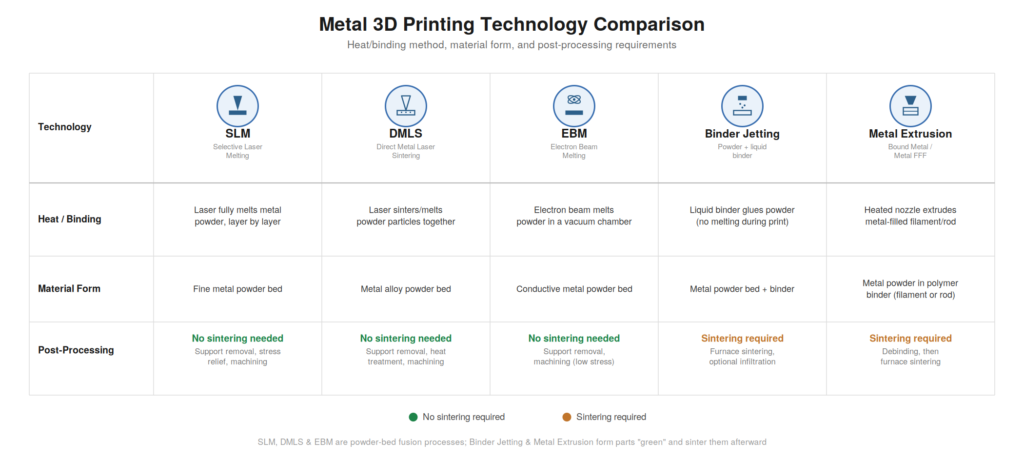
What it is: SLM is a powder bed fusion process that uses a high-powered laser to fully melt metal powder, layer by layer, fusing it into a dense solid part.
How it works: A thin layer of metal powder spreads across a build platform. A laser selectively melts the powder according to the sliced model, the platform lowers slightly, another layer spreads, and the process repeats until the object is complete.
Where it’s useful: Aerospace and medical applications where strength and precision matter, since SLM can produce dense, high-strength parts with complex internal geometries.
Who benefits: Engineers and manufacturers producing functional, load-bearing metal components with intricate shapes that would be difficult or costly to machine conventionally.
Main limitation: SLM machines are expensive, slow relative to production volume, and the process requires careful atmosphere control (often inert gas) to avoid oxidation, adding cost and complexity.
Direct Metal Laser Sintering (DMLS)
What it is: DMLS is closely related to SLM, sometimes described as a variation of the same core idea, though it traditionally sinters powder particles together rather than fully melting them, particularly with certain alloys.
How it works: The general process mirrors SLM — a laser fuses powder layer by layer — with the specific fusing mechanism and terminology depending on the manufacturer and alloy involved.
Where it’s useful: Widely used for metal alloys and complex parts in aerospace, tooling, and medical devices, where geometric complexity and material properties both matter.
Who benefits: Manufacturers needing production-grade metal parts in specific alloys where DMLS-certified processes are already established in their industry.
Main limitation: Like SLM, DMLS machines are costly, and the distinction between DMLS and SLM varies by manufacturer terminology, which makes direct technology comparisons a bit murkier than they should be.
Electron Beam Melting (EBM)
What it is: EBM uses a focused electron beam, instead of a laser, to melt metal powder in a vacuum environment.
How it works: The process happens inside a vacuum chamber, where an electron beam scans across a powder bed, melting the material layer by layer. The vacuum reduces oxidation risk without needing inert gas.
Where it’s useful: Often associated with titanium parts, particularly in aerospace and medical implants, since it can produce strong, low-oxidation parts with less residual stress compared to some laser-based processes.
Who benefits: Manufacturers working with reactive metals like titanium, where reduced residual stress and strong metallurgical properties are priorities.
Main limitation: EBM machines are typically slower to start up (the vacuum needs to be established) and tend to produce a rougher surface finish than laser-based methods, often requiring more post-processing.
Binder Jetting
What it is: Binder jetting builds parts by depositing a liquid binding agent onto layers of metal powder, rather than melting the powder directly during printing.
How it works: A print head deposits binder onto a powder bed layer by layer, gluing the powder particles together in the shape of the model. The resulting “green part” is fragile and needs a separate sintering step in a furnace to fuse the metal particles into a solid, dense object.
Where it’s useful: Can be faster and sometimes more cost-effective for certain geometries and volumes, since it doesn’t require a high-powered laser or electron beam during the print itself.
Who benefits: Manufacturers producing moderate-to-higher volumes of metal parts where the extra sintering step is an acceptable trade-off for potentially lower per-part costs at scale.
Main limitation: Sintering causes shrinkage that has to be accounted for in the design, and parts can end up with lower density and different mechanical properties compared to fully melted processes like SLM, unless additional infiltration or processing steps are used.
Metal Extrusion (Metal FDM / Bound Metal Deposition)
What it is: This approach adapts the familiar FDM process — the kind used in plastic desktop printers — to metal, using filament that’s actually a mix of metal powder and a plastic binder.
How it works: The metal-and-binder filament is extruded and printed similarly to plastic FDM, producing a “green part.” That part goes through a debinding step to remove the plastic binder, followed by sintering in a furnace to fuse the remaining metal powder into a solid object.
Where it’s useful: One of the more accessible entry points into metal 3D printing, since the printing step itself resembles familiar desktop printing rather than requiring lasers or vacuum chambers.
Who benefits: Smaller businesses, workshops, or engineers wanting to prototype metal parts without the cost of an industrial powder-bed system, accepting trade-offs in precision and material density.
Main limitation: Significant shrinkage occurs during sintering and needs to be modeled for, and the resulting parts, while genuinely metal, typically don’t match the density or mechanical performance of powder-bed fusion methods like SLM or DMLS.
Common Metals Used in Metal 3D Printing
The materials available depend heavily on the process, but a handful of metals show up across most metal 3D printing conversations.
Stainless steel is one of the most common starting points, largely because it’s relatively affordable, well understood, and suitable for a wide range of applications from tooling to functional prototypes. Stainless steel 3D printing shows up frequently in both industrial powder-bed systems and some binder jetting or metal extrusion setups.
Titanium is prized for its strength-to-weight ratio and biocompatibility, which is why titanium 3D printing shows up so often in aerospace components and medical implants. It’s also more expensive and more reactive during processing, part of why EBM — running in a vacuum — is a common choice for titanium parts.
Aluminum alloys are popular where weight matters and the higher strength of steel or titanium isn’t necessary, showing up in automotive and aerospace brackets, housings, and lightweight structural parts.
Cobalt-chrome alloys appear frequently in medical and dental applications, valued for biocompatibility and wear resistance. Nickel-based superalloys show up in aerospace and high-temperature applications where parts need to hold up under extreme heat and stress.
What Metal 3D Printers Can Actually Make
It’s worth being specific here, because “metal 3D printing” conjures up different mental images for different people.
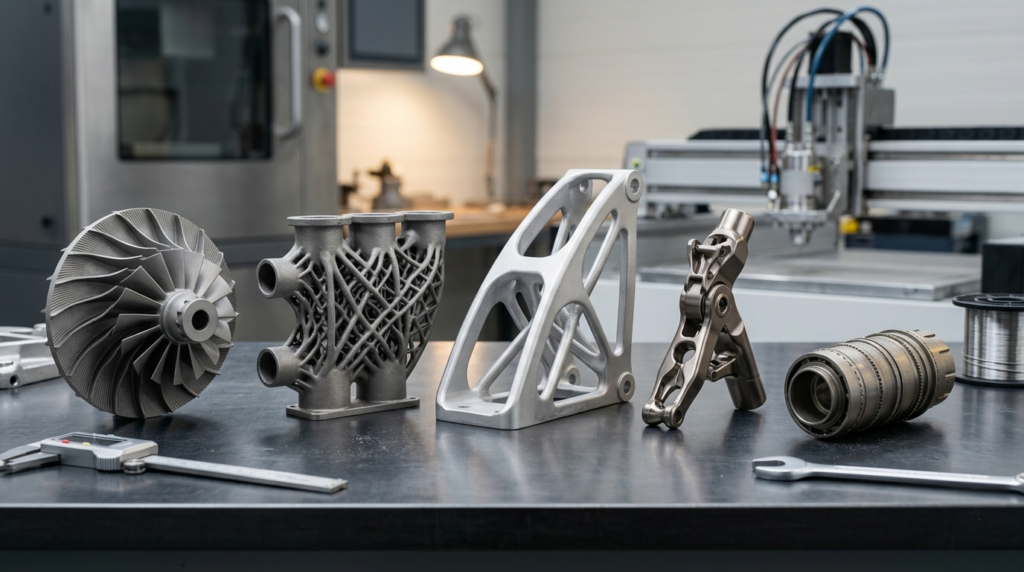
At a functional level, metal 3D printers can produce brackets, housings, tooling components, jigs and fixtures, custom medical implants, aerospace components with complex internal cooling channels, and prototype parts that need to behave like the final production material rather than a plastic stand-in.
What they generally aren’t well-suited for, at least not economically, is high-volume identical part production. If you need ten thousand identical steel brackets, traditional methods like casting or stamping are almost certainly cheaper and faster per part. Metal 3D printing tends to shine with complex geometries, low-to-moderate production volumes, and situations where design freedom — internal lattices, organic shapes, consolidated assemblies — actually matters for the part’s performance.
Industrial and Real-World Applications
Aerospace is probably the most talked-about application, and for good reason. The ability to produce lightweight parts with complex internal geometries, sometimes consolidating what used to be multiple assembled components into a single printed piece, genuinely changes what’s possible in aircraft and spacecraft design, at least for specific components rather than entire structures.
Medical applications are similarly significant. Custom implants — tailored to a specific patient’s anatomy — are one of the more meaningful uses of metal 3D printing, particularly with titanium and cobalt-chrome, since a generic implant doesn’t always fit as well as a custom one.
Tooling and manufacturing support is a quieter but practical application. Companies use metal 3D printing to produce custom jigs, fixtures, and mold inserts, sometimes with internal cooling channels that would be difficult or impossible to machine conventionally.
Automotive applications tend to focus on prototyping and low-volume specialty parts — motorsport components, for instance, where weight savings and rapid iteration matter more than mass-production cost efficiency.
Advantages and Limitations
The advantages are real, but they’re specific rather than universal.
Design freedom is probably the biggest one. Metal 3D printing allows for complex internal geometries, lattice structures, and organic shapes that traditional subtractive manufacturing simply can’t achieve, or can only achieve at enormous cost. It also allows for genuine part consolidation — combining several separate components, each requiring its own assembly step, into a single printed piece. Material efficiency is another advantage, at least for powder-bed processes, since you’re building up material where it’s needed rather than machining away excess stock.
The limitations are just as real. Speed is a genuine constraint — metal 3D printing, especially powder-bed fusion, is slow compared to casting or stamping for high-volume parts. Cost per part can be high, particularly for smaller runs where machine and material costs aren’t spread across thousands of identical pieces. Post-processing adds both time and cost, since very few metal 3D printed parts come off the machine ready to use. And build volume constraints mean there are real limits on how large a single printed object can be, at least without segmenting the design.
Metal 3D Printer Cost and Operating Considerations
This is where expectations often need adjusting. Metal 3D printers, particularly industrial powder-bed systems, represent a significant capital investment — equipment, facility requirements (including inert gas systems or vacuum chambers depending on the technology), and ongoing material costs that are all considerably higher than desktop plastic printing.
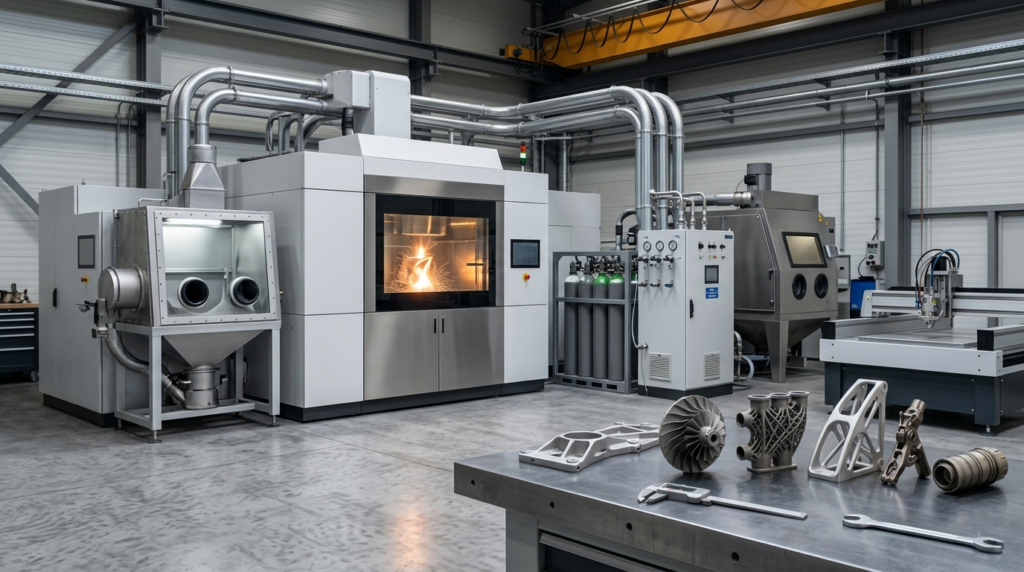
Beyond the printer itself, operating costs include metal powder (which isn’t cheap and often has strict handling and storage requirements), inert gas for processes like SLM, post-processing equipment for heat treatment and surface finishing, and in some cases dedicated ventilation and safety infrastructure. Metal extrusion systems tend to have a lower barrier to entry than powder-bed systems, but still require a debinding and sintering setup, adding cost and complexity beyond the printer itself.
It’s also worth factoring in that metal 3D printing, across nearly all these technologies, involves a learning curve steeper than plastic printing. Getting consistent, dense, mechanically sound parts takes real process knowledge, not just pressing print.
Desktop vs Industrial Metal 3D Printers
The line between “desktop” and “industrial” metal 3D printers isn’t always crisp, but it’s a useful distinction.
Desktop-oriented systems, largely represented by metal extrusion (bound metal deposition), are more accessible in upfront cost and don’t require the specialized facility infrastructure that powder-bed laser or electron beam systems need. They’re a reasonable entry point for smaller businesses or workshops wanting to prototype in metal, understanding that print quality, density, and mechanical properties will generally trail industrial powder-bed processes.
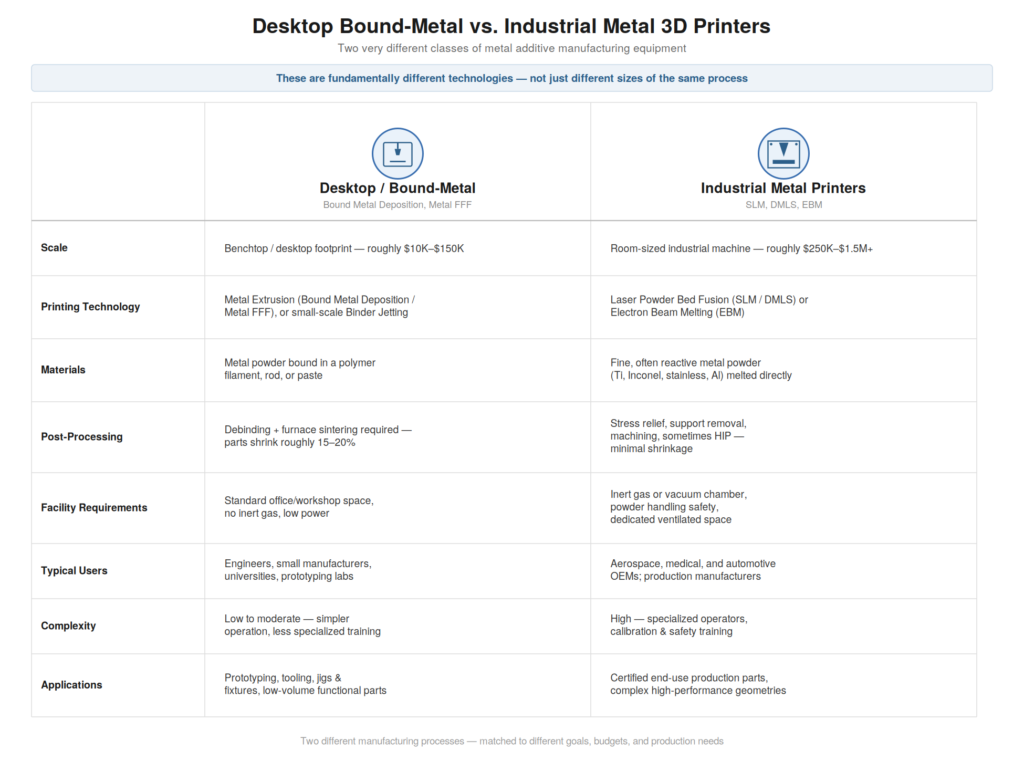
Industrial metal 3D printers — SLM, DMLS, EBM, and larger binder jetting systems — are built for production environments. They require dedicated space, safety infrastructure, trained operators, and significant capital investment, but they produce parts with mechanical properties and precision that can genuinely substitute for traditionally manufactured metal components in demanding applications.
If you’re weighing this decision personally, it’s worth being honest about which category actually matches your needs. A lot of interest in metal 3D printing comes from people drawn to the idea of it, rather than a specific, recurring need that justifies the cost and complexity of ownership.
Safety and Post-Processing Requirements
Metal 3D printing isn’t something to approach casually from a safety standpoint, and this is a part that gets glossed over in a lot of enthusiastic coverage.
Metal powders, especially fine ones used in powder-bed fusion, can be combustible and pose respiratory hazards if handled improperly. Processes involving lasers or electron beams require appropriate safety systems and trained operation. Inert gas systems, used to prevent oxidation in SLM, involve their own handling considerations. None of this is meant to be alarmist — these systems are used safely in professional settings every day — but it’s a genuinely different safety profile than a desktop plastic printer sitting on a workbench.
Post-processing is equally non-optional for most applications. Support structures typically need to be removed, often requiring specific tools given how strongly metal supports can bond to the part. Surface finishing might involve machining, sandblasting, or polishing, depending on the application. Heat treatment is frequently necessary to relieve internal stresses and achieve the mechanical properties the part actually needs, since as-printed metal parts often don’t match the properties of the same alloy in its traditionally processed form until treated.
What Beginners Should Know Before Buying
If you’re new to this and thinking about buying a metal 3D printer, it’s worth sitting with a few realities first.
This isn’t a plug-and-play hobby purchase the way a budget FDM plastic printer might be. Even the more accessible metal extrusion systems require you to manage debinding and sintering, which typically means additional equipment, a learning process, and real attention to detail to get consistent results.
Metal 3D printing generally makes more sense as a solution to a specific, ongoing need — prototyping metal parts in-house, producing custom low-volume components, or supporting a manufacturing process that genuinely benefits from additive manufacturing — rather than as a general-purpose tool. If you’re not sure exactly what you’d be printing regularly, it’s worth spending real time clarifying that before spending money on equipment.
Total cost of ownership matters more here than with plastic printing. Between materials, post-processing equipment, potential facility modifications, and the learning curve, the printer’s price tag is often just the starting point.
How to Choose the Right Metal 3D Printer
Here’s the part I need to be straightforward about, because it changes what’s actually worth buying: if you search “metal 3D printer” on Amazon US, what comes up is not what most people picture when they hear that phrase. There’s a real gap between the search term and what’s actually available to purchase, and it’s worth understanding that gap before you spend a dollar.
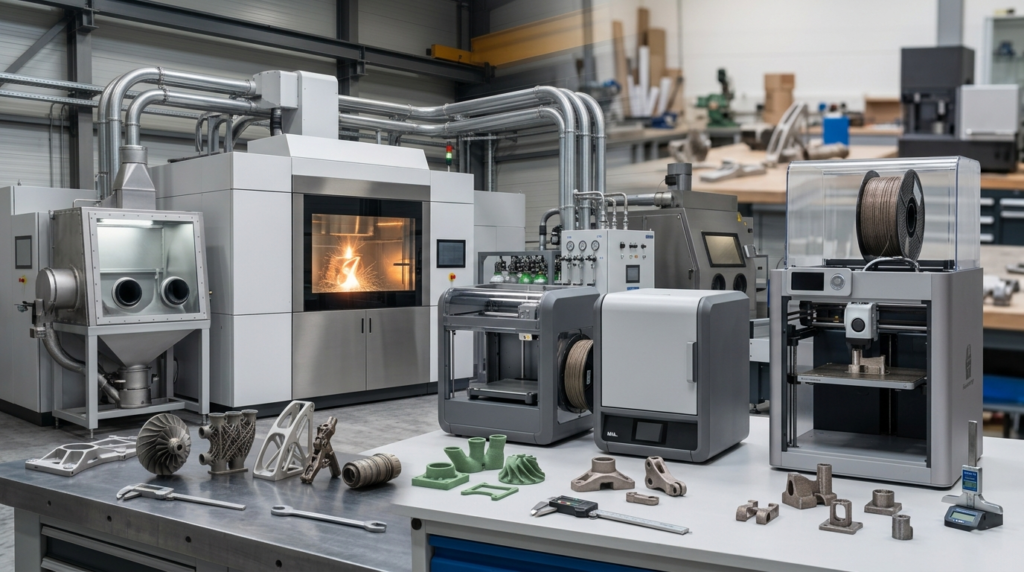
There are really three different things people mean when they say “metal 3D printer,” and they are not interchangeable:
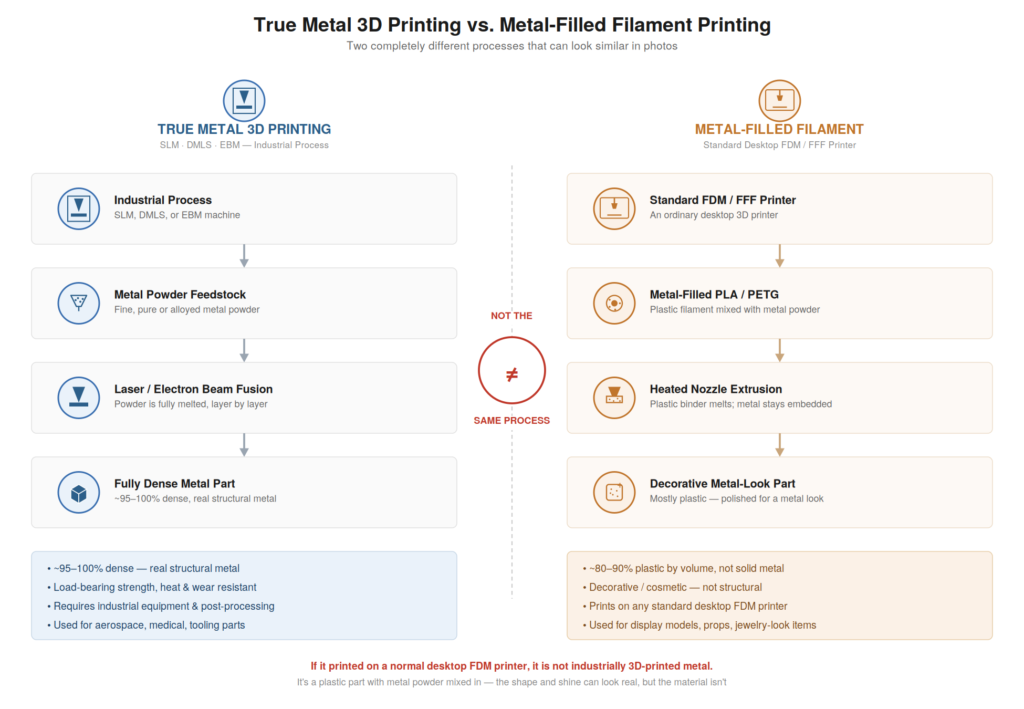
1. A true metal 3D printer (SLM, DMLS, EBM, or industrial binder jetting) produces fully dense, load-bearing metal parts using lasers, electron beams, or industrial-scale sintering. These systems cost tens of thousands of dollars at minimum, need specialized facilities, and are sold directly by manufacturers or through industrial equipment resellers with custom quotes — not through a standard e-commerce checkout.
2. A bound-metal deposition / debind-and-sinter system (Desktop Metal’s Studio System is the best-known example) prints metal-powder-filled rods or filament using a process that looks like ordinary FDM printing, but the result is a fragile “green part” that requires a separate debinding and sintering process in dedicated equipment before it’s actually metal. These systems, too, are sold direct from the manufacturer or through specialty industrial dealers, typically starting around six figures.
3. A normal FDM 3D printer running metal-filled decorative filament (PLA or PETG blended with real metal powder, usually copper, bronze, or stainless steel) produces objects that look and feel metallic — heavier than plastic, polishable, sometimes able to take on a patina — but the finished part is still mostly plastic. It has not been sintered, and it will not perform like a machined or cast metal part. This is genuinely useful for certain projects, but it should never be marketed or understood as “metal 3D printing” in the sense of categories 1 or 2.
Based on what’s actually listed and purchasable on Amazon.com, I could not verify any true metal 3D printer (category 1) or genuine debind-and-sinter bound-metal system (category 2) being sold there. Industrial metal printers and systems like Desktop Metal’s Studio System are purchased directly through the manufacturer or dedicated industrial equipment dealers. If a listing claims to sell a full metal 3D printer for a few hundred dollars, that’s a strong signal something doesn’t match the claim — most likely it’s a metal-filled-filament FDM printer being marketed with misleading language.
What you can genuinely buy on Amazon US right now, and verify yourself before purchasing, falls into the supporting-equipment category: real metal-filled decorative filament and the hardened nozzles needed to print it without destroying a standard brass one.
| Product | Type | Best For | Check Price |
|---|---|---|---|
| Protopasta Copper Composite Filament | Copper-filled PLA/HTPLA | Copper-look prints | Check Amazon |
| Protopasta Stainless Steel Filament | Stainless-steel-filled filament | Metallic finishes | Check Amazon |
| Gizmo Dorks 1.75mm Metal Copper Fill Filament | Copper-filled filament | Polishing & patina | Check Amazon |
| CC3D Silk Copper PLA 3D Printer Filament | Metal-filled filament | Budget projects | Check Amazon |
| Hardened Steel MK8/V6 Nozzle | Hardened nozzle | Abrasive filament | Check Amazon |
Note: The products above are intended for metal-filled filament printing, not true industrial metal 3D printing. They produce plastic-based parts containing metal particles and should not be confused with SLM, DMLS, EBM, or other true metal additive manufacturing systems.
Product availability, pricing, pack sizes, and Amazon listings can change, so check the current product page before purchasing, but exact pricing, pack sizes, and stock availability change constantly on Amazon — confirm current details on the listing itself before buying, rather than assuming a price you saw somewhere else still applies.
I couldn’t verify a specific desktop FDM printer model, build volume, or price confidently enough to list one here without risking outdated or incorrect specs. In practice, most modern FDM printers sold on Amazon from brands like Creality, Sovol, Elegoo, ANYCUBIC, and FlashForge can handle metal-filled filament reasonably well once fitted with a hardened nozzle — check the specific listing for hotend material and stated filament compatibility before buying if this matters to you.
Who each category actually fits
Beginners curious about metal-look 3D printing should start with whatever reliable FDM printer they already have (or a well-reviewed budget model), a hardened nozzle swap, and a small spool of copper or bronze-filled PLA from a brand like Protopasta. It’s the lowest-cost, lowest-risk way to see what metal-infused prints actually look and feel like before considering anything more serious.
Hobbyists who want to push further — polishing, patina work, heavier display pieces, cosplay props — can stay with the same FDM-plus-metal-filament setup, just paying closer attention to nozzle wear and print settings, since metal-filled filament is noticeably more abrasive than standard plastic and will chew through a brass nozzle quickly.
Small businesses exploring whether metal 3D printing could genuinely serve production needs should be cautious about assuming Amazon is the right shopping venue at all for anything beyond decorative filament. If the actual goal is structurally real metal parts, the practical next step is contacting bound-metal or powder-bed system manufacturers directly, or working with a metal 3D printing service bureau that already owns qualified equipment, rather than trying to improvise a path from hobbyist supplies.
Engineers prototyping designs headed toward eventual metal production are often better served by outsourcing early metal iterations to a service bureau, keeping in-house 3D printing limited to plastic prototypes until a design is validated enough to justify real metal investment.
Professional users — aerospace, medical device, or tooling companies with an established, recurring need — are the actual audience for true SLM, DMLS, EBM, or industrial binder jetting systems, and those purchases go through manufacturers like Desktop Metal directly, not through Amazon.
Amazon prices, stock, and specific listings change often, so treat everything above as a starting point for your own search and verification, not a locked-in recommendation — always check the current listing, price, and stated specifications on Amazon.com before buying anything.
The Future of Metal 3D Printing
It’s hard to predict specifics with real confidence, but a few directional trends seem reasonably likely to continue based on where things currently stand.
Costs will probably keep gradually decreasing as the technology matures and adoption increases, though “gradual” is doing a lot of work in that sentence — this isn’t likely to become desktop-hobbyist-cheap the way plastic FDM printing did. Material options will likely continue expanding, giving engineers more alloy choices suited to specific applications. Print speeds may continue improving, particularly for powder-bed systems, as laser and scanning technology advances.
Integration with traditional manufacturing seems like a more realistic near-term trend than full replacement — metal 3D printing filling in for the specific parts and situations where it offers a genuine advantage, working alongside casting, machining, and stamping rather than eliminating them.
You Might Also Like
- 3D Printing Innovations: What’s Actually Changing and Why It Matters
- How to Calibrate a 3D Printer: A Practical, No-Nonsense Guide
- Best Home Automation Light Switches for Beginners (2026)
- Beginner’s Guide to Mini RC Drift Cars (Real Experience After 3 Years)
- Drone with Thermal Camera — My Real 6-Month Experience (Mistakes Included)
- How to Become a Drone Pilot — What Actually Happened When I Tried It
- Agricultural Drone — What Actually Happened My First Season – 2026
Conclusion
A metal 3D printer isn’t a casual purchase, and it’s not really meant to be one. It makes the most sense for people and organizations with a specific, recurring need for complex, low-to-moderate volume metal parts — engineers prototyping functional components, manufacturers producing custom tooling, or industries like aerospace and medical devices where design freedom and material performance genuinely justify the cost.
For most hobbyists, and even many small businesses, the practical hurdles — cost, facility requirements, post-processing, and the learning curve — are real enough that it’s worth being honest about whether the need is specific enough to justify them, rather than being drawn in purely by how capable the technology looks in a video.
If you do move forward, understand the printer itself is only part of the investment. Materials, post-processing equipment, safety infrastructure, and the time it takes to get consistent results all factor into what owning a metal 3D printer actually involves. Go in with realistic expectations about that total picture, and metal 3D printing can be a genuinely valuable tool. Go in expecting it to work like a slightly upgraded plastic printer, and it probably won’t match what you had in mind.