

 By
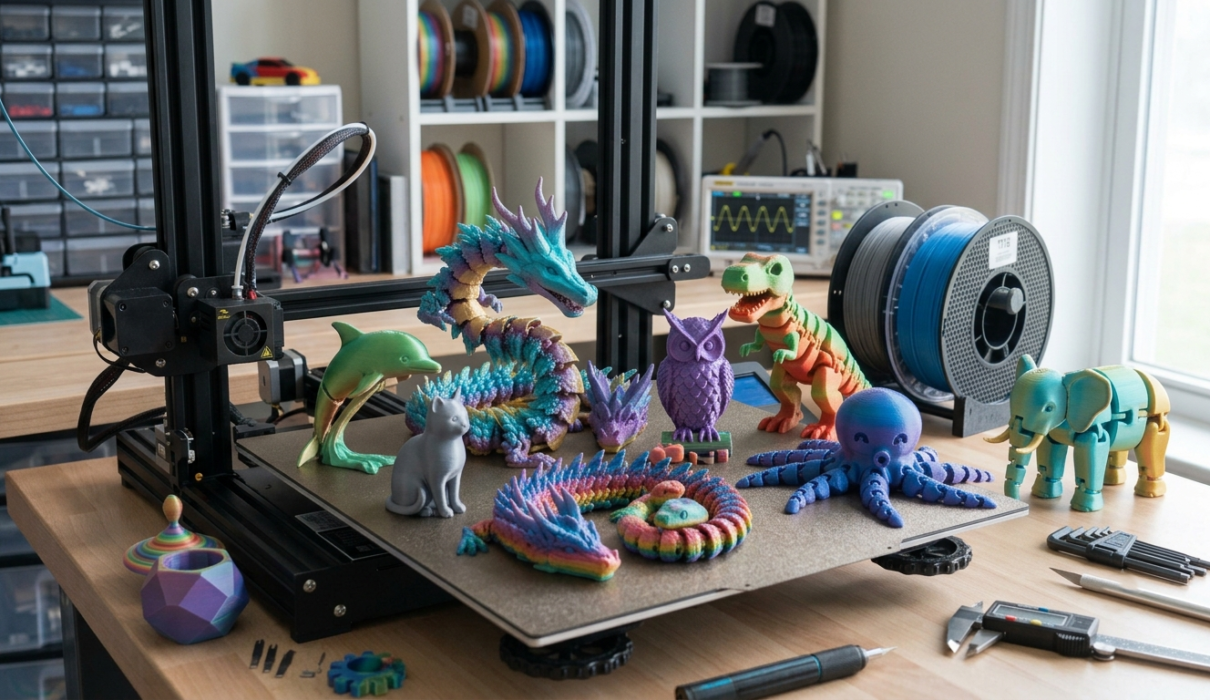
By At first glance, printing an animal sounds almost too simple. You download a model, press print, and eventually a plastic elephant, dragon, cat, or dinosaur shows up on the build plate. But 3D printed animals are actually one of the more interesting ways to see what a 3D printer can do, and that’s underrated compared to how much attention functional prints and gadgets tend to get.
Part of it is variety. 3D printed animals cover almost every level of difficulty and every reason someone might want to print something — a quick desk toy, a detailed display piece, a gift, a classroom prop, a weird little dragon that folds up like an origami puzzle.
Part of it is the specific appeal of articulated 3D printed animals and print-in-place animals, where a printer builds something with moving joints already in place, and there’s no gluing a dozen tiny legs together afterward. There’s something genuinely satisfying about watching a flat-looking print come off the bed and immediately bend, coil, or wiggle.
What I find interesting about this category is just how much range exists under one broad label. 3D printed animals cover everything from a simple, chunky beginner-friendly fox to an intricately detailed realistic wolf meant purely for display, and the design choices behind each one say a lot about what 3D printing is actually good at.
This article walks through what 3D printed animals actually are, why they’re such a popular category, what materials and settings matter, and — the main event — 111 specific 3D printed animal models across pets, farm animals, wildlife, sea creatures, birds, reptiles, insects, dinosaurs, and a handful of fantasy creatures.
What Are 3D Printed Animals?
The term 3D printed animals covers a wide range of models. Some 3D printed animals are static — a single, solid object meant to sit still and look good, similar to a small sculpture. Others are articulated, with joints or segments that move after printing, either assembled from separate printed pieces or built as one connected print-in-place object that moves right off the plate.
There’s also a real difference between realistic models, which aim for anatomical accuracy and fine surface detail, and more stylized or toy-like designs, which simplify shapes to make printing easier and often make the finished object more durable. Neither approach is objectively better — it depends on what you want out of the print.
Why Are 3D Printed Animals So Popular?
A big part of it is visual appeal combined with approachability. Animals are instantly recognizable, which makes them satisfying to print even without painting or finishing work — an immediate payoff that matters a lot for people early in their 3D printing hobby.
They’re also genuinely useful as toys, desk decorations, and gifts. A small articulated animal costs relatively little filament and print time compared to larger projects, making it a low-risk way to try a new technique, color, or printer setting. For students and educators, animal models double as teaching aids — an anatomically shaped model or a regional wildlife representation can help a lesson land in a way a textbook photo can’t quite match.
There’s also a maker-culture angle. 3D printed animals get remixed, resized, recolored, and modified constantly, and that culture of customization is part of what keeps this category interesting rather than static.
What Types of Animals Can You 3D Print?
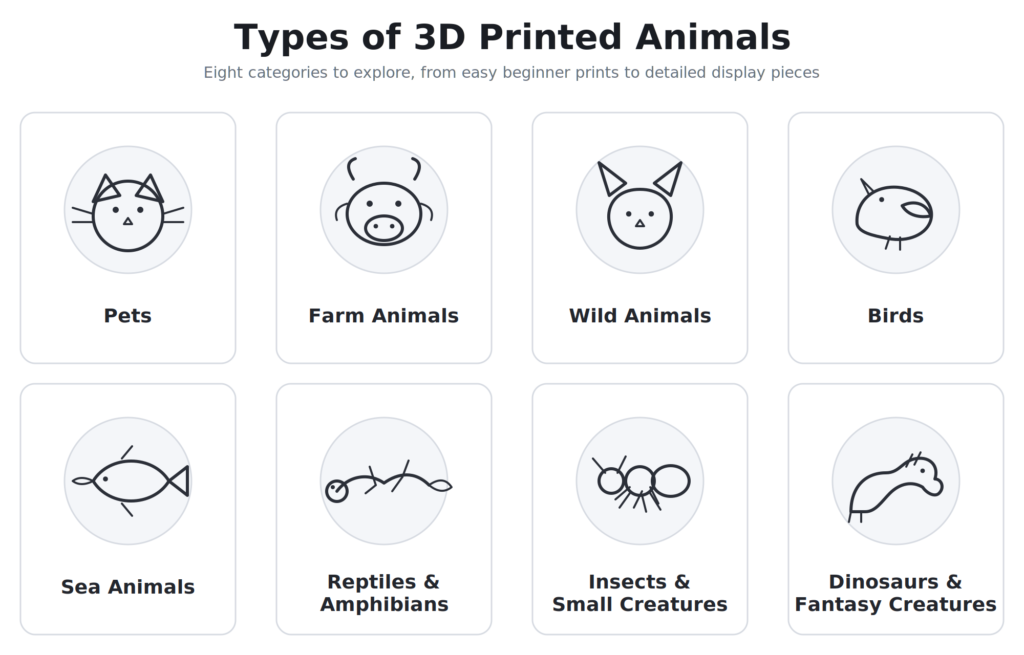
Realistically, almost any animal has been modeled by someone at some point, but a few broad categories come up constantly when people look for the best animals to 3D print: pets, farm animals, wildlife, sea creatures, birds, insects and small creatures, reptiles and amphibians, dinosaurs, and fantasy creatures that borrow design cues from real anatomy.
Beyond individual species, plenty of 3D printed animal models also exist specifically for teaching — labeled anatomy, food chains, or regional wildlife sets meant for classroom or homeschool use. Difficulty varies a lot within each category too; a chunky owl is an easy print, while a bird with thin outstretched wings is a genuinely harder one. The full list below walks through specific examples across all of these categories.
Articulated and Print-in-Place 3D Printed Animals
This category deserves its own explanation, because it’s genuinely one of the more clever tricks in home 3D printing. On paper, a print-in-place animal sounds almost magical: the printer builds the body, the joints, and the connecting sections all in one job, and a moving object comes straight off the plate.
The catch is that those joints have to stay separate from each other while technically touching, which leaves very little room for sloppy tolerances. If the gap between two segments is too tight, or if the first layer squishes slightly wider than it should, adjacent parts can fuse together during printing. The result looks completely fine sitting on the bed and only reveals the problem once someone tries to move it and nothing happens.
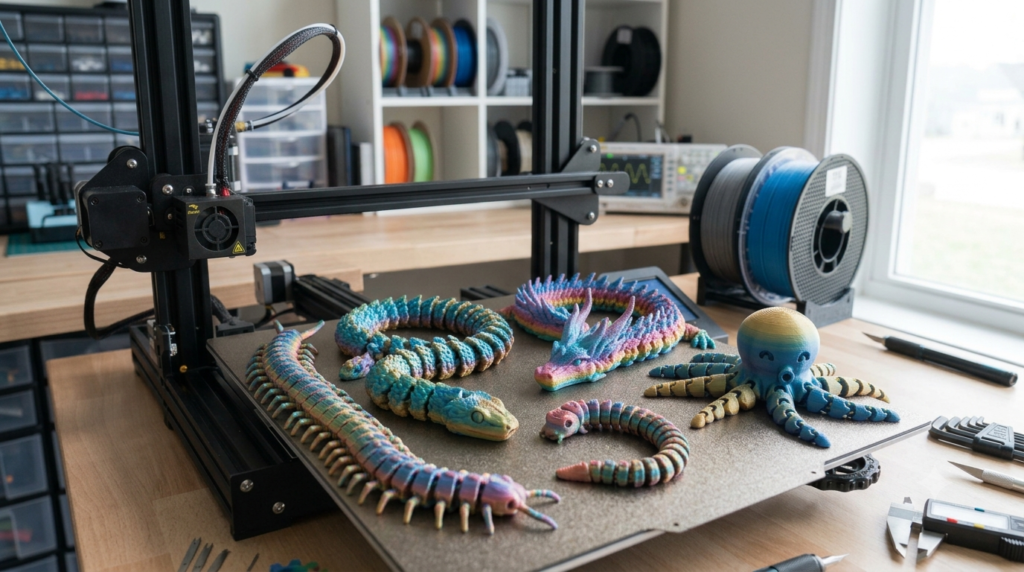
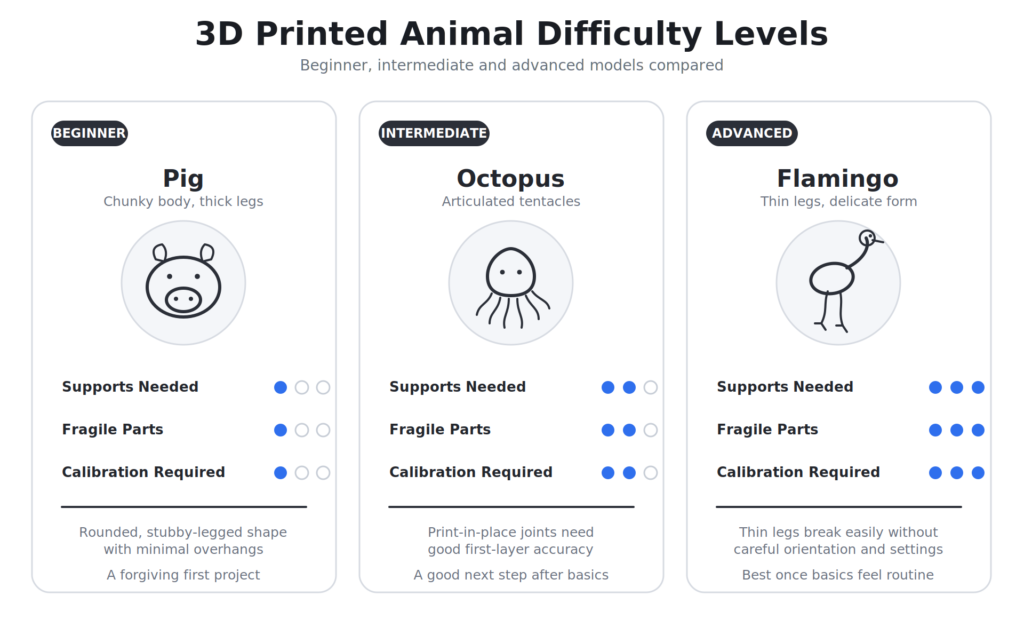
This is where printer calibration genuinely matters beyond just making prints look nicer. A well-leveled bed, consistent extrusion, and accurate first-layer height all reduce the odds of joints bonding shut. Thinner joints, common on smaller or more delicate animals, are also more prone to snapping if a stuck connection gets forced rather than worked loose gently. Chunkier designs — the kind aimed at beginners — tend to be more forgiving simply because there’s more material and clearance to work with.
What Filament Is Best for 3D Printed Animals?
There isn’t one correct answer, since it depends heavily on the specific model and what you want from it.
PLA
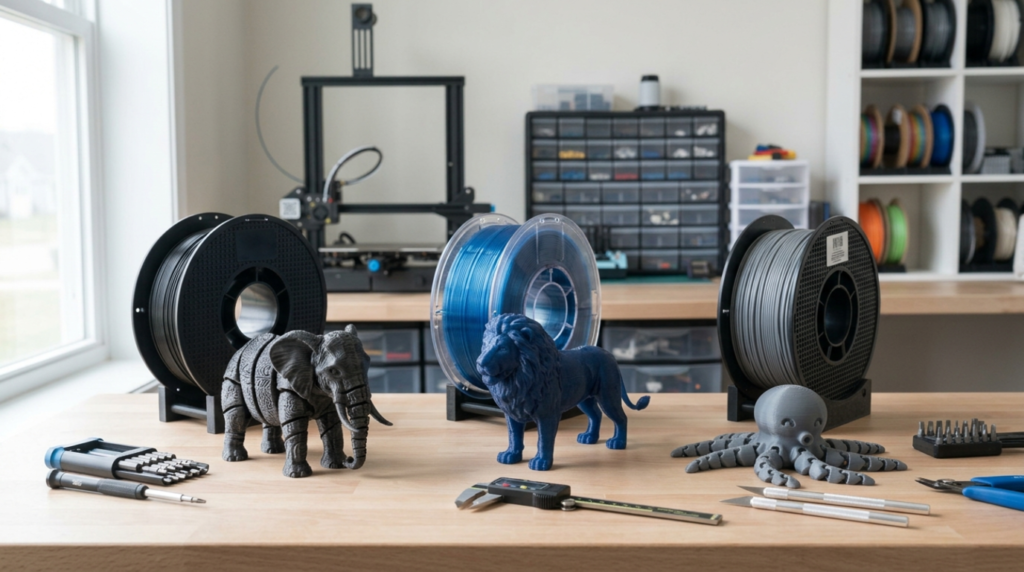
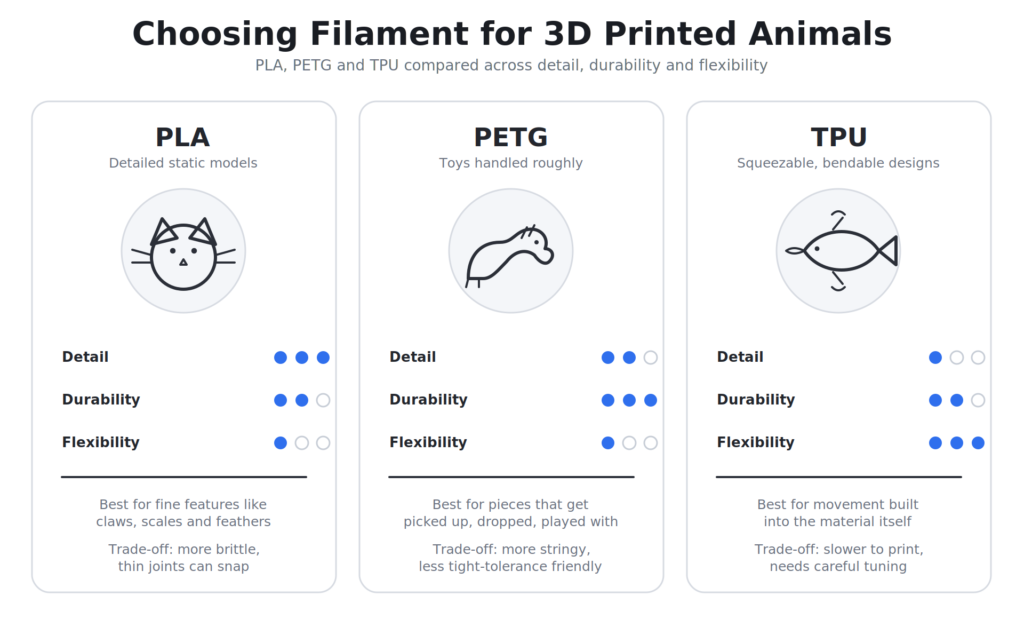
PLA is the default for most animal models. It prints reliably, holds fine detail well, and doesn’t require a heated enclosure, which matters for capturing small features like claws, feathers, or scales. The trade-off is that PLA is more brittle than some alternatives, so thin joints or appendages can snap under repeated handling.
PETG
PETG makes sense when durability matters more than fine surface detail — a toy that’s going to be picked up, dropped, and generally roughed up benefits from PETG’s added toughness. It can be a bit stringier and less forgiving with tight tolerances than PLA, worth knowing before committing a print-in-place design to it.
TPU
Flexible filament opens up squeezable, bendable designs where the material itself provides movement instead of separate joints. TPU is less beginner-friendly, generally needing slower speeds and more careful tuning, but for the right design, like a soft flexi-fish, it produces a feel rigid filament can’t match.
None of these is universally “the best.” A detailed display piece and a durable kid’s toy have different needs, and the right filament follows from that.
Print Settings, Supports, and Orientation
A handful of settings show up repeatedly when animal prints go wrong, and understanding why helps more than memorizing numbers. Layer height affects how cleanly small details resolve — scales, fur texture, or tiny claws generally look sharper at a finer layer height, at the cost of longer print time.
Wall count and infill matter more for durability than most people assume; a slightly thicker wall on legs or joints goes a long way toward preventing snapped appendages. Bed adhesion and first-layer quality deserve particular attention for print-in-place animals, since any shift in that first layer can throw off the tolerances between moving joints — and tolerances themselves are usually offered as a starting point rather than a guarantee, since dimensional accuracy varies from printer to printer.
Animals are also genuinely one of the more support-heavy categories in 3D printing. Legs, tails, ears, horns, wings, and snouts all tend to stick out at angles that create overhangs, and overhangs beyond a certain angle need support material to print cleanly. Orientation is the main tool for managing this — printing an animal lying on its side rather than standing upright often reduces the support needed and can improve strength, though it can trade off surface quality on whichever side faces the support material.
Beginner-Friendly 3D Printed Animals
Easy 3D printed animals tend to share a few characteristics that make them considerably more forgiving on a first attempt: simple, chunky static shapes with thick limbs and minimal overhangs, or simple flexi-style designs like a basic fish or snake that offer movement without the tight-tolerance risk of a fully jointed print-in-place design. Worth avoiding early on: extremely thin legs or antennae, tiny moving joints with little clearance, support-heavy sculptural poses, and highly detailed miniatures that demand near-perfect calibration. None of these are impossible for a beginner — they’re just a better fit for a second or third project.
Realistic vs. Articulated Animal Models
Realistic animal models aim for visual accuracy and detail, which makes them strong choices for display pieces and educational use. The trade-off is more support material, thinner and more fragile features, and longer print times.
Articulated animal models trade some visual realism for movement, and are often more forgiving of print-in-place tolerances than the intricate detail work realistic sculpts demand. The trade-off: joints are sensitive to tolerance issues, can fail or fuse without good calibration, and thinner joints are simply more breakable than a solid static shape. Neither category is better across the board — it comes down to whether you want something to look at or something to play with.
Customizing 3D Printed Animals
Customization is one of the strongest arguments for printing your own 3D printed animals instead of buying a manufactured toy. Changing filament color changes the entire feel of a print without touching the model file, and scaling a design up or down changes how it’s used — larger for display, smaller for a faster, lower-material print. For people with some CAD experience, more direct customization becomes possible: adjusting joint tolerances, adding simple textures, modifying a pose, or combining features from multiple designs. Multi-color printing and post-print painting add further personalization. It’s worth being mindful that modifying a design for personal use is different from taking someone else’s copyrighted work and treating it as your own, particularly beyond personal, non-commercial use.
Educational Use and 3D Printed Animals as Toys
3D printed animals show up naturally in classrooms and homeschool settings, since a physical object often communicates something a diagram can’t — a simplified anatomical model for a biology lesson, or a regional wildlife set for a geography unit. None of this replaces proper curriculum material, but a hands-on model is a genuinely useful supplement.
As toys, articulated 3D printed animals, dinosaurs, and simple figures work well, and for a lot of makers that’s the whole appeal — a customizable alternative to store-bought toys. It’s worth being realistic, though: a home-printed toy isn’t automatically equivalent to a commercially manufactured one in terms of consistency, finish, or the safety testing that goes into mass-produced children’s products.
Are 3D Printed Animals Safe?
This depends on the specific object, the material, and who’s using it. Small parts and pinch points are a real consideration around young children, particularly with articulated models that have detachable pieces or joints that could pinch. Sharp edges from a rough first layer or leftover support material are worth checking and cleaning up before handing a print to anyone. Material suitability matters too — most standard filaments aren’t manufactured or tested for food contact, so it’s a mistake to assume a printed animal is safe to chew on just because it’s plastic. If a toy is genuinely intended for a young child likely to mouth objects, a purpose-made product is the safer choice.
Can You Sell 3D Printed Animal Models?
Selling printed animals is possible, but a free downloadable model is not automatically free to sell. Many shared designs come with licenses that restrict commercial use even when the file itself costs nothing to download, and ignoring those terms disregards what the original designer permitted. There’s also a separate copyright and trademark question for anything based on recognizable characters or branded creature designs. Anyone considering selling also needs to think through consistent print quality across a batch, appropriate material for the toy’s use, reasonable packaging, and realistic buyer expectations. None of this makes selling impossible — plenty of small makers do exactly this — but skipping the legal groundwork is a real risk, not a minor technicality.
Where to Find 3D Printable Animal Models
Model-sharing platforms are the natural starting point for anyone looking for 3D printed animals they can make at home, the same as with other beginner 3D printing projects. Before downloading, check the license and commercial-use terms, any recommended print settings or tolerances the designer included, whether other users have posted successful prints or comments, and whether the model needs supports or a specific orientation to print cleanly.
Common Problems When Printing Animal Models
Fused joints are the most frequent complaint with articulated designs, almost always traced back to tolerances too tight for a specific printer or a first layer that squished wider than intended. Stringing shows up often too, particularly on models with a lot of small, separated features like legs or spikes — largely a retraction and temperature issue rather than something unique to animal models.
Warping affects larger or wider prints more than small ones, especially without good bed adhesion, and can throw off dimensional accuracy even when the print looks fine at a glance. Broken legs or thin appendages are a recurring complaint, since thin structural features are inherently the weakest part of most animal designs. Failed supports and visible layer shifting from a bumped printer are also common, and elephant’s foot — a slight bulge at the base caused by the first layers spreading more than intended — can subtly throw off how well a model sits or how cleanly a joint moves.
Helpful Tools and Materials for Printing Animal Models
A few supporting items make printing 3D printed animals noticeably smoother. A reliable PLA for detailed static models, a tougher PETG for anything handled roughly, and a flexible TPU for squeezable designs cover most of what animal printing calls for. Deburring tools and small precision knives help clean up support marks and rough edges without damaging fine detail. Digital calipers are genuinely useful for checking whether a print-in-place joint’s tolerance matches what the designer intended before committing to a full print. A properly leveled build plate, a well-suited nozzle, and some basic filament storage to keep materials dry round out a reasonable starting kit.
Affiliate Disclosure: Some links below may be affiliate links, which means we may earn a commission if you make a purchase through them, at no additional cost to you.
| Product Type | Best For | Why Consider It | Buy Now |
|---|---|---|---|
| PLA filament | Detailed static models, fine surface texture | Prints reliably and captures small features like claws, scales, or feathers well | Buy Now |
| PETG filament | Toys and models that get handled roughly | Adds toughness for animal prints that will be picked up, dropped, or played with | Buy Now |
| TPU filament | Squeezable, bendable animal designs | Provides flexibility that rigid filaments can’t replicate for soft, squishy prints | Buy Now |
| Digital calipers | Checking print-in-place tolerances | Helps confirm a joint’s actual gap matches the model’s intended clearance before a full print | Buy Now |
| Precision deburring/cleanup tool | Post-print finishing | Cleans up support marks and rough edges without damaging fine detail | Buy Now |
| 0.4mm nozzle | General-purpose animal printing | A standard, versatile size that handles most animal models without excessive print time | Buy Now |
111 Best 3D Printed Animals to Make
Here’s the full list — 111 3D printed animals and creatures worth considering, grouped by category. It’s a genuine mix rather than a single type of project: some entries are simple, low-support prints good for a first attempt, others are articulated or print-in-place designs built around movement, and a few are detailed, display-oriented models meant to be admired rather than handled. Some lean educational, some are just fun desk objects. Each entry notes what makes it interesting or worth watching out for.
“Best” here doesn’t mean every model on this list is ideal for every printer. Printer capability, calibration, and personal skill level all affect whether a given design turns out well. This is meant as a practical mix of easy, articulated, detailed, educational, and fun animal-printing ideas — not a ranked list where every entry suits every situation equally.
Pets
1. Cat — A classic subject for both static display pieces and articulated designs; simplified cat models are common beginner projects, while detailed ones test fine fur-texture printing.
2. Dog — Comes in endless breed-specific variations; chunkier breeds like a bulldog print more forgivingly than long, thin-legged designs.
3. Rabbit — Popular as both a static Easter-style figure and a print-in-place design with foldable ears; PLA holds the ear detail well.
4. Hamster — A small, rounded body makes this an easy, low-support print, popular as a quick desk toy.
5. Guinea Pig — Similar chunky, rounded shape to a hamster, generally beginner-friendly with minimal overhangs.
6. Ferret — A longer, more serpentine body shape lends itself to articulated, wiggling designs.
7. Hedgehog — The spiky texture is more decorative than functional, and printing it well often benefits from a finer layer height.
8. Goldfish — A simple, curved body shape that works nicely as a flexi-style print, moving side to side once removed from the plate.
Farm Animals
9. Cow — A large, boxy body with short legs makes this one of the more forgiving farm animals to print.
10. Sheep — The wool texture adds visual interest and hides minor surface imperfections well.
11. Goat — Slightly leaner than a cow or sheep, with horns that may need support depending on the pose.
12. Horse — A genuinely challenging print due to thin legs; often benefits from a thicker-legged stylized version for beginners.
13. Pig — Rounded and stubby-legged, one of the easier farm animals to print without support issues.
14. Chicken — Small and simple, a popular quick print for farm-themed sets or classroom projects.
15. Duck — Similarly simple to a chicken, with a smooth body that prints cleanly at most layer heights.
16. Turkey — Tail feathers add some support complexity depending on the design’s level of detail.
17. Donkey — Comparable difficulty to a horse, with slightly stockier proportions that can make it a bit more print-friendly.
18. Llama — A tall, narrow body with a long neck; orientation matters a lot here to avoid excessive support material.
Wild Animals
19. Lion — A mane adds textural interest and can help visually disguise layer lines on a static print.
20. Tiger — Similar build to a lion; stripes are typically achieved through painting or multi-color printing rather than the geometry itself.
21. Elephant — A great beginner choice thanks to its large, chunky body and thick legs; also popular as a print-in-place design with moving legs or trunk.
22. Giraffe — One of the harder animals to print well due to the long, thin neck and legs; needs careful support planning.
23. Zebra — Similar difficulty to a horse, with stripe detail usually added after printing.
24. Gorilla — A stocky, muscular build with fewer thin features than most primates, making it reasonably printer-friendly.
25. Bear — Rounded and sturdy, a solid choice for both realistic display pieces and simplified toy versions.
26. Wolf — Popular as both a detailed static sculpt and an articulated, flexi-style design.
27. Fox — A bushy tail is often the most support-intensive part of an otherwise manageable print.
28. Deer — Antlers are the main printing challenge here, often requiring careful orientation or separate printing and assembly.
29. Kangaroo — The tail and hind legs create some interesting balance and support considerations.
30. Koala — Compact and rounded, generally an easy, low-support print.
31. Panda — A favorite for beginners thanks to its chunky, simplified shape and immediately recognizable coloring.
32. Rhinoceros — Thick-bodied and sturdy, with a horn that’s usually the only feature needing extra support attention.
33. Hippopotamus — Large and rounded, one of the more forgiving big-animal prints available.
34. Cheetah — A leaner build than a lion or tiger, with a long tail that benefits from careful orientation.
35. Leopard — Comparable to a cheetah in build and printing considerations.
36. Bison — A heavy, low-slung body shape with minimal thin features, generally straightforward to print.
37. Moose — Large antlers make this one of the more support-heavy wildlife prints.
38. Otter — A small, streamlined body that works well as either a static figure or a simple flexi design.
39. Raccoon — A compact, rounded body similar in difficulty to a fox, with a ringed tail that adds visual detail.
40. Squirrel — Small and often posed with a raised tail, which can complicate support requirements depending on the design.
41. Beaver — A flat tail and rounded body make this a reasonably beginner-friendly print.
42. Sloth — Popular for articulated, hanging poses where the arms and legs move independently.
43. Armadillo — The segmented shell design translates naturally into an articulated, rolling print-in-place model.
44. Skunk — Similar build to a squirrel, with a raised tail that affects orientation choices.
45. Meerkat — Often printed in an upright, standing pose, which can require a stable base or slight redesign to avoid tipping.
46. Chipmunk — Small and simple, a quick, low-material print good for beginners.
Birds
47. Eagle — Outstretched wings are the main printing challenge, often needing supports or a folded-wing alternative pose.
48. Owl — A rounded, compact body makes owls one of the easier birds to print successfully.
49. Parrot — Colorful in real life, so multi-color printing or painting adds a lot to the finished piece.
50. Penguin — Small flippers and a stable, upright shape make this a genuinely beginner-friendly bird print.
51. Flamingo — Thin legs make this one of the harder birds to print without breakage; a thicker-legged stylized version is more practical for beginners.
52. Peacock — The tail feathers are usually the most detailed and support-intensive part of the design.
53. Swan — A graceful curved neck that needs thoughtful orientation to avoid weak points.
54. Crow — Simple, dark-colored, and relatively easy to print with a compact body shape.
55. Toucan — The oversized beak is the standout feature and the main area needing careful support placement.
56. Hummingbird — Genuinely difficult at small scale due to thin wings and a delicate body; better suited to more experienced printers.
57. Ostrich — Long legs and neck make this one of the more support-heavy bird prints available.
58. Pelican — A large beak pouch adds an interesting design element without excessive fragility.
Sea Animals
59. Whale — A large, smooth body with few thin features, making it a straightforward and satisfying print at bigger scales.
60. Orca — Similar build to a whale, with distinct coloring usually handled through paint or multi-color printing.
61. Dolphin — A sleek, curved shape that works nicely as either a static piece or a simple flexi design.
62. Shark — Popular in both realistic and stylized forms; fins typically need minor support depending on the pose.
63. Octopus — A favorite for articulated designs, since each tentacle can be printed with independent movement.
64. Squid — Similar to an octopus in articulation potential, with a more elongated body shape.
65. Seahorse — A naturally curled body shape lends itself well to a simple, low-support flexi print.
66. Sea Turtle — Flippers and a rounded shell make this a reasonably forgiving print for most skill levels.
67. Manta Ray — A flat, wide body that prints well but needs a large enough bed to accommodate the wingspan.
68. Crab — Jointed legs make this a natural candidate for an articulated or print-in-place design.
69. Lobster — Similar articulation potential to a crab, with a more elongated tail section.
70. Jellyfish — Flowing tentacles are often best achieved with flexible filament rather than rigid plastic.
71. Starfish — A flat, simple shape with virtually no overhangs, making it one of the easiest sea animals to print.
72. Clownfish — Small and simple, a popular quick print, often paired with anemone or reef-themed accessories.
Reptiles and Amphibians
73. Snake — Perhaps the single most popular articulated 3D print overall; a simple segmented body creates smooth, satisfying coiling motion.
74. Crocodile — A low, wide body with a textured back that hides layer lines reasonably well.
75. Alligator — Very similar in shape and printing difficulty to a crocodile.
76. Chameleon — A curled tail and textured skin make for an interesting but moderately challenging print.
77. Gecko — Small, flat, and low-profile, generally an easy print with minimal support needs.
78. Frog — A compact, rounded body shape that prints cleanly and works well as a beginner project.
79. Iguana — A spiny ridge along the back adds detail but also some support complexity.
80. Salamander — Similar build to a gecko, simple enough for a first attempt at a reptile print.
81. Tortoise — A rounded shell and stubby legs make this one of the easiest reptile prints available.
82. Toad — Nearly identical in printing difficulty to a frog, with a slightly bumpier surface texture.
Insects and Small Creatures
83. Butterfly — Thin wings look striking but are genuinely fragile; a slightly thicker stylized design holds up better to handling.
84. Bee — Small and rounded, generally straightforward, though delicate wings need careful printing or a simplified design.
85. Beetle — A rounded, armored body shape that’s naturally well-suited to 3D printing with minimal overhangs.
86. Praying Mantis — Thin limbs make this one of the more delicate insect prints; better suited to more experienced printers.
87. Dragonfly — Similar wing-fragility concerns as a butterfly, with a long, thin body adding another delicate feature.
88. Ladybug — A simple, rounded dome shape that’s genuinely one of the easiest insect prints to attempt.
89. Ant — Small scale and thin legs make this trickier than it looks despite the simple overall body shape.
90. Spider — Popular as an articulated design, with jointed legs that can move after printing.
91. Scorpion — A curled, segmented tail translates naturally into an articulated or print-in-place mechanism.
92. Snail — A rounded shell and simple body make this one of the most beginner-friendly small-creature prints.
93. Grasshopper — Thin legs, particularly the long back legs, are the main printing challenge here.
94. Centipede — A long, segmented body is a natural fit for an articulated, wiggling print-in-place design.
Dinosaurs
95. Tyrannosaurus Rex — Consistently one of the most requested dinosaur prints, with sturdy legs that make it fairly beginner-friendly for its size.
96. Triceratops — A low, wide body and short legs make this one of the easier dinosaurs to print successfully.
97. Velociraptor — Leaner and more dynamic in pose than a T-Rex, generally requiring more careful support planning.
98. Stegosaurus — The back plates add visual interest without significantly complicating the print.
99. Brachiosaurus — A long neck and tall stance make this one of the more support-heavy dinosaur prints.
100. Ankylosaurus — A low, armored, tank-like body with minimal thin features, genuinely one of the easier dinosaurs to print.
101. Spinosaurus — The distinctive back sail adds a striking silhouette but also more surface area needing support.
102. Pterodactyl — Wide, thin wings make this a genuinely tricky print, similar in difficulty to a bird with outstretched wings.
103. Parasaurolophus — A distinctive head crest is the main detail area, with a body shape otherwise comparable to other mid-difficulty dinosaurs.
104. Dilophosaurus — A slender build with head crests, moderately challenging but manageable with careful orientation.
105. Pachycephalosaurus — A domed skull is the standout feature, with a body shape that prints without much extra difficulty.
106. Diplodocus — An extremely long neck and tail make this one of the largest and most support-intensive dinosaur prints on this list.
Fantasy and Creature-Inspired Models
107. Dragon — Perhaps the most popular fantasy print overall, often designed as an articulated, print-in-place model with a flexible, coiling body.
108. Phoenix — Borrows heavily from bird anatomy, with outstretched wings presenting the same support challenges as a realistic eagle.
109. Unicorn — Essentially a stylized horse with an added horn, sharing most of the same printing considerations as a real horse model.
110. Griffin — Combines lion and eagle anatomy, inheriting the wing-support challenges of bird models along with a sturdier mammalian body.
111. Kraken — Modeled loosely on an octopus or squid, often designed with multiple articulated tentacles for dramatic, tangled poses.
Frequently Asked Questions
What are the easiest 3D printed animals for beginners?
Chunky, static animals with thick limbs, or simple flexi designs like a basic fish or snake, tend to be the most forgiving starting points.
What animals are easiest to 3D print?
Larger-bodied animals like cows, pigs, or bears generally print more reliably than animals with thin legs or delicate features, since there’s more material and clearance to work with.
What filament is best for 3D printed animals?
PLA is the most common choice for detailed static models, PETG suits toys that get handled roughly, and TPU works for flexible, squeezable designs.
Can you 3D print articulated animals?
Yes, either as separately printed parts assembled afterward or as print-in-place designs that move directly off the build plate, depending on the specific model.
What is a print-in-place animal?
A model where the body and moving joints print as one connected object, with small deliberate gaps between segments that let the finished piece move without any assembly.
Do 3D printed animals need supports?
Many do, especially realistic models with legs, tails, or overhanging features, though some articulated and print-in-place designs are specifically built to minimize or avoid support material.
Why do articulated animal models get stuck?
Usually because the tolerance between moving parts was too tight for that printer, often combined with slight over-extrusion or a first layer that effectively closed the gap meant to allow movement.
Can you sell 3D printed animal models?
Sometimes, but only if the design’s license permits commercial use and the model doesn’t involve trademarked or copyrighted characters — this needs to be checked rather than assumed.
Are 3D printed animals safe for children?
It depends on the object, the child’s age, and the material. Small parts, pinch points, and sharp edges are real considerations, and printed plastics shouldn’t be assumed safe for a child who might mouth objects.
Where can you find 3D printable animal models?
Model-sharing platforms are the usual starting point — the same kind used for other beginner 3D printing projects — and it’s worth checking the license, settings notes, and any user-submitted photos before printing.
You Might Also Like
- 3D Printing Innovations: What’s Actually Changing and Why It Matters
- How to Calibrate a 3D Printer: A Practical, No-Nonsense Guide
- Metal 3D Printer: A Practical Guide to How They Work, What They Cost, and Whether You Actually Need One
- Things to 3D Print: A Practical Guide to Useful, Fun, and Worthwhile Projects
- Creality Ender 3 V3: A Practical Look at Features, Specs, and Whether It’s Right for You
- 31 Best 3D Printed Fidget Toys & Fun Toys to Make
- Agricultural Drone — What Actually Happened My First Season – 2026
Final Thoughts
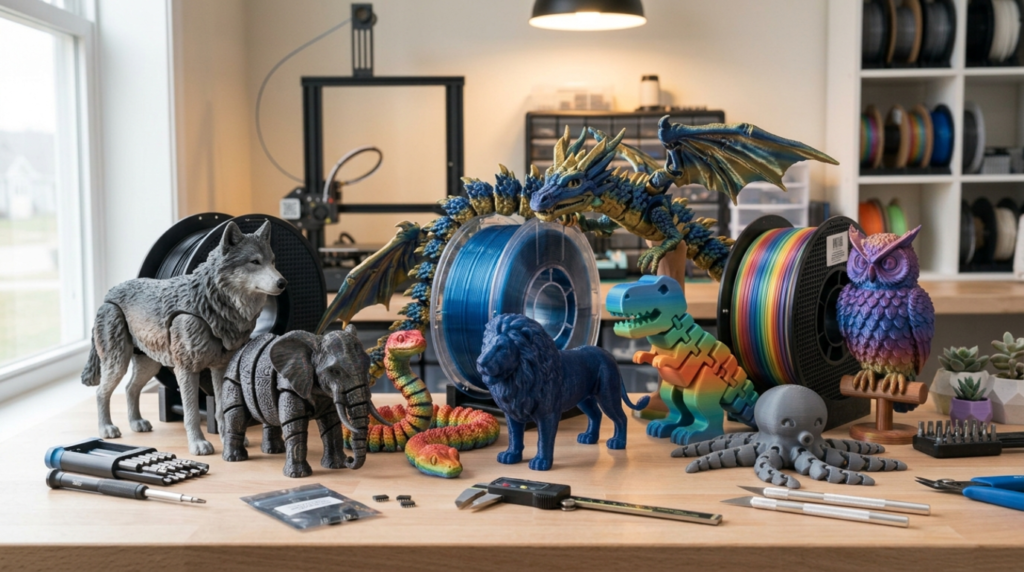
3D printed animals end up being a surprisingly good showcase for what 3D printing is capable of, precisely because the category covers so much range. A simple farm animal teaches a beginner the basics. A print-in-place dragon or snake demonstrates what articulated 3D printed animals and printer calibration can achieve together. A detailed realistic wolf shows what fine layer heights and careful supports can produce on a display piece.
Getting a print-in-place animal to move perfectly on the first try isn’t guaranteed, and it’s worth expecting a few fused joints or snapped legs along the way rather than treating them as failures — that’s just part of learning how a specific printer and design interact. Between the variety covered here — pets, farm animals, wildlife, sea creatures, birds, insects, reptiles, dinosaurs, and a few fantasy creatures — there’s enough range in 3D printed animals that almost any interest or skill level has somewhere reasonable to start. There’s something quietly satisfying about picking a random idea off a long list like this and actually watching it come off the printer bed, ready to move.