

 By
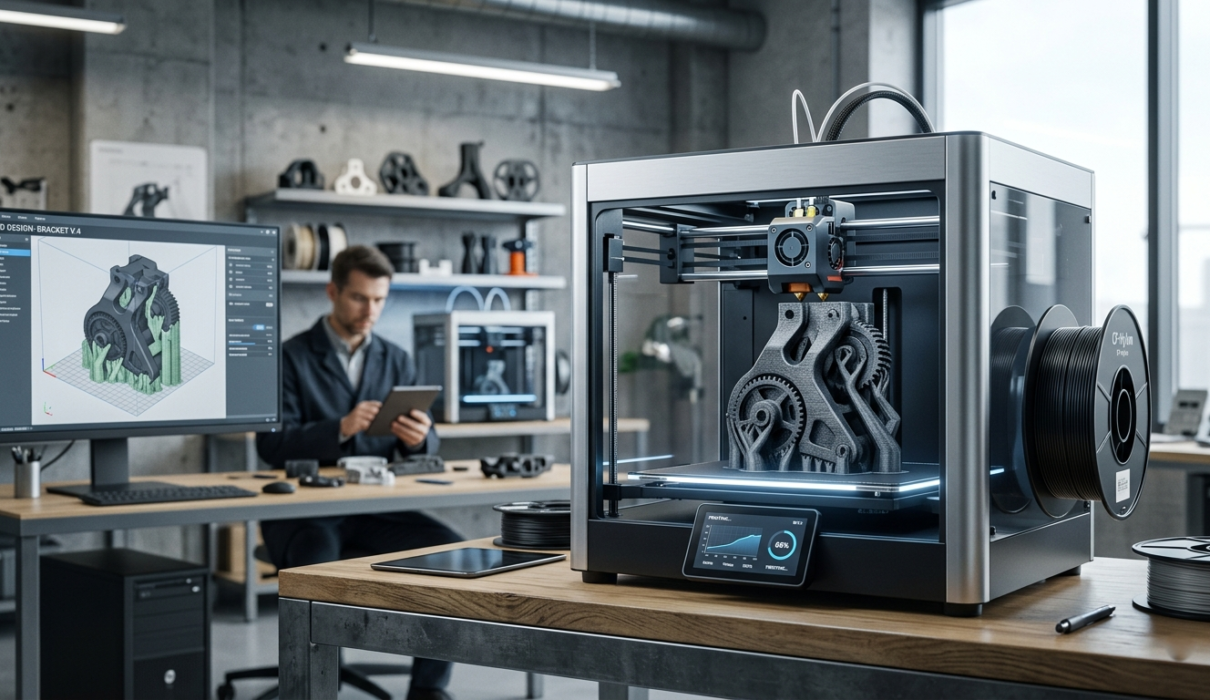
By Watching a 3D printer work is oddly undramatic. No sparks. No noise you’d call impressive. Just a nozzle moving back and forth, laying down thread-thin lines of plastic that, somehow, turn into a real object by the time it stops. It feels less like watching a machine and more like watching something grow, slowly, in a way that doesn’t match how fast the rest of the tech world usually moves.
That contrast is more or less the whole story of 3D printing innovations right now. The process still looks simple from the outside — almost too simple to be taken seriously as “advanced” technology. But underneath that simplicity, a lot has changed. Materials behave differently than they used to. Machines are faster and more forgiving. Software does work that used to require years of engineering intuition. And the list of industries actually using this stuff, not just experimenting with it, has grown well past hobbyists and prototype labs.
This isn’t going to treat every new development as revolutionary. Some of what’s happening in 3D printing is genuinely impressive. Some of it is still clunky, expensive, or overhyped. Both can be true at once, and that’s a more honest way to talk about where this technology stands heading into 2026.
So if you’ve wondered whether 3D printing is “there yet,” or you’re just curious what’s changed since the last time you thought about it, this is meant to give you a clearer, less filtered picture — including where AI-assisted design, automation, new materials, faster printers, healthcare applications, multi-material printing, and large-scale manufacturing all fit into the current picture.
What Do People Actually Mean by “3D Printing Innovations”?
Here’s the tricky part: the phrase gets used to describe a lot of very different things. New materials. Faster machines. Smarter software. Entire industries adopting the process for reasons that didn’t exist a few years ago. A materials scientist and a hobbyist printing phone stands are technically talking about the same underlying process — additive manufacturing — but they’re not really talking about the same thing at all.
Additive manufacturing just means building an object up, layer by layer, instead of cutting it down from a solid block the way traditional machining does. That basic principle hasn’t changed. What’s changed is everything surrounding it.
The Biggest 3D Printing Innovations in 2026
If you’re catching up on the space, a few developments stand out as the ones actually shaping how people design, print, and use 3D-printed parts right now:
- AI-assisted design and automated monitoring. AI tools now help generate and optimize part geometries, and camera-based systems can catch failing prints automatically, without replacing human judgment on the final design.
- Multi-material and multi-color printing. Printers that combine rigid and flexible materials, or multiple colors, in a single print job are becoming more common on both consumer and industrial machines.
- Expanded materials. Engineering-grade filaments, composites, and advanced resins continue to widen what’s realistically printable, from functional mechanical parts to biocompatible dental pieces.
- Faster, more precise machines. CoreXY motion systems and lighter print heads have cut print times for common jobs substantially, without giving up much quality.
- Healthcare adoption. Custom prosthetics, dental appliances, and patient-specific surgical models are increasingly routine uses, even as more ambitious applications like bioprinting remain further out.
- Large-scale and industrial printing. Construction-scale printers and industrial additive manufacturing continue to fill gaps traditional manufacturing struggles with, particularly for complex geometries and low-volume production.
None of this replaces traditional manufacturing outright. It’s a steady expansion of where and how 3D printing makes sense.
How the Technology Has Actually Changed
If you used a 3D printer ten years ago, you probably remember the warping, the failed prints, the hours spent babysitting a job because you couldn’t trust it to finish without shifting halfway through and ruining everything.
That’s improved. Not perfectly — failures still happen, and anyone who prints regularly will tell you that — but noticeably. Better sensors, steadier motion systems, and firmware that corrects small errors mid-print instead of plowing through them have all played a part.
None of this came from one dramatic leap forward. It came from a pile of small, unglamorous fixes: better cooling fans, extruders that don’t clog as often, auto bed-leveling that actually works instead of half-working. Individually, none of those sound like “innovation.” Stack them together, though, and you get a machine a beginner can use successfully on the first try — something budget-friendly options like the Creality Ender 3 V3 have helped make more common — which, not long ago, genuinely wasn’t the case.
New Materials Are Expanding What’s Possible
This is probably the area that’s changed the most. Early on, if you wanted to print something, your real choice was between PLA and ABS. PLA printed easily but was brittle and didn’t handle heat well. ABS was tougher, but temperamental — prone to warping, and unpleasant to print indoors because of the fumes.
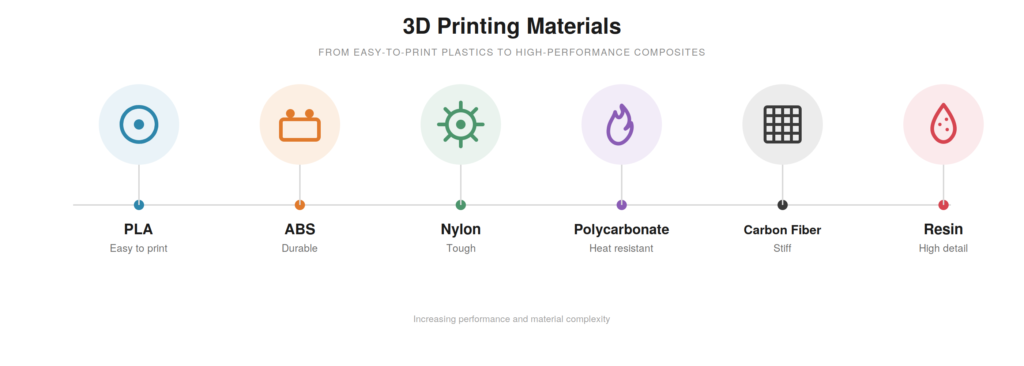
The material list has grown a lot since then, and not just in terms of colors.
Take engineering-grade filaments like nylon and polycarbonate. These let people print parts meant to survive actual mechanical stress — brackets, gears, tool housings — rather than purely decorative objects. Nylon in particular is a pain to work with; it absorbs moisture straight out of the air, and if you don’t dry it properly, the results can be surprisingly bad. A small technical detail, but the difference between a functional part and a wasted afternoon.
Composite filaments are worth sitting with too. These blend plastic with carbon fiber, glass fiber, or even wood particles to add strength or stiffness. Carbon-fiber-infused filament produces stiffer, stronger parts — but it’s also abrasive enough to wear down a standard brass nozzle fairly quickly, so you often need a hardened steel one just to print it. Not an upgrade you get for free; you’re trading one problem for a different one.
Resins used in SLA-style printing have come a long way too. Depending on the formulation, modern resin can be flexible, tough, biocompatible, or heat-resistant, which is a big reason resin printing has caught on for dental models, jewelry casting, and detailed miniatures. The catch is that working with resin is genuinely messier than filament — you’re handling liquid chemicals and post-processing steps that filament printing doesn’t require.
What all of this actually means, for someone who isn’t deep into materials chemistry, is fairly simple: 3D printing isn’t just “making plastic shapes” anymore. Depending on what material you choose, you can end up with something flexible like a phone case, something rigid enough to be structural, or something biocompatible enough for certain medical uses. Material choice has become almost as important as the design itself — and it’s a big part of what makes browsing lists of things to 3D print more interesting than it used to be.
Printers Are Getting Faster — and More Precise
Speed used to be one of 3D printing’s biggest weaknesses. A moderately complex object could easily take most of a day to print, which made the technology impractical for much beyond prototypes and personal projects.
Newer printer designs — Core XY motion systems, lighter print heads — have cut those times down substantially for a lot of common jobs, without giving up much quality. That sounds minor until you experience it. When a print that used to take five hours takes forty-five minutes instead, the printer stops feeling like a slow specialty tool and starts feeling like a normal part of the workflow.
Precision has crept forward too, though it’s a quieter kind of progress. Better stepper motors, refined firmware, tighter mechanical tolerances — none of it sounds exciting alone. But if you’re printing gears that need to actually mesh, or an enclosure where a millimeter of slop matters, this kind of improvement might matter more than raw speed does.
Multi-Material and Multi-Color Printing
One of the more practical shifts in recent 3D printing innovations is the rise of multi-material and multi-color printing — machines that can combine two or more filaments, or switch colors, within a single print job.
This matters because a lot of useful objects aren’t made of one material in real life. A phone case benefits from a rigid shell and a flexible bumper. A prototype might need a rigid structural body with soft-touch grips. Historically, achieving that meant printing separate parts and assembling them by hand, which added time and weak points at the seams.
Multi-material setups solve part of that by printing combined properties directly into a single object. Multi-color printing serves a different purpose: it’s less about mechanical performance and more about producing finished-looking parts, signage, or models without painting afterward. Both are still more complex to set up than single-material printing — more calibration, more waste material from purge sequences — but they’re increasingly accessible outside of high-end industrial machines.
Where AI and Automation Actually Fit In
“AI” and “3D printing” can sound like a buzzword pairing more than an actual development, but a few applications here are legitimate, even if the term gets thrown around loosely elsewhere.
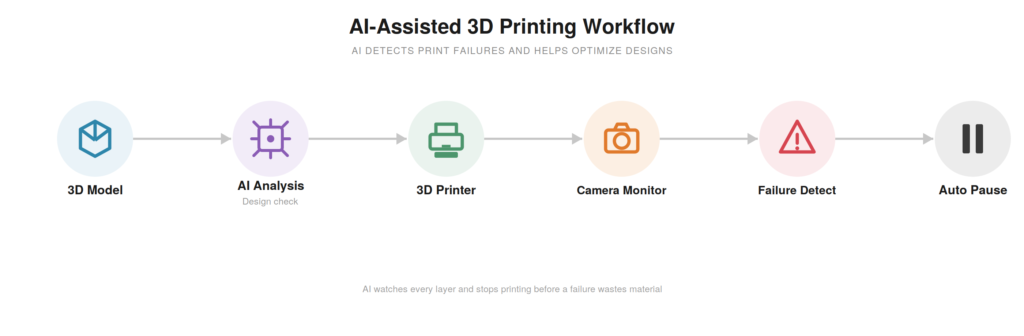
AI-assisted 3D design is one of the more visible additions. Tools that turn a text description or a reference image into a rough 3D model — sometimes called text-to-3D or image-to-3D workflows — have started showing up in consumer and hobbyist software. They’re useful for generating a starting shape or concept quickly, but the output typically still needs cleanup, correction, and human judgment before it’s actually printable or functional. These tools speed up the earliest stage of design; they don’t replace the modeling process.
Print failure detection is another practical use. Some newer systems use cameras paired with machine learning models trained to spot the early signs of a failing print — the tangled mess that happens when an object detaches from the bed partway through — and pause the job automatically. Catching a failure two hours into an overnight print, instead of finding a ruined mess the next morning, saves real time and material.
Generative design is a related but separate application. Software suggests part geometries optimized for strength relative to weight, based on constraints fed into it. This doesn’t replace engineers — it gives them a faster starting point for shapes that would be genuinely hard to work out by hand. These AI-generated designs often end up looking organic, almost bone-like, since nature solved a lot of the same structural problems long before software did.
Then there’s automation that’s less flashy but arguably more consequential for anyone running printers at scale: self-calibrating build plates, automatic material switching, and print farms managing dozens of machines with minimal oversight. Not headline material, but it’s what makes the economics of running 3D printing as a business actually work.
Healthcare Might Be Where This Matters Most
Of everywhere 3D printing has landed, healthcare is probably where its impact is most tangible — and also where it’s easiest to overstate what’s actually happening.
Custom prosthetics are one of the more established use cases. 3D printing can help produce prosthetic components tailored to an individual’s measurements and requirements, potentially improving fit and comfort in suitable cases. In some situations, the digital design and manufacturing process can also help reduce production time and cost compared with traditional fabrication.
Dental work has quietly become one of the more routine applications — clear aligners, dental models, even some crowns are now produced this way, largely because the process suits highly customized, one-off objects better than traditional manufacturing ever could.
Surgical planning models are a less talked-about but genuinely useful case. A surgeon can hold a 3D-printed replica of a patient’s own anatomy, built from that patient’s CT or MRI scan, before a complicated procedure. Planning something delicate based only on flat scans is a very different experience from being able to physically hold and examine the shape beforehand.
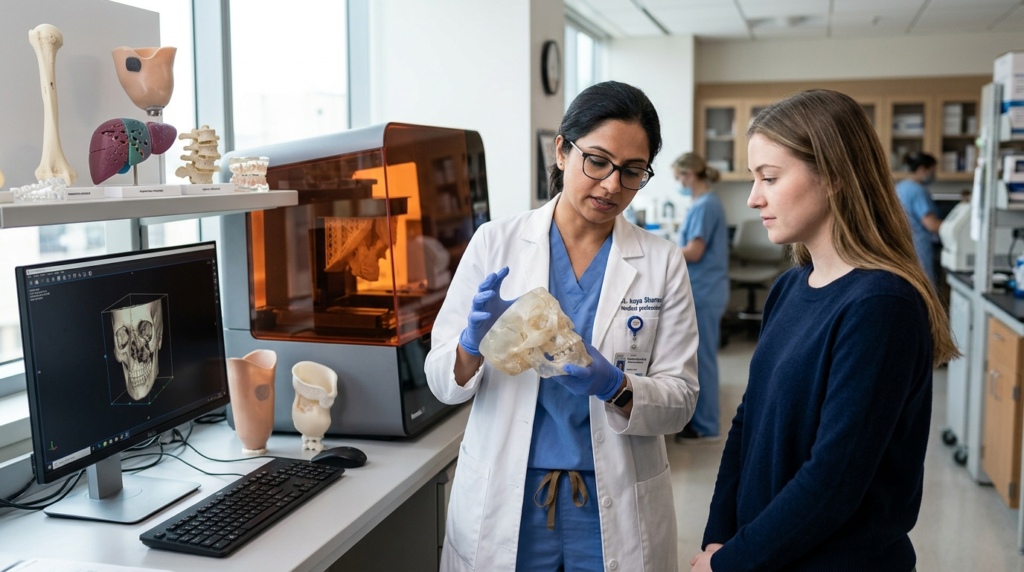
Bioprinting — printing with living cells to build tissue — gets a lot of attention in the media, and it’s a real, active area of research. But it’s worth being clear here: fully functional printed organs are nowhere near being a normal part of medicine. Progress is happening. It’s just slower and more limited than headlines usually suggest.
Manufacturing: Filling Gaps, Not Replacing the Whole System
In manufacturing, the real story isn’t that 3D printing has replaced traditional methods. It hasn’t, and probably won’t anytime soon — injection molding and CNC machining are still far more efficient for producing thousands of identical parts.
Where 3D printing has become genuinely useful is in rapid prototyping and low-volume, complex production. Think about what that actually looks like day to day: a designer takes an idea, prints a physical version, holds it, notices the grip feels wrong or a joint doesn’t quite line up the way it did on screen, adjusts the design, and prints another version — sometimes within the same day. That loop used to take weeks when it depended on traditional tooling.
Manufacturers are also using printers for tooling itself — custom jigs, fixtures, molds that used to require significant lead time to source. Printing a fixture in-house instead of waiting on an outside supplier shortens timelines in a way that’s easy to underestimate.
Aerospace and automotive companies have adopted industrial 3D printing for specific components too, especially lightweight parts with internal geometries that would be hard to machine conventionally. It’s about using the right tool where traditional manufacturing genuinely struggles, not replacing assembly lines wholesale.
Small Businesses and Independent Creators
This might be where the innovations matter most on an everyday, human level, simply because the barrier to entry has dropped so much.
A small business selling custom jewelry, miniatures, or personalized products doesn’t need a factory. A single desktop printer — or a handful of them — can produce enough inventory to run an entire shop. Ten years ago, producing custom physical goods at that scale was either expensive or just impractical for one person.
For designers, being able to prototype quickly changes the whole approach to a project. Instead of committing to a design based purely on a digital render, it’s possible to hold a physical version, notice something that doesn’t feel right in the hand, and fix it before ever manufacturing at scale.
Educators have found their own use for this. Printed anatomical models, geometric shapes, historical artifacts — giving students something to physically hold beats a flat diagram for a lot of topics.
And then there are people with no business or classroom agenda at all — someone who needs a replacement part for something broken around the house, or wants a gift, or a custom organizer that doesn’t exist in any store. Small, quiet usefulness, but real.
Is 3D Printing Actually Sustainable?
This is one of those areas where the reality is messier than the marketing suggests, and it’s worth saying that plainly.
On the positive side, additive manufacturing can reduce material waste compared with some subtractive methods, although the actual savings depend on the process, material, and design.
On the other hand, most standard filaments — PLA included, despite coming from renewable sources like corn starch — don’t break down easily outside specific conditions. PLA is technically compostable, but only under industrial composting conditions that most people don’t have access to. Tossing it in a backyard compost pile won’t do much.
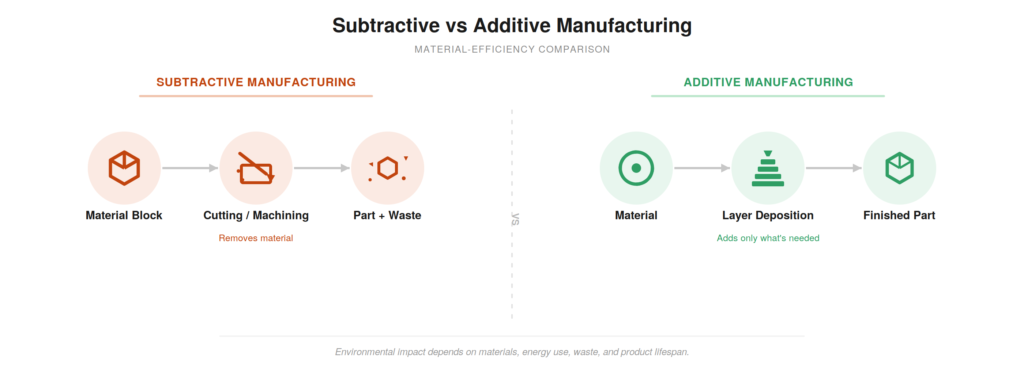
There’s real progress on recycled filament made from post-consumer plastic waste, and some companies now run recycling programs for failed prints and support material. That helps, but it’s not a complete answer yet — recycled filament often has less consistent quality, which matters if you’re printing something that needs to be reliable.
3D printing has real sustainability potential, especially around reducing waste and enabling local, on-demand production instead of shipping mass-produced goods long distances. But it isn’t automatically eco-friendly just because it’s newer. That depends heavily on the materials and habits behind it.
Printing at a Much Bigger Scale
Footage of a house being 3D printed looks strange the first time you see it — a huge gantry system slowly extruding thick, concrete-like layers, building walls the same way a desktop printer builds a small object, just scaled up dramatically.
This is one of the more visually striking developments in the space, and it’s actually being used, not just tested in a lab somewhere. Construction 3D printing can reduce the time needed to build certain structural components, although timelines vary significantly by project.
Worth being clear, though: 3D-printed construction usually handles the wall structure and not much else. The printer isn’t installing plumbing, wiring, windows, or a roof — those parts still need traditional labor. Think of this as a faster way to build a shell, not a fully automated house-building process.
The Software Behind the Scenes
None of the hardware or material progress would matter much without decent software to support it, and that side of things doesn’t get talked about nearly enough.
Slicing software — the program that turns a 3D model into instructions the printer can actually follow — has gotten noticeably smarter. Modern slicers can detect where supports are needed, optimize orientation for strength, and adjust settings automatically based on the material in use. A decade ago, a lot of that required manual trial and error, and plenty of wasted filament.
CAD tools have gotten more approachable too. Years of engineering training aren’t required anymore to design something printable — simplified, sometimes free tools let hobbyists and small business owners build functional designs, even if professional-grade software still wins out for complex work.
Simulation software has changed the workflow as well. Stress and weight distribution can now be simulated before ever printing a physical part, catching design flaws on a screen instead of after wasting hours of material. Going from “print it and see” to “simulate it and predict” is a quiet shift, but not a small one.
What Still Doesn’t Work Well
It wouldn’t be honest to talk about 3D printing innovations without naming what still falls short.
Speed, even improved, is still a real limitation for large or intricate objects compared to mass production. A single detailed part might take hours to print; injection molding can produce the same part in seconds once a mold already exists.
Materials still have gaps. Not every plastic or metal used in traditional manufacturing has a good 3D-printable equivalent, and printed parts are often weaker along certain directions because of how the layers bond — something engineers have to design around, not ignore.
Cost remains a genuine barrier at the industrial end. Metal printers especially are still expensive enough to keep some advanced applications out of reach for smaller businesses.
Consistency is another sticking point. For parts that need strict tolerances or safety certifications, 3D printing isn’t yet reliable enough at scale — part of why it hasn’t replaced traditional manufacturing for high-volume, safety-critical production, even where it excels at prototypes and small runs.
And then there’s the more human limitation: the learning curve. Machines are more forgiving now, but getting consistently good results still takes patience and a willingness to fail a few times before it clicks.
Where This Might Be Headed
Nobody can predict this with real confidence, and it’s worth being a little wary of anyone who claims otherwise. But a few directions seem reasonably likely to continue.
Materials will probably keep expanding, especially toward more sustainable and recyclable options, given how much attention that’s getting across industries generally. Multi-material printing is likely to become more common, which opens up designs that currently require assembling several separate printed parts by hand.
Automation should keep lowering the amount of hands-on effort required, which makes the technology more approachable for people without a technical background. AI-assisted design tools will probably keep improving too, though they seem likely to stay assistive rather than fully autonomous for a while yet — useful for generating a starting point, not a replacement for human judgment on the final call.
Healthcare applications, especially custom prosthetics and surgical planning, seem likely to keep growing steadily. Bioprinting’s more ambitious promises, on the other hand, probably remain a longer-term story than most coverage of it suggests.
FAQ: 3D Printing Innovations
Is AI actually used in 3D printing today?
Yes, in specific, limited ways. AI helps with generative design, automated print-failure detection, and early-stage text-to-3D or image-to-3D modeling. It speeds up parts of the design and monitoring process but doesn’t replace human design judgment.
What are the newest 3D printing materials?
Beyond standard PLA and ABS, current materials include engineering-grade filaments like nylon and polycarbonate, carbon-fiber and glass-fiber composites, and advanced resins with flexible, tough, or biocompatible properties.
How much faster are modern 3D printers?
Newer motion systems, like CoreXY designs, and lighter print heads have cut print times substantially for many common jobs compared to older printers, without a major loss in quality.
Is 3D printing environmentally friendly?
It can reduce material waste compared to subtractive manufacturing, but most standard filaments don’t easily biodegrade outside industrial composting conditions. Sustainability depends heavily on the specific materials and recycling practices used.
What is multi-material 3D printing used for?
It’s used to combine different properties, like rigid and flexible sections, or multiple colors, in a single print. This is useful for functional prototypes, finished-looking parts, and objects that would otherwise require assembling separate printed pieces.
newest 3D printing materials ?
Recent developments include engineering-grade filaments, carbon-fiber and glass-fiber composites, high-performance polymers, and specialized resins with flexible, tough, heat-resistant, or biocompatible properties.
You Might Also Like
- 3D Printing Innovations: What’s Actually Changing and Why It Matters
- How to Calibrate a 3D Printer: A Practical, No-Nonsense Guide
- Metal 3D Printer: A Practical Guide to How They Work, What They Cost, and Whether You Actually Need One
- Things to 3D Print: A Practical Guide to Useful, Fun, and Worthwhile Projects
- Creality Ender 3 V3: A Practical Look at Features, Specs, and Whether It’s Right for You
- How to Become a Drone Pilot — What Actually Happened When I Tried It
- Agricultural Drone — What Actually Happened My First Season – 2026
Final Thoughts
What stands out most about 3D printing innovations isn’t any single breakthrough. It’s how many small, unglamorous improvements have quietly stacked up into something genuinely different from where this technology started — better materials, smarter software, more reliable machines, and a wider range of real, practical applications, from someone printing a replacement part at home to a surgeon studying a patient-specific model before an operation.
It’s not a perfect technology, and it isn’t trying to replace everything else, either. Traditional manufacturing still does plenty of things better, faster, and cheaper, especially at scale. What 3D printing has gotten genuinely good at is filling the gaps — customization, quick iteration, complex shapes, small production runs.
If you’re thinking about trying it, for a business idea, a school project, or just curiosity, this seems like a reasonable time to start. The tools are more forgiving than they used to be, and what you can realistically make has grown a lot. Just go in with reasonable expectations. It still takes patience and some trial and error — and that might be part of what makes it satisfying when something finally comes out right.