

 By
By When you first start looking at filament, it’s easy to think the main decision is simply which color to buy. Red or blue, matte or glossy, maybe a nice wood-toned option for something decorative. But color has almost nothing to do with whether your print actually turns out well. What matters is which of the many 3D printer filament types you picked for the job.
Knowing the different 3D printer filament types sounds obvious once you know it, but it trips up a lot of people. PLA, PETG, ABS, TPU, and the long tail of specialty blends don’t just look different on the spool. These 3D printer filament types behave in completely different ways once they’re actually being printed and used. One prints beautifully and picks up fine detail, then snaps the moment you flex it too far. Another can survive getting dropped on concrete, but strings everywhere if your settings aren’t quite right. A third won’t even finish a print without warping unless it’s sitting in an enclosure with decent airflow.
One thing that becomes pretty obvious after you’ve spent some time printing is how many failed prints actually come down to picking the wrong 3D printer filament types, not the printer. Somebody prints a phone case in plain PLA, it cracks the first time it hits the floor, and they blame the machine. The real problem was choosing a brittle plastic for a job that needed something tougher.
This guide walks through the different 3D printer filament types and uses, what each one is actually good for, how to think about matching material to project, and the practical habits — drying, nozzle choice, storage — that separate filament that behaves from filament that fights you the whole way through a print. If your printer itself still needs dialing in, it’s worth pairing this with a guide on calibrating a 3D printer, since filament choice and calibration are really two halves of the same problem.
What Are 3D Printer Filament Types?
At its core, 3D printer filament types are different thermoplastics: plastics that soften under heat and harden again as they cool. A printer’s hot end melts it and lays it down layer by layer to build an object. That much is true no matter which type of 3D printer filament you’re using. What changes from one material to the next is almost everything else — how hot it needs to run, how well it sticks to itself and to the bed, how strong or bendy the final part ends up, and how much patience it demands from whoever’s printing it.
These 3D printer filament types come in a standard diameter most of the time, usually 1.75mm, though a handful of printers are built around thicker filament instead. Beyond diameter, 3D printer filament types vary a lot in how much moisture they soak up from the air, how much they shrink or curl while cooling, and whether they need a heated enclosure to behave at all. None of that shows up on the spool’s label the way color does, which is exactly why understanding 3D printer filament types and uses ends up mattering more than most beginners expect going in.
Types of 3D Printer Filament: The Main Materials
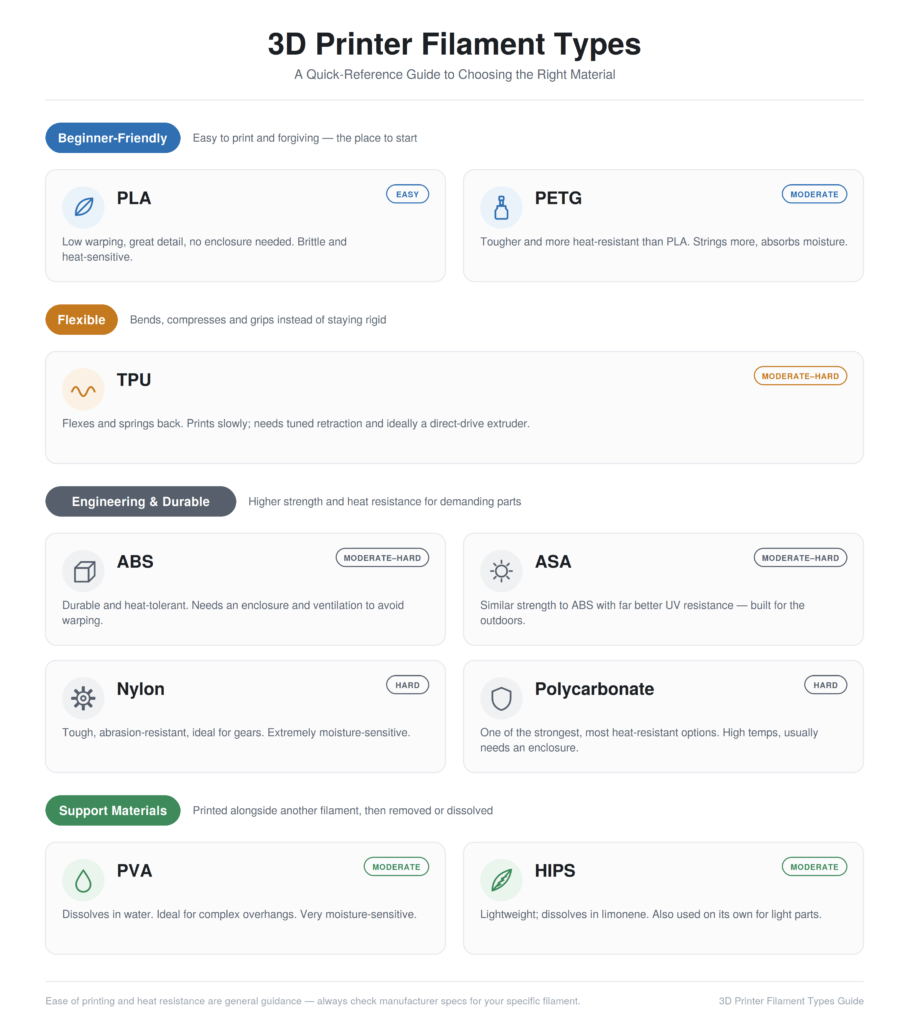
If you’re standing in front of a wall of 3D printer filament types and wondering where to start, these are the materials you’re most likely to come across, with the bigger trade-offs among PLA, PETG, and ABS/ASA covered in more depth further down. Not every printer handles every one of these 3D printer filament types equally well. Hotend temperature range, whether there’s a heated bed, and whether there’s an enclosure all factor into which of these 3D print filament types you can realistically print, so it’s worth checking your machine’s specs against the notes below rather than assuming.
3D printer filament typesPLA
The default beginner filament, and for good reason. It prints easily, warps very little, and holds detail nicely. The trade-off is that it’s more brittle than tougher options and softens at fairly low temperatures.
PETG
A step up from PLA in toughness and moisture resistance, with solid layer adhesion. It’s a bit more finicky to dial in and prone to stringing if your settings aren’t quite right.
ABS
Durable and reasonably heat-resistant, but it wants an enclosure to avoid warping and benefits from decent ventilation while it prints.
ASA
Chemically close to ABS with a similar strength profile, but noticeably better at resisting UV damage, which is why it’s the go-to for anything that’ll live outside.
TPU
The flexible one. It bends and compresses instead of holding a rigid shape, which makes it useful anywhere a part needs to flex, grip something, or soak up an impact.
Nylon
Tough, a little flexible, and great at resisting abrasion. The catch is that it’s extremely sensitive to moisture and isn’t really a friendly material for someone just starting out.
Polycarbonate (PC)
One of the stronger, more heat-tolerant filaments you’ll find in general use, though it usually needs high temperatures and an enclosure to print without issues.
PVA
A water-soluble support material. Nobody prints an entire object in PVA — it’s there to dissolve away complex supports once the print is done.
HIPS
A lightweight material sometimes used as a dissolvable support alongside ABS, or occasionally on its own for lightweight parts. It’s fallen out of favor somewhat as other options have improved.
Specialty Types of Filament for 3D Printing
Once you get past the usual PLA, PETG, and ABS 3D printer filament types, things get a lot more interesting. Manufacturers start mixing different additives into the base plastic to change how these 3D printer filament types look, feel, and behave while printing. It’s worth being clear that these aren’t drop-in substitutes for the plain version of the same plastic — the additives change how the filament actually prints, not just how the finished part looks.
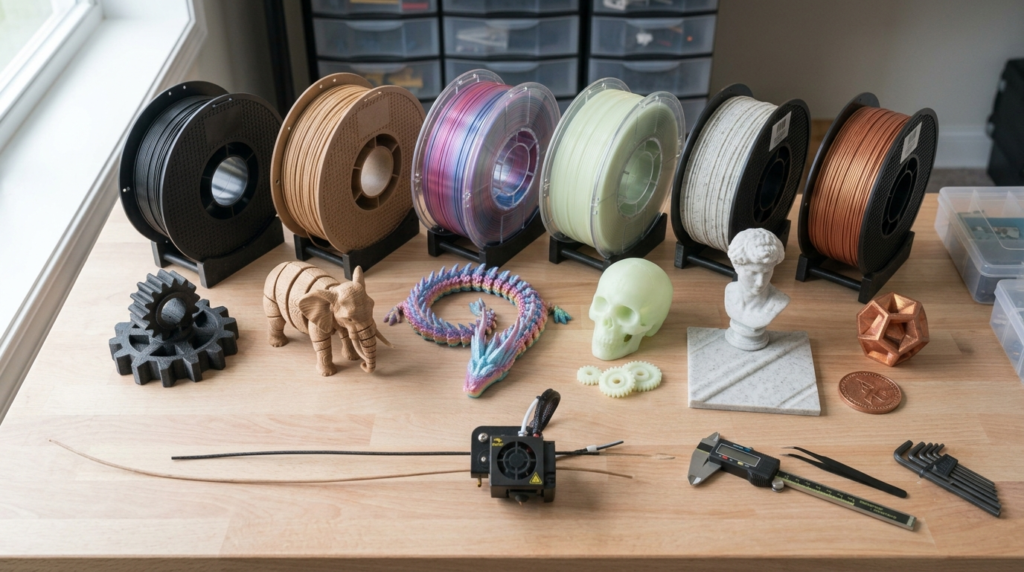
Carbon fiber filament mixes chopped carbon fiber into a base plastic, often PETG or nylon, which adds real stiffness and gives parts a matte, textured look. The catch is that those fibers are abrasive enough to chew through a standard brass nozzle fairly quickly, so a hardened steel nozzle is basically a requirement. Glass fiber filament does something similar for stiffness, just with a less aggressive additive.
Wood-filled filament blends actual wood particles into a PLA base. It genuinely looks and feels like wood, can be sanded and stained, but tends to clog finer nozzles and usually prints better a touch slower. Silk filament, on the other hand, is purely cosmetic — a PLA variant tuned for a glossy sheen, with no real structural difference from regular PLA.
Glow-in-the-dark filament contains phosphorescent particles that can be mildly abrasive on your nozzle over time. Marble or stone-filled filaments add mineral particles for a speckled look and print a lot like standard PLA, just with a bit more wear on the nozzle. Metal-filled filaments, usually bronze or copper based, add genuine weight and a metallic finish, but they’re dense, abrasive, and honestly not something I’d hand a first-timer.
Conductive filament is formulated to carry a small electrical charge, useful for basic circuits or sensor projects, though it’s not a substitute for actual electrical wiring and shouldn’t be treated as safety-rated. The rule that ties all of these specialty 3D printer filament types together is simple: additives change how the filament behaves, and there’s no guarantee a given specialty filament will work well on your printer without some tweaking.
3D Printer Filament Types Chart
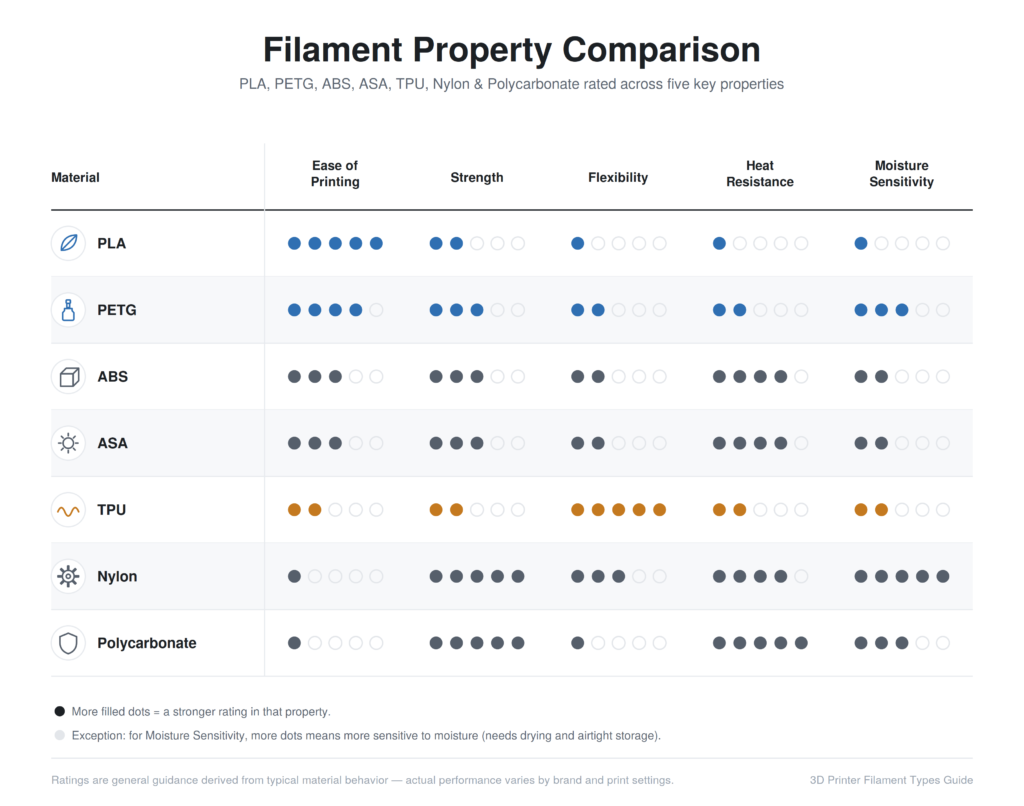
Sometimes you don’t need another long explanation—you just want to put the different 3D printer filament types next to each other and see how they compare. Treat the numbers below for these 3D printer filament types as general guidance rather than lab-tested figures — actual performance shifts by brand and formulation, so manufacturer documentation should win out over any general chart, this one included.
A practical way to compare these 3D printer filament types: find your project type under “Best For” first, then check “Ease of Printing” against your own comfort level, and cross-reference “Heat Resistance” or “Flexibility” against whatever the part specifically needs. The columns roughly mirror the questions people actually ask themselves — how strong does this need to be, will it flex, will it see heat, and how much patience will this material demand?
| Filament | Ease of Printing | Strength | Flexibility | Heat Resistance | Moisture Sensitivity | Nozzle Needed | Best For | Main Drawback |
|---|---|---|---|---|---|---|---|---|
| PLA | Easy | Moderate | Low | Low | Low | Standard brass | Detailed models, beginners, decorative prints | Brittle, softens in heat |
| PETG | Moderate | Good | Low-moderate | Moderate | Moderate | Standard brass | Functional parts, outdoor-adjacent use | Stringing, moisture-sensitive |
| ABS | Moderate-hard | Good | Low-moderate | Moderate-high | Low-moderate | Standard brass | Durable functional parts, enclosures | Warping, needs ventilation |
| ASA | Moderate-hard | Good | Low-moderate | Moderate-high | Low-moderate | Standard brass | Outdoor parts needing UV resistance | Similar warping challenges to ABS |
| TPU | Moderate-hard | Moderate | High | Low-moderate | Low-moderate | Standard brass | Flexible parts, grips, phone cases | Slow printing, retraction tuning |
| Nylon | Hard | Very good | Moderate | Moderate-high | Very high | Standard brass (hardened if reinforced) | Gears, mechanical, abrasion-prone parts | Highly moisture-sensitive |
| PC | Hard | Very good | Low | High | Moderate | Standard brass (hardened if reinforced) | High-strength, heat-resistant parts | High temps, often needs enclosure |
| PVA | Moderate | N/A (support only) | Low | Low | Very high | Standard brass | Dissolvable supports for complex geometry | Very moisture-sensitive |
| HIPS | Moderate | Moderate | Low | Moderate | Low-moderate | Standard brass | Lightweight parts, dissolvable ABS supports | Less common, needs limonene to dissolve |
One thing worth flagging separately: any abrasive specialty filament — carbon fiber, glass fiber, metal-filled — generally wants a hardened steel nozzle no matter which base plastic it’s built on. That’s less about the material family and more about what’s mixed into it, so it doesn’t fit neatly into the chart above.
3D Printer Filament Types and Uses
This is where 3D printer filament types and uses start to make practical sense: forget the 3D printer filament types’ names for a moment and think about what the finished part actually has to do. It helps to sit down and think through what the object needs to do rather than just reaching for whatever’s already loaded in the printer. This is where different 3D printer filament types and their uses genuinely come together in practice, rather than staying abstract.
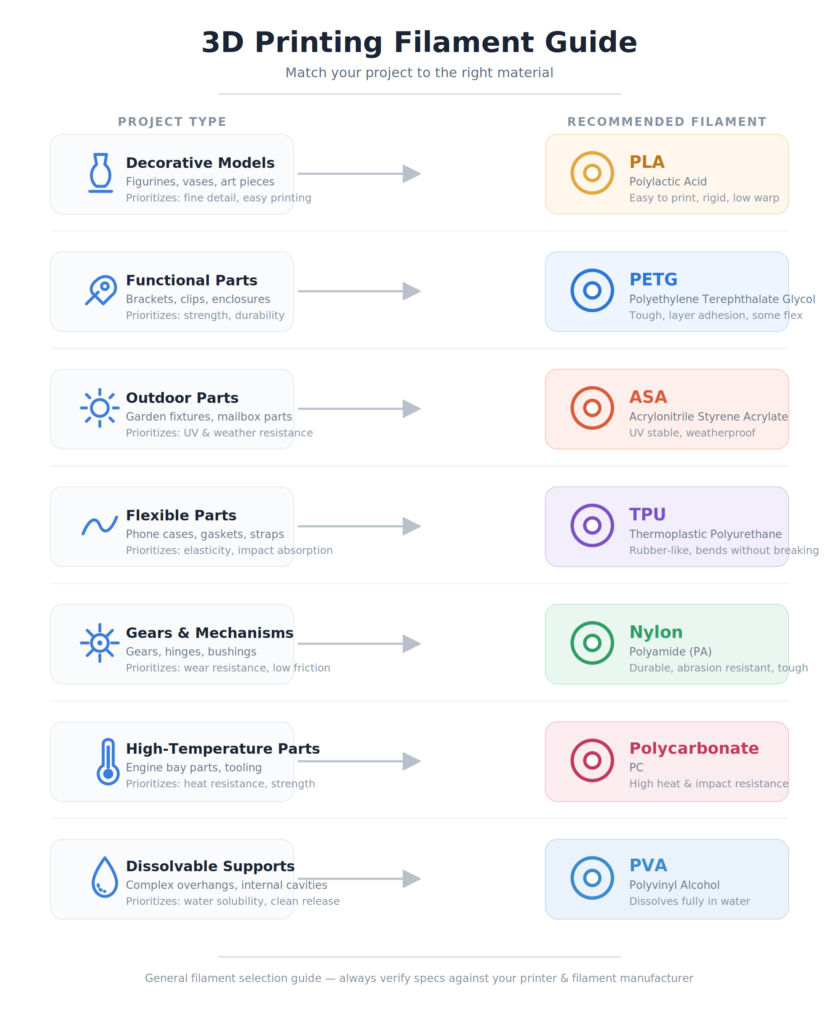
Among 3D printer filament types, decorative models and miniatures generally do best in PLA, since fine detail and easy printing matter far more than toughness for something that’s mostly going to sit on a shelf. Toys are trickier and really depend on context — a display piece is fine in PLA, but anything a kid is actually going to handle benefits from PETG’s added durability. There are real caveats around food and mouth contact, which I’ll get into later.
Functional parts and mechanical components — brackets, gears, enclosures under real load — usually call for these 3D printer filament types: PETG, nylon, or polycarbonate depending on how much stress and heat is involved. Outdoor projects point toward ASA first because of its UV resistance, with ABS as a reasonable fallback where sun exposure isn’t a major factor. Flexible parts like grips, gaskets, and phone cases are TPU’s territory, almost by default at this point.
High-temperature applications, anything sitting near a real heat source, generally need polycarbonate or a heat-resistant nylon blend rather than plain PLA or even PETG. Prototypes often just need PLA for a cheap, fast first pass, with an upgrade to PETG or ABS once the design has to survive actual handling. Support structures on complex overhangs sometimes lean on PVA or HIPS specifically because they dissolve away instead of needing to be pried off by hand.
Cosplay and props frequently use PLA for large, lightweight pieces, sometimes paired with something more flexible for anything worn against the body. If you’re after more prop and display ideas in general, a broader list of things to 3D print is worth a browse. Educational projects tend to favor PLA for the same reasons beginners do. And household enclosures or parts near any heat or friction often hold up better in PETG or ABS than plain PLA, which softens under warmer household conditions more easily than people expect.
PLA Filament: Easy, Popular, and Beginner-Friendly
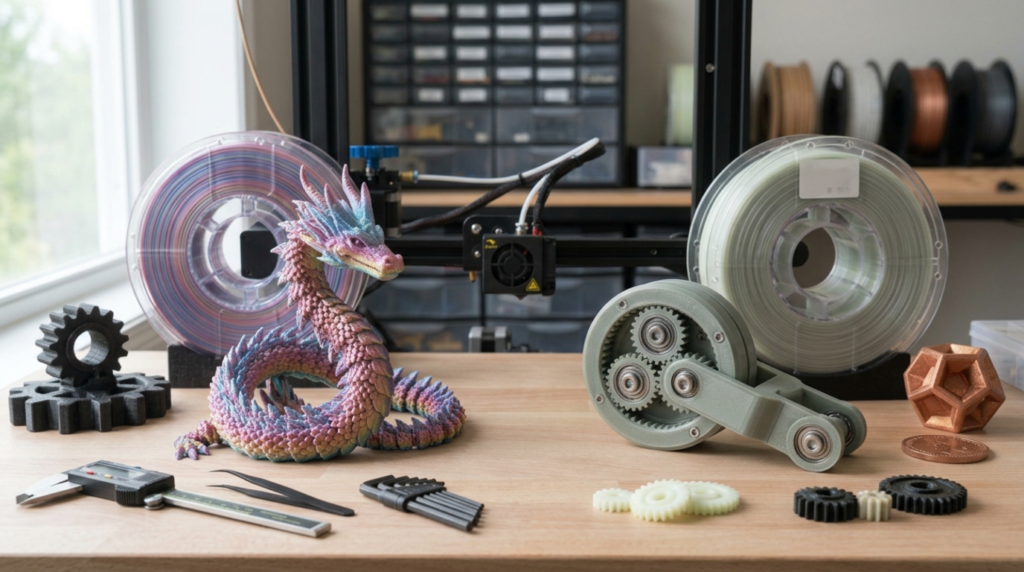
There’s a reason PLA is usually the first of the 3D printer filament types people buy, and it’s not just because everyone recommends this filament type. It prints at relatively low temperatures, skips the need for a heated enclosure, warps far less than ABS, and captures fine detail nicely. That combination is exactly why it’s the go-to for miniatures, decorative objects, and most people’s first prints ever.
The trade-offs are real, though, and worth taking seriously. PLA is more brittle than PETG or ABS, so anything under repeated stress or impact is more likely to crack over time. It also softens at a lower temperature than most alternatives, which makes it a poor pick for anything that’ll end up in a hot car, sitting in direct sun near a window, or close to a heat source. For a decorative print, a beginner project, or anything genuinely low-stress, PLA isn’t just a training-wheels material you’re supposed to graduate from. It’s a sensible, deliberate choice.
PETG Filament: Strength and Practical Durability
Moving between these two 3D printer filament types — PLA to PETG — is one of those changes where you notice the difference pretty quickly. Among 3D printer filament types, PETG handles impact and stress noticeably better than PLA and its layer adhesion tends to be stronger too, which matters a lot for parts that need to hold together under real mechanical load.
It comes with its own quirks, though. PETG strings more than PLA if your retraction settings aren’t well tuned, and it’s more sensitive to moisture. That sensitivity shows up as popping sounds during printing and a rougher surface finish than you’d expect. Its heat resistance lands meaningfully above PLA but below ABS or nylon, which makes it a solid middle-ground pick for functional parts that need durability without demanding an enclosure or serious ventilation.
For outdoor use, PETG holds up reasonably well in the short term, though ASA is generally the smarter long-term choice anywhere UV exposure is a real concern.
ABS vs ASA: When Should You Use Them?
ABS and ASA are close chemical cousins, and picking between them usually comes down to one question: is this part going to see sunlight?
Both of these 3D printer filament types offer solid heat resistance and impact strength compared to PLA, and both tend to warp as they cool unless they’re printed in a heated enclosure with stable ambient temperature. Ventilation matters for both too — like most heated thermoplastics, they give off noticeable fumes while printing, and following the manufacturer’s airflow guidance is worth taking seriously rather than shrugging off.
Where they really part ways is UV resistance. ABS tends to yellow and turn brittle after prolonged sun exposure, while ASA was formulated specifically to hold up better outdoors. If a part is headed for a windowsill, a car, or genuine outdoor use, ASA is generally the smarter pick. For indoor functional parts where UV isn’t a factor, the choice often just comes down to whichever material your printer setup handles more reliably.
TPU and Flexible Filaments
TPU behaves nothing like the rigid 3D printer filament types on this list, because the entire point of it is that it bends, compresses, and springs back instead of holding a fixed shape. Even within TPU, flexibility isn’t one fixed thing — it comes in a range of hardness levels, commonly measured on a Shore A scale, running from soft and rubber-like to stiffer formulations that flex a lot less dramatically.
Printing TPU takes real patience compared to PLA or PETG. The material’s give makes it prone to buckling in a Bowden-style extruder, which is why a direct-drive extruder tends to handle it far more comfortably. Retraction needs careful tuning as well, since aggressive settings are more likely to jam flexible filament than rigid material.
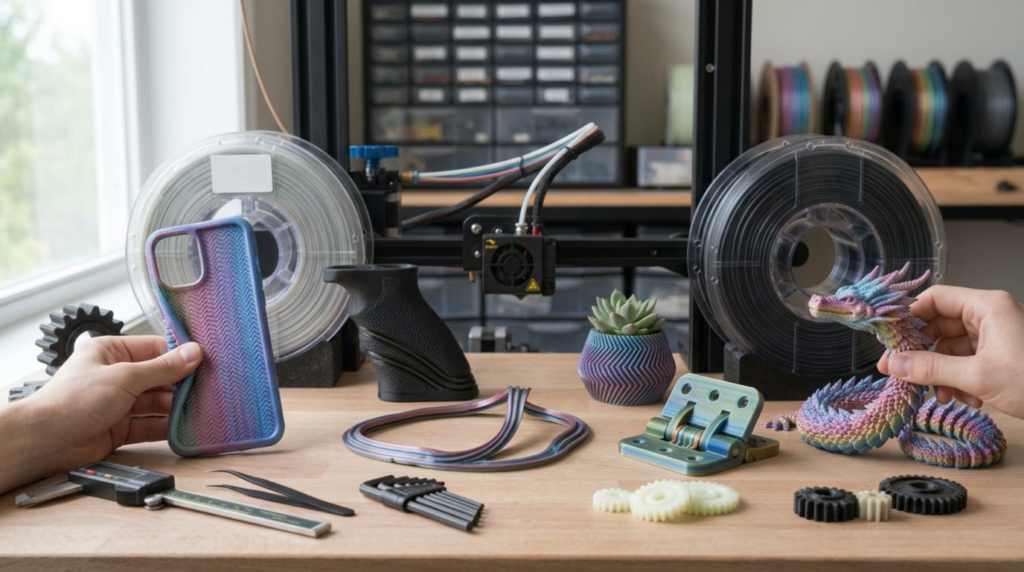
The extra effort is worth it when you actually need a part that can bend instead of simply breaking: phone cases, gaskets, flexible hinges, non-slip feet, grips, and squeezable toys, none of which would hold together printed in PLA.
Nylon and Other Engineering Filaments
Nylon and polycarbonate belong in their own category among 3D printer filament types, the “engineering filament” tier, and neither is a great choice for someone printing their very first object. Both bring real strength and toughness advantages over PLA and PETG. Nylon in particular has excellent abrasion resistance, which makes it a strong pick for gears and anything that deals with ongoing friction.
The biggest headache with nylon is moisture, and it’s not a small one. It’s dramatically more hygroscopic than PLA or even PETG, soaking up ambient humidity fast enough that even a few hours sitting out in open air can visibly hurt print quality. Dry storage, and often active drying before printing, aren’t optional extras with nylon the way they might be with PLA.
Polycarbonate needs genuinely high nozzle temperatures and usually a heated enclosure to avoid warping, plus a hardened nozzle if it’s reinforced with fiber. Reinforced or composite versions of either material, carbon-fiber nylon being a good example, add stiffness but demand a wear-resistant nozzle in return. These are capable, serious materials. They also ask a lot more of both printer and person than PLA or PETG ever do.
What Filament Diameter Should You Use?
Filament comes in a couple of standard diameters, most commonly 1.75mm, with 2.85mm (sometimes labeled 3.0mm) less common but still around on certain printers. This isn’t really a question of which diameter is “better” in any general sense. It’s entirely about what your specific printer and extruder are built to feed.
Using the wrong diameter for your hardware generally just won’t work, since the extruder’s feed mechanism and hotend are sized for a particular width. If you’re not sure which your printer takes, check the spec sheet rather than guess.
How to Choose the Right 3D Printer Filament Type
When I’m deciding which of the many 3D printer filament types makes sense for a project, I find it easier to start with a few basic questions rather than simply using whatever is already on the printer.
What are you actually printing, and does it need to survive real handling, or does it just need to sit there and look good? Does it need meaningful strength, or is appearance the whole point? Will it flex, or does it need to stay rigid no matter what? Will it face heat — a car dashboard, direct sun, a warm garage? Is it headed outdoors, where UV resistance suddenly starts to matter a lot? Does surface finish or color consistency matter for how it’ll be displayed or used?
Beyond the object itself, two more questions carry just as much weight: does your printer actually support the material, in terms of hotend temperature range and whether it has a heated bed or enclosure, and can your current nozzle handle it, since abrasive filaments chew through standard brass fairly fast. And finally, does the filament need drying before or during use? Skipping that step with a moisture-sensitive material is one of the more common reasons prints turn out inconsistent for no obvious reason.
Which Filament Is Best for Different Projects?
A few project types deserve a quick, specific callout beyond the general uses above. Gears and other friction-heavy mechanisms benefit especially from nylon’s abrasion resistance if they’re going to see regular use. Enclosures for electronics often lean on PETG or ABS for a decent balance of strength and moderate heat tolerance. For cosplay props worn against the body, blending PLA structural pieces with TPU or foam padding usually works better than an all-rigid build. And for support structures on especially complex geometry, PVA’s dissolvability in water makes the extra setup worth it compared to manually snapping off and cleaning up support material.
3D Printer Settings for Different Filament Types
One of the easiest mistakes to make is assuming that a slicer profile that worked perfectly for PLA will work just as well for other 3D printer filament types. Nozzle temperature is the most obvious variable here. PLA typically prints at meaningfully lower temperatures than PETG, PETG runs hotter still, and ABS, nylon, and polycarbonate generally need higher temperatures beyond that. These ranges shift by brand and formulation, so the guidance printed on the spool or product page is a far better reference than treating any single number as universal.
Bed temperature follows a similar logic, generally climbing alongside nozzle temperature and playing a bigger role in adhesion and warp prevention for materials like ABS and ASA. Print speed and cooling work as a pair — PLA tolerates aggressive cooling well, while ABS and nylon often need it dialed back to avoid warping and layer separation. Retraction settings differ meaningfully too, and TPU in particular wants a gentler touch than any rigid filament.
First-layer settings and bed adhesion matter across every material, but they become especially critical for anything prone to warping. For ABS, ASA, or polycarbonate, a heated enclosure often isn’t a nice-to-have so much as the actual difference between a usable part and a warped failure. If your prints are struggling across several different materials rather than just one, that’s usually a sign to step back and revisit basic print quality troubleshooting before pointing the finger at the filament.
Which Nozzle Is Best for Different Filaments?
Standard brass nozzles handle PLA, PETG, ABS, and most unfilled 3D printer filament types without any complaints, and there’s no real reason to upgrade for typical use. The picture changes once abrasive filaments enter the mix. Carbon fiber, glass fiber, metal-filled, and even some glow-in-the-dark blends contain particles hard enough to wear down brass noticeably faster than plain plastic ever would.
A hardened steel nozzle resists that wear far better and is generally the smart call for regular use with abrasive materials, even though it costs more upfront and can be marginally less thermally efficient than brass. Nozzle diameter is its own separate decision. A standard 0.4mm size covers most projects, a smaller nozzle captures finer detail at the cost of print time, and a larger one speeds things up on bigger prints at some cost to detail. Since exact abrasiveness varies by formulation, it’s worth checking a product’s own documentation before committing a brass nozzle to a heavily filled filament.
Why Filament Storage and Drying Matter
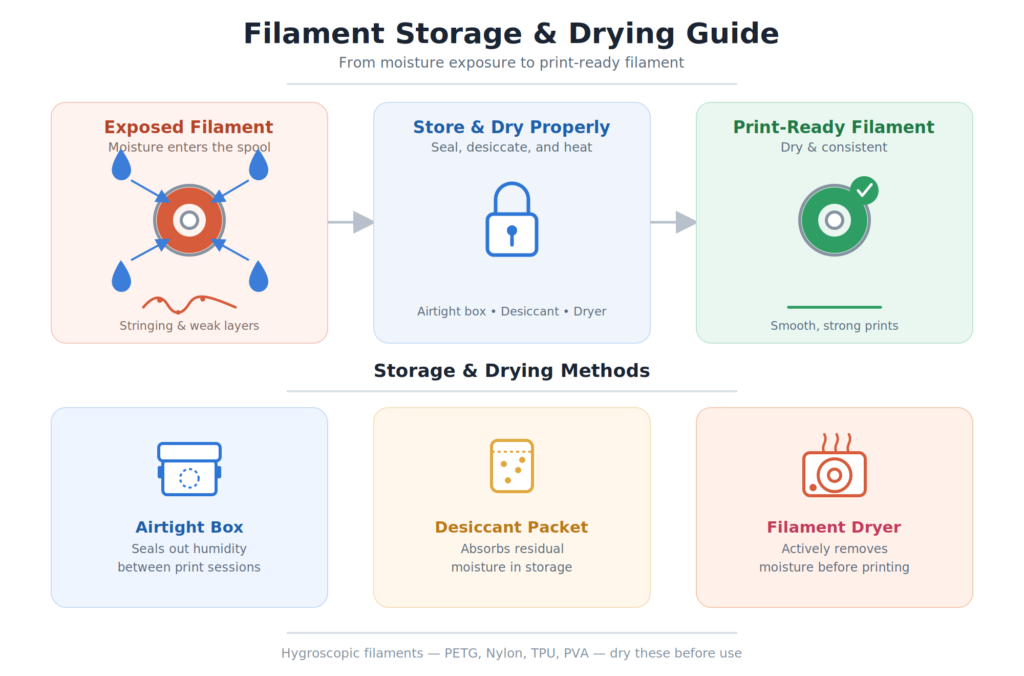
Moisture is one of those problems you don’t think much about until a perfectly good spool suddenly starts producing terrible prints. Hygroscopic materials — nylon and PVA sit at the extreme end, with PETG and even PLA affected to a lesser degree — soak up ambient humidity over time. That trapped moisture turns straight to steam the moment the filament hits a hot nozzle.
Once you’ve seen these problems a few times, the symptoms become surprisingly easy to recognize: audible popping during extrusion, stringing that wasn’t there before, small bubbles on the surface, a rougher finish than usual, and filament that snaps more easily than it did when it was fresh. Storing it in an airtight container with desiccant packs slows moisture absorption between uses, and for especially sensitive materials, an active filament dryer, which applies gentle, sustained heat to drive out absorbed moisture before printing, makes a genuine difference.
Not every one of these 3D printer filament types needs the same level of caution here.PLA is fairly forgiving. Nylon essentially demands proper storage and drying if you want it to print well at all.
Common 3D Printer Filament Problems
Stringing, those thin wisps of plastic connecting separate parts of a print, usually comes down to retraction settings, a nozzle temperature that’s slightly too high, or moisture in a material prone to absorbing it. Warping, where corners lift off the bed as the print cools unevenly, shows up most often with ABS and other high-shrinkage materials, and it’s addressed through better bed adhesion, an enclosure, or reduced cooling.
Poor bed adhesion often traces back to bed temperature, a dirty or improperly prepared surface, or a first-layer height that’s just slightly off. Brittle filament is frequently a moisture problem, especially with nylon or PLA that’s been sitting around a while. Under-extrusion, where layers come out thin and weak-looking, can stem from a partially clogged nozzle, wrong flow settings, or a filament diameter mismatch, while over-extrusion causes the opposite problem, with excess material bulging along edges.
Layer separation, where a print delaminates along a layer line, often points to a nozzle temperature too low for good bonding, not enough cooling time between layers, or a material with naturally weaker interlayer adhesion. Blobs and zits on the surface usually come down to retraction or pressure building up at the nozzle. Clogging itself can result from debris, degraded filament, or a nozzle that’s simply worn out from abrasive material. And heat creep, where filament softens too early inside the hotend’s cooling zone, shows up more with certain flexible or low-viscosity materials and is generally fixed with better cooling around the hotend.
Best 3D Printer Filament for Beginners
PLA earns its default status honestly, for all the reasons already covered: reliable printing, good detail, minimal warping, no enclosure required. That said, “PLA is always the best” oversimplifies things more than it should. A beginner who specifically wants a durable phone case or an outdoor bracket is genuinely better off learning PETG, despite the steeper learning curve, because PLA just isn’t suited to that job regardless of how skilled you get with it.
TPU is approachable enough for a beginner curious about flexible prints, though it demands more patience with print speed and retraction than PLA ever asks for. Specialty filaments like wood, silk, and glow-in-the-dark are generally fine for beginners too, since most print similarly to standard PLA with only minor adjustments, aside from the abrasive ones needing a hardened nozzle.
For a beginner, I don’t think there’s much value in asking which filament is “best” without first asking what you’re actually trying to print. It’s which of the many 3D printer filaments types actually fits the specific project you have in mind right now.
PLA vs PETG vs ABS
These three 3D printer filament types come up constantly as the natural starting comparison, and each one wins on different terms. PLA is the easiest to print, holds detail best, and warps the least, but it’s also the most brittle and least heat-resistant of the three.
PETG splits the difference: tougher and more heat-resistant than PLA, easier to print than ABS, and it doesn’t need an enclosure the way ABS typically does, though it can string more than either alternative. ABS brings strong impact resistance and better heat tolerance than PETG, but it warps more aggressively, generally wants an enclosure and good ventilation, and is less forgiving for someone printing for the first time.
For pure appearance, PLA generally produces the cleanest, most detailed surface of the three. For beginner suitability, PLA wins outright unless the project specifically calls for PETG’s or ABS’s added toughness. And for anything genuinely functional that gets handled often, PETG tends to be the practical middle ground between PLA’s ease and ABS’s durability.
Is 3D Printer Filament Safe?
This deserves an honest, balanced answer rather than a flat yes or no, because it really does depend on the specific material and how it’s being used. Most standard 3D printer filament types, PLA and PETG included, aren’t manufactured or certified for food contact, and that holds true even for filaments marketed as “food safe” in some contexts.
The printing process itself, with its layer lines and the possibility of contamination from a shared nozzle, complicates that claim regardless of what the raw material is. Assuming a printed object is safe to eat off of, or safe for a child to put in their mouth, is a mistake worth avoiding.
Ventilation matters more for some materials than others. ABS and similar filaments release more noticeable fumes while printing than PLA typically does, and following manufacturer guidance on adequate airflow is a reasonable precaution rather than an overreaction.
Handling filament and finished prints is generally low-risk for adults, but small parts, sharp edges left over from supports or rough layers, and unsupervised access for young children are worth thinking through the same way you would with any small handmade object. None of this is a medical claim about any specific outcome. It’s just practical caution based on how these materials are actually made and used.
Does More Expensive Filament Mean Better Filament?
Not automatically, but there’s usually a real reason behind the price gap. Pricier 3D printer filament types often reflect tighter diameter tolerance, more consistent color and quality from batch to batch, and sometimes a genuinely different formulation with added strength or specific properties baked in. Specialty additives, whether that’s carbon fiber, metal particles, or an engineering-grade base plastic, also cost more to produce, and that shows up in the price no matter which brand you’re buying from.
That said, a higher price tag doesn’t guarantee a better experience for every single project. A budget PLA spool might be entirely adequate for a decorative print, while a premium specialty filament would be complete overkill for that same job. Price alone isn’t a very useful way to judge a spool. It’s whether its actual properties match what the project actually needs. Consistency matters more for functional parts and difficult materials, while a lower-cost option is often perfectly reasonable for something casual.
Where to Buy Filament: What to Check
Rather than chasing a specific brand name, it’s more useful to know what to actually check before buying any of these 3D printer filament types. Confirm the material fits your project’s needs and that your printer can handle it.
Check that the listed diameter matches your printer’s requirement, and look for a stated diameter tolerance where it’s available, since tighter tolerance generally means more consistent extrusion. Note the spool size too, since larger spools reduce cost per unit but represent a bigger commitment if you’re just testing out a new material.
Look for the manufacturer’s recommended temperature range as a practical starting point for your slicer settings. Check whether the filament ships in moisture-protected packaging, particularly for hygroscopic materials like nylon or PVA. Color consistency between batches matters more for bigger projects using multiple spools of the same color.
And for anything abrasive, whether that’s carbon fiber, glass fiber, or metal-filled, confirm your nozzle can actually handle it before buying, since a hardened nozzle purchase might genuinely be part of the real cost of that filament choice. If you’re still weighing your first printer purchase, it’s worth reading a 3D printer buying guide before settling on a machine that ends up limiting which filament types you can use down the road.
| Product | Type | Best For | Key Feature | Buy |
|---|---|---|---|---|
| PLA Filament | PLA | Beginners & Models | Easy printing | Check Price |
| PETG Filament | PETG | Functional Parts | Tough & durable | Check Price |
| TPU Filament | TPU | Flexible Parts | Flexible & impact-resistant | Check Price |
| ASA Filament | ASA | Outdoor Parts | UV resistant | Check Price |
| Hardened Steel Nozzle | Accessory | Abrasive Filaments | Wear resistant | Check Price |
| Filament Dryer | Accessory | Nylon/PETG/PVA | Moisture control | Check Price |
Affiliate Disclosure: This post contains affiliate links. If you purchase a product through these links, we may earn a small commission at no extra cost to you. Our recommendations are based on product relevance and usefulness to readers.
Frequently Asked Questions
What are the main types of 3D printer filament?
The most common 3D printer filament types and uses are PLA, PETG, ABS, ASA, TPU, nylon, polycarbonate, PVA, and HIPS, plus a range of specialty blends like carbon fiber and wood-filled filament built on those base materials.
What is the best filament for beginners?
PLA is the most forgiving starting point for most projects, though a beginner specifically needing durability or flexibility may be better served learning PETG or TPU despite the added learning curve.
What is the strongest 3D printer filament?
Among common materials, polycarbonate and nylon generally offer the highest strength and toughness, though “strongest” really depends on whether you mean impact resistance, tensile strength, or abrasion resistance specifically.
What is the difference between PLA and PETG?
PLA prints more easily and holds finer detail but is more brittle and less heat-resistant. PETG is tougher and more heat-resistant but strings more easily and is more moisture-sensitive.
Is ABS better than PLA?
Not universally. ABS offers more heat resistance and impact strength, but it warps more, needs better ventilation, and is generally harder to print well than PLA.
What filament is best for outdoor 3D prints?
ASA is generally the strongest choice for prolonged outdoor exposure thanks to its UV resistance, with PETG as a reasonable shorter-term alternative.
What filament is best for flexible parts?
TPU is the standard choice for anything that needs to bend, compress, or grip, since rigid filaments simply can’t replicate that kind of behavior.
What filament is best for high-temperature applications?
Polycarbonate and certain nylon blends handle heat better than standard PLA, PETG, or even ABS, though they require higher printing temperatures and often an enclosure.
Does 3D printer filament need to be dried?
Some materials need it far more than others. Nylon and PVA are highly moisture-sensitive and often require drying before use, while PLA is comparatively forgiving, though not entirely immune to moisture issues over time.
What nozzle should be used for carbon fiber filament?
A hardened steel nozzle is generally recommended, since the carbon fiber content wears down standard brass nozzles considerably faster than unfilled plastic.
How many 3D printer filament types are there?
There’s no single fixed number, since specialty blends keep expanding the list, but the core materials — PLA, PETG, ABS, ASA, TPU, nylon, polycarbonate, PVA, and HIPS — cover the vast majority of real-world projects.
You Might Also Like
- 3D Printing Innovations: What’s Actually Changing and Why It Matters
- How to Calibrate a 3D Printer: A Practical, No-Nonsense Guide
- Metal 3D Printer: A Practical Guide to How They Work, What They Cost, and Whether You Actually Need One
- Things to 3D Print: A Practical Guide to Useful, Fun, and Worthwhile Projects
- Creality Ender 3 V3: A Practical Look at Features, Specs, and Whether It’s Right for You
- 31 Best 3D Printed Fidget Toys & Fun Toys to Make
- 111 Best 3D Printed Animals to Make: Easy, Articulated & Fun Ideas
Conclusion
After looking at all these materials, the biggest takeaway is pretty simple: there isn’t one filament that wins at everything. It’s about matching what a filament actually does well to what your project actually needs. PLA remains the sensible default for detailed, low-stress prints. PETG steps in once durability starts to matter more than ease of printing. ABS and ASA handle heat and outdoor exposure differently enough that the choice between them usually just comes down to sunlight. TPU exists for anything that needs to flex, and nylon or polycarbonate cover the demanding end of functional, mechanical parts.
None of that works particularly well without paying attention to the practical side too: correct settings for the specific material, a nozzle that can actually handle abrasive blends, and proper storage or drying for anything moisture-sensitive. Skip any of that and it tends to show up as a frustrating print rather than an obviously identifiable filament problem, which is exactly why so many print failures end up blamed on the printer when the real mismatch was upstream the whole time. Once you understand why different plastics behave differently, choosing filament stops feeling like guesswork—and that’s probably the most useful thing to take away from all of this.