

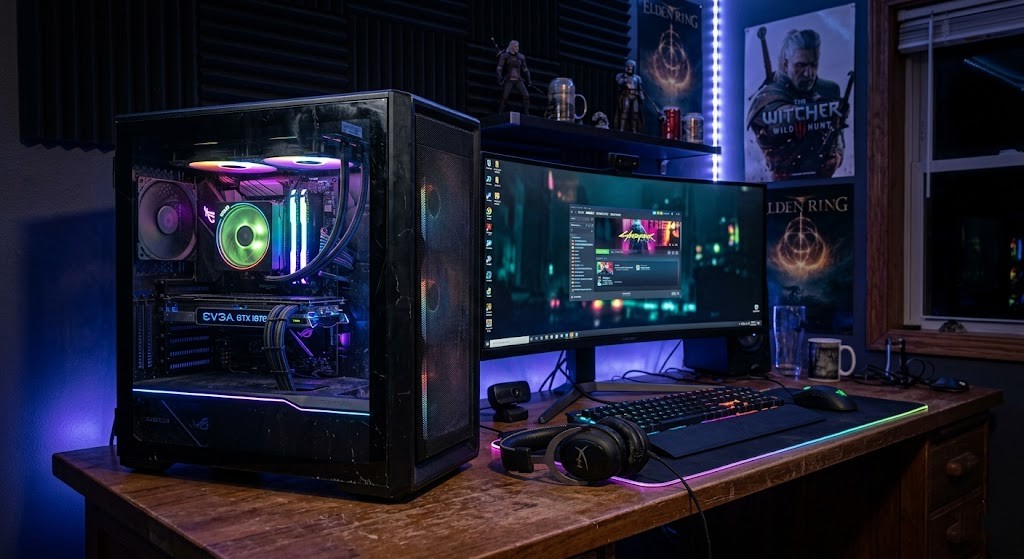
 By
By My old PC died mid-Warzone match. Ranked game. Teammates who were actually competent for once — which happens maybe twice a month — and then black screen. Not the game. The whole machine. Motherboard gone. Repair quote came back at nearly the cost of something new, which felt like a personal insult honestly.
I didn’t have budget for a new build. Not even close. Was looking at iBUYPOWER and CyberPowerPC pre-builds but the decent ones were $900 to $1,100 and I just couldn’t do it. Then my friend — the guy who buys weird tech stuff and somehow it always works out, you probably know someone like this — mentioned he’d been running a refurbished gaming PC for a year with zero problems.
I was skeptical. Openly skeptical. Told him it sounded like a bad idea.
Then I spent two weeks researching it at 1am like some kind of insomniac. Reddit threads, YouTube unboxings, forum posts from people who’d been burned and people who hadn’t. The honest vibe I got: it’s a calculated risk. Some people have horror stories. Some have nothing but good things to say. Most land somewhere in the middle.
I landed in the middle. Which is probably the most useful thing I can tell you going into this.
Found a seller on eBay — not some random guy, an actual business that specifically refurbishes machines, 4.9 stars, 2,300+ reviews, clear listing. i7-9700K, 16GB DDR4, RTX 2070. $480. Felt almost too good. I sat on it for two days before clicking purchase, refreshing the page like that would tell me something useful.
What Happened When It Arrived
Five days shipping. Double-boxed, which I appreciated because I’d read about people getting refurbished gaming PC orders wrapped in basically bubble wrap and hope. Tower looked okay. Few small scratches on the side panel, one loose front USB port that annoyed me more than it probably should have.
First mistake — and I’m embarrassed about this because I’d literally read not to do it — I just plugged it in and booted without checking if it had been properly wiped. It hadn’t. Windows loaded fine but there were leftover files from the previous owner. Guy named Dave apparently. His desktop wallpaper was still there. His folders. Nothing malicious, just… weird. Felt like walking into someone’s house when they’d just left in a hurry.
I reinstalled Windows myself. Knew how to do it, wasn’t a disaster, but it added a couple hours I hadn’t planned for. If you’re not comfortable with OS reinstalls, just know going in that you might need to do this. Do it immediately before anything else. Don’t skip it the way I did.
After the clean install I ran CPU-Z and GPU-Z to verify what was actually inside matched the listing. This part made me nervous — I’d read Reddit threads where people opened their refurbished gaming PC and found a different GPU than advertised. Half expected a GTX 1080 hiding in there. But no. Genuine RTX 2070. Small wave of relief.
Loaded Cyberpunk 2077 first because I wanted to actually stress it. High settings, 1080p. 60 to 75fps, small dips to 55 in heavy scenes. For $480 I sat there kind of stunned. Then I loaded Deep Rock Galactic and Hades — games I actually play regularly — and those ran at 120fps plus without any effort. The machine just handled them like it was bored.
The Three Weeks That Almost Made Me Regret Everything
Here’s the part of this story that usually gets skipped because it’s not dramatic enough to be a disaster and not clean enough to be a success story. But it’s the most honest part.
Three weeks in, random restarts started happening. No blue screen. No error. Just — gone, back at login screen. Twice a week at first. Then more often.
I started spiraling a little. Late night rabbit holes reading about refurbished gaming PC failures. Convincing myself I’d made a mistake. Almost just accepted the loss and decided to flip it.
But I kept at it. Turns out it was the power supply — not failing completely, but one of those no-name units some sellers throw in to cut costs. Wasn’t holding stable voltage under load. Only figured it out by running HWMonitor during a gaming session and watching the voltage rails jump around more than they should. Replaced it with a Corsair RM650x, another $90.
That stung. And this is what I’d want anyone considering a refurbished gaming PC to actually understand — the sticker price isn’t always the final price. Sometimes it is. My friend who recommended this route didn’t have to replace anything. I did. It’s genuinely unpredictable and I’d be lying if I said otherwise.
After the PSU swap, zero issues. But those three weeks were frustrating in a way I don’t want to sugarcoat.
Best Upgrades for a Refurbished Gaming PC
Disclosure: This article may contain affiliate links. If you buy through these links, I may earn a small commission at no extra cost to you.
| Component Upgrade | Recommended Product | Why It Helps | CTA |
|---|---|---|---|
| Power Supply | Corsair RM750x | Stable power delivery for gaming PCs | Check Price |
| Thermal Paste | Thermal Grizzly Kryonaut | Lower CPU temperatures | View on Amazon |
| RAM Upgrade | Corsair Vengeance DDR4 16GB Kit | Enables dual-channel performance | Buy Now |
| SSD Upgrade | Samsung 990 EVO NVMe SSD | Faster loading times and Windows boot | See Details |
| Air Cooler | Thermalright Peerless Assassin 120 SE CPU Cooler | Better cooling for older CPUs | Check Availability |
| Surge Protector | Anker Power Strip with 2100J Surge Protector, Outlet Extender, 20W, 12 AC | Protects refurbished PCs from power issues | View Deal |
Two More Things I Caught Late
Second mistake — more embarrassing than the first — I didn’t check how the RAM was configured. 16GB like the listing said, but running in single channel. One 16GB stick instead of two 8GB sticks. Dual channel makes a real difference especially with the 9700K. I didn’t catch it for almost a month because it honestly didn’t occur to me to check.
Bought a matched 8GB stick for $20 and fixed it but I felt like an idiot for missing it. When your refurbished gaming PC arrives, open the case and check your RAM slots before you assume everything is set up correctly. Takes two minutes.
Third thing — thermal paste looked original. As in, possibly applied when the machine was first built years ago. Re-pasted with Thermal Grizzly Kryonaut and CPU temps dropped about 8 degrees under load. Not urgent but worth doing, especially on an older CPU that’s been sitting in a warehouse somewhere.
So. Three fixes on top of the $480. Total came to around $600. Still significantly less than a comparable new build. But worth knowing before you go in expecting to spend exactly what the listing says.
Six Months Later — Honest Verdict
I play two or three hours most evenings. Sometimes more on weekends. Elden Ring, Baldur’s Gate 3, a lot of multiplayer stuff. The refurbished gaming PC handles all of it without complaint.
RTX 2070 is genuinely still a solid card for 1080p in 2026 — I didn’t expect that going in, thought it might feel dated, but it’s kept up with nearly everything I’ve thrown at it. The 9700K shows its age slightly in CPU-heavy newer titles but nothing unplayable. Nothing that’s made me wish I’d spent more.
Temps are fine — CPU idles around 38C, hits about 68C under gaming load after the thermal paste job. GPU runs around 72-75C in long sessions which is completely normal for this card. No throttling, no thermal shutdowns, nothing concerning.
Honestly the weirdest part is how unremarkable it’s become. After those first few weeks of troubleshooting, it just became my computer. I don’t think about it being refurbished anymore. I don’t check HWMonitor obsessively the way I did in month one. It boots, runs games, doesn’t complain. That’s all I wanted.
Was the refurbished gaming PC worth it? Yes — but with an honest asterisk. I knew enough to diagnose what went wrong. If you’re not comfortable opening a case or running basic diagnostics, the risk looks different. Doesn’t mean don’t do it — just means buy from somewhere with a real warranty. Back Market, certified refurbishers, not full eBay detective mode like I did.
I got lucky in some ways. GPU was legitimate, CPU wasn’t damaged, no hidden motherboard problems. The issues I hit were fixable. A dead GPU or cracked board would’ve been a completely different story and I know it.
Comparing It to Building From Used Parts
I looked at this option seriously before I bought. Sourcing everything individually from Facebook Marketplace and eBay might’ve saved me $50 to $80, but I’d have been testing each component separately and hoping nothing had hidden damage. A GPU from some random seller could have been a mining card running hot for two years. A CPU could have bent pins. At least with a refurbished gaming PC from an established seller, someone else has already done basic testing and stands behind the listing enough to accept returns.
The refurbished complete unit saved real time even accounting for the troubleshooting I ended up doing. Different trade-off, not a clear winner either way — depends how much your time is worth and how comfortable you are diagnosing individual components from scratch.
If I had to pick again with the same budget and same knowledge level, I’d still go the refurbished route. But I’d buy from Back Market or a certified refurbisher with at least a 90-day warranty rather than playing eBay seller roulette like I did. The extra peace of mind is worth a few extra dollars on the listing price.
One more thing worth saying: the refurbished gaming PC market has gotten better over the last couple of years. More legitimate businesses doing this properly, better listings, actual quality control. It’s not the wild west it used to be — though you still have to be careful and read the seller’s feedback history before you commit.
Questions I Keep Getting Asked
Is a refurbished gaming PC actually reliable or is it just going to die? Depends entirely on the seller. Mine’s been solid for six months after the PSU situation. Buy from somewhere with at least a 90-day warranty. Avoid zero-return-policy listings — that’s usually not a good sign and there’s no reason a legitimate seller wouldn’t offer returns.
Is the RTX 2070 still worth it in 2026? For 1080p, genuinely yes. Keeps up with almost everything on high settings. If you’re aiming for 1440p, look for something with a 3060 or 3070 instead. I was surprised how well it’s held up — that part I didn’t expect.
What’s the first thing to do when a refurbished gaming PC arrives? Reinstall Windows before you do anything else. Don’t be me. Don’t boot into someone else’s desktop files. Fresh install, then verify your components with CPU-Z and GPU-Z, then check your RAM configuration. Do all of that before you even think about launching a game.
Would you do it again? Probably. Next time I’d buy from a seller with a longer warranty and go in mentally budgeting an extra $100 to $150 for whatever small thing might need fixing. Expecting perfection from a refurbished gaming PC is where people get disappointed. Expecting a solid machine that might need a little attention — that’s the right mindset going in.
Still Running Fine
If you asked me today whether buying a refurbished gaming PC was the right call, my answer is the same as it was at month one — yes, with eyes open. The machine is sitting on my desk right now. Six months of evenings and weekends, zero issues since the PSU swap.
I’ve recommended this route to two people since I bought mine. One went for it — bought from Back Market, had zero issues, loves it. The other got nervous reading about the horror stories and bought a new mid-range build instead. Both made the right call for who they are. The refurbished gaming PC path isn’t for everyone, and I’d rather be honest about that than oversell it.
What I’ll say is this: if you’re reasonably comfortable with basic PC stuff — opening a case, reinstalling Windows, checking component specs — the risk is manageable and the value is real. If you’ve never touched a PC before and the idea of diagnosing a random restart fills you with dread, either buy from somewhere with a long warranty and good support, or just build new.
That’s kind of all that matters when you’re buying a refurbished gaming PC on a tight budget. Not whether it’s perfect. Whether it runs, whether it keeps running, and whether what you paid made sense. Mine checks all three after six months.
If you’re on the fence — I get it. The uncertainty is real and I felt it too. But for what I paid versus what I ended up with, it’s hard to feel bad about it. Even the frustrating weeks taught me things about PC hardware I didn’t know before, which was its own kind of payoff.
Go in with eyes open, buy from somewhere reputable, and budget mentally for one small fix. Do that and you’ll probably be fine.
You Might Also Like
- Gaming PC Under $600: Honest 6-Month Review & Build Guide
- How to Optimize Gaming PC for Ray Tracing Without Killing FPS (2026)
- White Gaming PC Review: The Beautiful Mistake I Don’t Regret (2026)
- Best Power Supply for Gaming PC: The Expensive Mistake That Saved My Build (2026)
- Home Automation Switches for Beginners (Honest 2026 Guide)
- Savant Home Automation Review: My Shocking Real Experience After 2 Months