

 By
By I bought my first one on impulse. That’s the honest version.
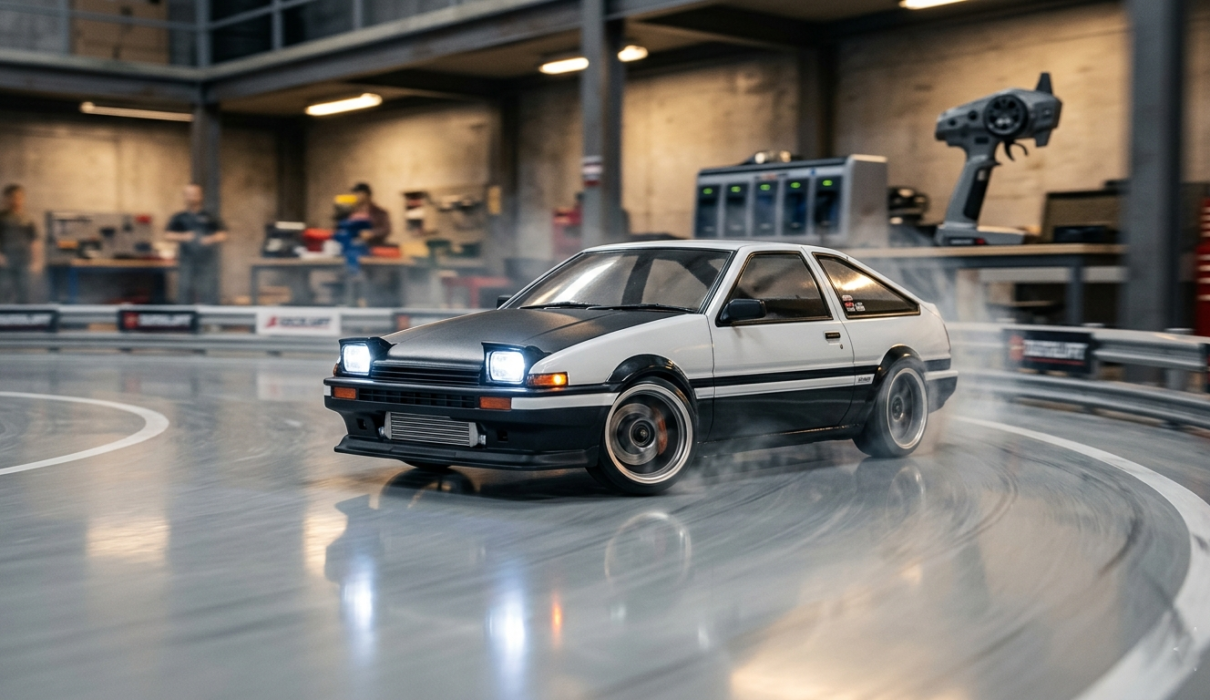
I was at a hobby shop picking up some servo wire and there was a little Toyota AE86 shell sitting on a display shelf — all white, Trueno headlights — and somebody had set up a tiny loop of smooth tile near the register for demos. The guy behind the counter flicked a transmitter and the thing just slid. Perfectly. A controlled, lazy arc around the loop, rear end stepping out like it knew what it was doing.
I had it in my hands thirty seconds later. Paid too much. Didn’t care.
That was three years ago. Since then I’ve gone through a handful of different mini RC drift cars, stripped more tiny grub screws than I want to admit, argued with people on forums at 11pm about gyro gain settings, and gradually figured out what actually matters when you’re trying to get one of these things to behave properly. Some of it I figured out fast. A lot of it took embarrassingly long.
This isn’t a buyer’s guide. This is just me writing down what I’ve actually learned, what I got wrong, and what I think is genuinely worth paying attention to if you’re getting into this hobby or trying to take it more seriously.
Why This Hobby Is More Interesting Than It Sounds
Look, I know “RC drifting” sounds niche. It is. But here’s what I didn’t expect: the skill transfer.
I drive full-scale cars and take them to occasional track days. Spending time getting mini RC drift cars to do consistent, linked transitions taught me something about throttle modulation and car balance that reading articles never did. Feeling a rear end break loose in your hands — even at tiny scale — starts to rewire your instincts. That surprised me. I wasn’t expecting a toy to teach me anything real.
The community is also genuinely interesting. Less gatekeeping than some other hobby spaces. People post setups, argue about gyro settings, share DIY solutions for body mounts. It’s messy and specific and I enjoy it.
Scale Is Not What You Think It Is
The first mistake I made — and I’ve seen this catch a lot of people — was treating the scale like a novelty instead of a design constraint.
Mini RC drift cars in the 1:28 or 1:24 range are not just small versions of bigger RC cars. The physics don’t scale perfectly. Rotational inertia, traction, weight transfer — everything feels compressed and quick. Way quicker than I expected.
My first instinct was to set up the car the way I’d seen people set up 1:10 touring cars. That was wrong. Badly wrong. The gyro gain I started with made the car twitch and snap rather than flow. I kept thinking the car was defective. Spent a full weekend assuming there was a hardware issue. There wasn’t. I just needed to back the gain off and learn to be smoother with my inputs.
The key thing with mini RC drift cars at smaller scales: forgiveness shrinks with the car. Any jerkiness in your thumbs gets amplified. If you’re coming from larger RC cars or gaming, you probably need to consciously slow your hands down before anything starts to feel right.
The Gyro — What It Does and How I Got It Wrong Twice
Gyros are small sensors on the steering channel that help counteract unwanted yaw during a drift. They make the car easier to control by automatically correcting small deviations. In theory. In practice, the gain setting is something you’ll mess with constantly.
Too high and the car becomes nervous — it fights corrections before they’re fully applied, which produces that snatchy, unpredictable behavior I just described. Too low and you’re trying to catch every slide manually at high speed, which is incredibly difficult. There’s a window in the middle where the car just starts to flow, and finding that window is more feel than science.
Here’s the thing I didn’t realize for the longest time: gyro response changes with the surface. The gain that worked perfectly on the smooth laminate in my living room was completely wrong on the concrete in my garage. Same car, same settings, different surface, completely different behavior. I kept blaming my inputs for weeks. It was the surface.
Some mini RC drift cars have adjustable gyro gain on the transmitter. Others have a physical dial on the car. A few have both. Get a car where you can adjust without pulling it apart — because you will be adjusting constantly at first.
Surface — The Question Nobody Asks First
Everyone talks about what car to buy. Almost nobody asks what surface they’re going to run on. I didn’t. Huge oversight.
Mini RC drift cars run on hard, slick tires — ABS plastic rings, polished rubber, sometimes PTFE-coated — because those create the low-traction slide that makes drifting possible. On smooth surfaces like tile, sealed concrete, or polished wood, they work beautifully. On carpet? Disaster.
I tried running mine on low-pile carpet once because it was convenient and I was impatient. The car barely moved. The pile grabbed the tires and killed all momentum. Embarrassing session. Total waste of an afternoon.
The practical reality: you need a smooth, clean surface. A lot of people buy a roll of smooth vinyl flooring from a hardware store and tape it down as a drift mat. Portable, consistent, rolls up for storage. I eventually did this and it changed how much I was actually able to use the car.
Surfaces that work well:
- Sealed garage concrete — as long as it’s clean, dust kills traction predictability
- Smooth tile or laminate flooring
- Vinyl sheet flooring — the portable solution
- Smooth hardwood floors — ask permission from whoever else lives in your house first
Before you buy mini RC drift cars, figure out where you’re actually going to run them. This question matters more than most people realize before they run into the problem.
Recommended Gear
Disclosure: This article may contain affiliate links. If you buy through these links, I may earn a small commission at no extra cost to you.
| Product / Tool | What It’s Used For | Best For | Where to Buy |
|---|---|---|---|
| LiPo Charger | Safely charging RC batteries and keeping battery health stable | Battery maintenance | Best prices on Amazon |
| LiPo Batteries | Powering mini RC drift cars for longer sessions | Extended drifting time | Check latest deals on Amazon |
| RC Gyro | Helping stabilize steering during drifts | Better drift control | Available on Amazon |
| RC Transmitter | Controlling throttle and steering inputs | Smooth driving experience | View on Amazon |
| RC Drift Tires | Creating consistent low-traction slides | Drift performance | Buy on Amazon |
| Precision Screwdriver Set | Adjusting tiny screws and car components | RC maintenance | Best seller on Amazon |
| Vinyl Drift Mat | Creating a smooth portable drift surface indoors | Home drift setups | Check price on Amazon |
| Painter’s Tape | Marking drift layouts and securing mats | DIY drift tracks | Available on Amazon |
| Phone Mount | Recording drifting footage from creative angles | Content creation | Shop on Amazon |
| Action Camera | Capturing FPV-style drift videos | Cinematic RC footage | Latest price on Amazon |
| Dremel Rotary Tool | Cutting and modifying RC body shells | Custom RC builds | Buy from Amazon |
Setup and Tuning — The Part That Took Me Longest
I resisted the tuning rabbit hole for a while. I wanted to just drive. That was naive.
Mini RC drift cars are usually set up from the factory to be accessible — not to perform at their best. Weight distribution might be off. Ride height often too high. The gyro gain is a starting point, not a finish line.
Change one thing at a time. Obvious advice I kept ignoring. I’d adjust the gyro and the steering endpoint and the throttle curve all in one session, then not know what had fixed or caused a problem. Spent way too long in that loop.
Things worth adjusting, in rough order of impact:
Gyro gain — the biggest single variable for how controllable a mini RC drift car feels. Start lower than you think.
Steering throw and dual-rate — reducing this calms the steering down considerably. My car went from twitchy to manageable with one adjustment here.
Throttle expo or curve — softening initial throttle response helps enormously on low-traction surfaces. Smooth inputs, smooth slides.
Ride height — lower is usually better for stability, but too low and you ground out on transitions.
Weight distribution — small amounts of weight added toward the front can stabilize drift angle. I use small metal weights from a fishing tackle kit. Costs pennies.
One thing I was wrong about: I assumed stock motor pinion gearing was fine. Regeared one of my mini RC drift cars after reading a forum post — dropped top speed slightly, got more torque in the low end — and the car immediately became easier to initiate slides with. Significant improvement for maybe 15 minutes of work.
Buying Your First One — What I’d Tell a Friend
The market for mini RC drift cars has filled in a lot over the last few years. There are genuinely good options in the $40-$80 range now — things that perform well out of the box and have a platform worth tuning and upgrading. A few years ago that wasn’t really the case.
My honest recommendation: don’t go too cheap, but don’t go expensive either. The $25 stuff from random online sellers usually isn’t worth the frustration. Weak motors, flaky electronics, impossible to find replacement parts. Spend a bit more and get something from a brand that actually supports the product.
That said — more expensive doesn’t mean more beginner-friendly. I bought something in the upper price range early on, got frustrated that I still had to tune it, and felt a bit cheated. Dumb. Higher-end options are often more sensitive to inputs and harder to learn on. Counterintuitive but true.
Look for:
- Adjustable gyro gain on the transmitter or car body
- A downloadable manual that actually makes sense
- Available spare parts — at minimum, replacement tires
- A community or forum around the specific car or brand
Mid-range with good parts availability beats high-end mystery brand every time when you’re starting with mini RC drift cars.
Mistakes I Made — Being Direct About It
Running on the wrong surface and blaming the car. Done it multiple times. The car is usually fine. The surface is wrong.
Ignoring battery health. Mini RC drift cars pull real current and small LiPo cells degrade faster than you’d expect if you overcharge, undercharge, or store them at full charge. I killed two packs early on by storing them charged for weeks. Gets expensive fast.
Maxing gyro gain because the car feels unstable. It feels unstable because the gain is too high. Lower it first. Counterintuitive but consistently true.
Trying complex linked transitions before the basics are down. I wasted weeks trying to nail figure-eight linked drifts before I could hold a consistent angle in a single direction. The basics are boring to practice. Do them anyway. Thousands of runs before it looks effortless — that’s what you’re watching when you see those clean online videos.
Not cleaning the tires. Drift tires pick up dust and debris. Dirty tires behave inconsistently in ways that feel like the car is broken. Ten seconds with a damp cloth after each session prevents a lot of confusion.
Assuming every problem is a hardware problem. I once spent actual money on replacement electronics when the issue was entirely my inputs. Sat there replacing a perfectly good ESC and wondering why the new one had the same problem. Embarrassing in retrospect, useful lesson at the time.
Questions I Actually Get Asked
Is it hard to learn? Yes and no. Initiating a slide is usually easy — flick the steering, apply throttle, the car slides. Getting it to slide at a controlled angle and then link that into another direction — that’s the hard part. Took me about two months of regular practice before I felt genuinely in control rather than just getting lucky.
Do you need a specific surface? Yes. Smooth and hard. Tile, sealed concrete, hardwood, vinyl sheet flooring. Not carpet, not rough pavement, not anything with dust. Mini RC drift cars depend on predictable, low-friction surfaces to slide properly.
How expensive does this get? Variable. It can be very cheap if you buy once and just drive. It gets expensive fast if you start buying bodies, multiple cars, upgraded motors, better transmitters. My “casual” spend has been maybe $400 over three years, but I know people who’ve spent that in a single month once they got serious about building.
Are mini RC drift cars good for kids? Depends on the kid. A patient kid interested in figuring things out? Probably yes, at around 10 or older. A kid who wants to bash things around? Probably not — these aren’t designed for roughhousing and small components don’t take impacts well. The skill curve is real and requires patience.
Three Years In — What I’d Tell Myself at the Start
Give yourself permission to be bad at it for longer than feels comfortable.
I kept expecting to pick it up quickly because I’d driven RC cars before, understood the theory of oversteer, played driving sims. None of that mattered much in the first month. The inputs are small, the car is fast, and your hands will do the wrong thing repeatedly before they start doing the right thing automatically.
The mini RC drift car itself is almost incidental. It’s a vehicle — no pun intended — for developing a specific set of reflexes. Once you have those reflexes, you can make a lot of different cars work. Before you have them, even a really good car will feel frustrating.
Start on a smooth surface. Set the gyro lower than you think you need. Drive slowly before you drive fast.
Those three things would have saved me several weeks of being confused and annoyed. I figured them out eventually. Earlier would have been better.
You Might Also Like
- Best AI Tools for Teachers in 2026 (Actually Useful in Real Classrooms)
- Best AI Avatar Tools for Multilingual Voiceovers (Real Review 2026)
- Affordable AI Recruiting Tools for Small Teams (Honest Review 2026)
- Beginner’s Guide to Mini RC Drift Cars (Real Experience After 3 Years)
- Home Automation Switches for Beginners (Honest 2026 Guide)