

 By
By My name is Jigar and I am the founder of JigTechHub. I usually write articles on topics like technology, tools and finance. Discovering new technologies, learning about gadgets and researching financial topics all this is part of my job. But gardening is not just a subject for me, it is my personal hobby.
I love spending time with nature. The world of bonsai in particular attracts me a lot. Taking care of a small plant for years and giving it a beautiful shape there is a different kind of peace in this process.
When I got my first bonsai, I made the same mistake as many people. I thought that bonsai meant indoor plants. But in a short time, I realized that each species has its own needs. I learned a lot from that experience.
In this article, I am not just providing information, but also sharing my own experience and lessons learned so that if you are thinking of getting a Juniper bonsai, you can start more wisely.
If you are interested in bonsai and wondering where to start, a common question comes to mind is Juniper a good tree for bonsai? If you ask any experienced bonsai grower, most of them will tell you the same thing, Juniper is an excellent choice for bonsai. But there are many reasons behind this “yes.” To understand this better, it helps to look at why Juniper is so popular, how to properly care for it, and whether it’s really right for you.
What are the characteristics of Juniper bonsai?
Juniper stays green throughout the year, which already makes it attractive for bonsai it remains green all year round. Its leaves are scaly or scale-like, which gives a natural and ancient look to bonsai. When pruned and shaped properly, it can look like an old tree despite being a small tree.
One of the biggest reasons people trust Juniper is its toughness. It can withstand cold, heat, and general weather changes. Therefore, it is also suitable for new learners. Many people start bonsai with Juniper because it is easy to care for and forgiving.
Is Juniper suitable for beginners?
Bonsai is not an art that can be learned in a day. It requires patience, observation, and regular care. It is natural to make some mistakes in the beginning, such as how much water to give, how to prune, and how much sunlight is needed. Juniper can tolerate these mistakes to a great extent.
Juniper is a safe choice for beginners because its growth is moderate. It grows neither too fast nor too slow. So, you can gradually shape its branches. Even if a small mistake is made, it can recover quickly.
Can Juniper be kept indoors or not?
A lot of beginners misunderstand this part. Many people believe that bonsai is an indoor plant. In fact, Juniper is originally an outdoor tree. It needs natural air, sunlight and seasonal changes.
If Juniper is kept indoors for a long time, it may weaken. Its leaves may start to turn brown and growth may stop. It is better to keep it in a balcony, terrace or garden. It grows well if it gets at least four to six hours of sunlight a day.
It can be kept indoors only for occasional display, but its permanent place should be outdoors.
How to take proper care of Juniper bonsai?
Juniper care is easy, but it needs to be regular. First of all, it is important to understand about water. Juniper does not like constantly wet soil. Water should be given when the top part of the soil feels a little dry. If the soil does not have proper drainage and remains waterlogged, the roots can rot.
Sunlight is very important for Juniper. Without sunlight, its energy production decreases. As a result, it becomes weak. So, keep it in a place where it gets enough light.
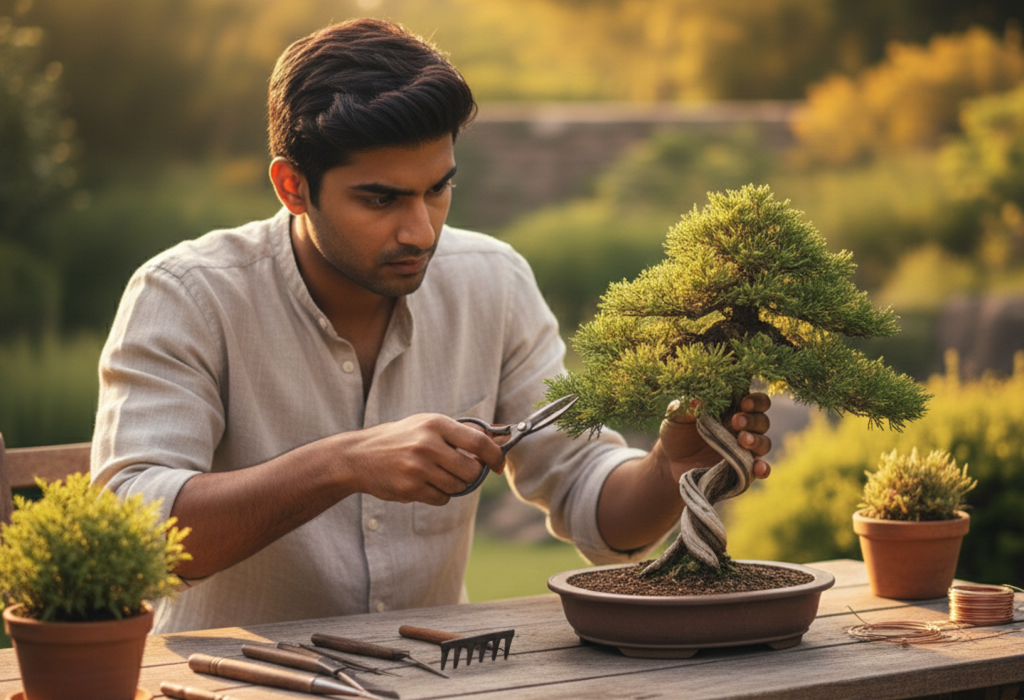
Pruning is the soul of bonsai. Juniper can be shaped by gently trimming when new shoots appear. Avoid pruning too much at once, as it can stress the tree. Regular and gentle trimming is better.
Juniper can be shaped into various styles through wiring. Its branches are flexible, so it can be given the desired shape by gradually bending it. But while wiring, be careful not to tie the wire too tightly, otherwise it may leave marks on the branch.
The soil should be well-draining. Ordinary garden soil is not suitable for bonsai. Special bonsai mix soil is better. Fertilizer should be given lightly once a month, especially during the growing season.
Popular types of juniper tree
Juniperus procumbens
Origin: Japan
Growth Habit: Low-growing, spreading shrub
Special Features:
- Naturally creeping nature makes it ideal for cascade (Kengai) and semi-cascade styles.
- Needle-like foliage, which is sharp and dense in the juvenile stage.
- Compact internodes give great proportions in small bonsai pots.
- Ideal for beginners tolerates hard pruning and wiring well.
Care Tips:
- Prefers full sun.
- Avoid overwatering soil should be well-draining.
- Regular pinching makes foliage dense.
This variety is especially popular for traditional Japanese bonsai training.
- Japanese Juniper Bonsai Tree – 4″ Pot – Juniperus procumbens – Nana
- Perfect Plants Blue Pacific Juniper Shrub 1 Gallon | Real Live Outdoor Plant | Exotic Groundcover Perennial | Evergreen Foliage All Year Long
Juniperus chinensis (Chinese Juniper)
Origin: China, Japan, Mongolia
Growth Habit: Upright or spreading, depending on variety
Special Features:
- Very versatile species can be used in many styles including informal upright (Moyogi), slanting (Shakan), cascade.
- Juvenile and mature foliage are distinct (needle and scale-type leaves).
- Excellent for deadwood techniques (jin and shari) bark texture is beautiful.
Popular Cultivars:
- ‘Shimpaku’ (very popular for bonsai)
- ‘Itoigawa’ (known for fine foliage)
Care Tips:
- Bright sunlight required.
- Strong root system repotting every 2–3 years.
- Can be left wired for styling for a long time, but avoid bark damage.
A highly preferred species for advanced bonsai artists.
Juniperus squamata (Blue Juniper)
Origin: Himalayas India, China
Growth Habit: Spreading shrub
Special Features:
- Blue-silver foliage is its most distinctive feature.
- The ‘Blue Star’ cultivar is very popular.
- Used in display bonsai for dramatic color contrast.
Care Tips:
- Colors become more vibrant in full sun.
- Excess humidity can cause fungal issues.
- Regular thinning required foliage becomes dense very quickly.
This species is very attractive for visual impact
Juniper bonsai – Detailed Pros and Cons
Juniper bonsai is one of the most popular bonsai species in the world. It is considered a reliable option, especially for beginners and outdoor bonsai lovers. Below are its Pros and Cons explained in detail.
Pros
1️. Long Lifespan
- Juniper can live a very long-time decades with proper care.
- Over time, its trunk becomes thicker and more characterful.
- Can also be kept as a generational bonsai.
2️. Excellent choice for beginners
- Very forgiving plant.
- Can tolerate some care mistakes.
- Builds confidence for those learning bonsai.
3️. Affordable and readily available
- Cheaper than other species.
- Easily available in nurseries and garden canters.
- Low initial investment.
4️. Very flexible for styling
- Traditional styles: Formal upright, Informal upright, Cascade, Semi-cascade.
- Can also be easily molded into modern creative styles.
- Holds wiring well.
- Very suitable for deadwood techniques (jin & shari).
5️. Hardy and strong
- Can tolerate cold weather.
- Remains strong in outdoor conditions.
- Pest resistance is higher than many other species.
6️. Aesthetic Appeal
- Always remains green (Evergreen).
- Fine foliage structure is perfect for a bonsai look.
- Natural aged look is easily developed.
Cons
1️. Not suitable for indoor
- Juniper is an outdoor plant.
- Keeping it indoors for a long time weakens it.
- Direct sunlight and fresh air are essential.
2️. High risk of overwatering
- Roots are very sensitive.
- Root rot occurs quickly with excess water.
- Root rot is difficult to save.
3️. Slow Growth (in some varieties)
- Thick trunk takes time to develop.
- Patience is required.
4️. Foliage Management is a bit technical
- Foliage can become weak if the pinching technique is not correct.
- Scissor cutting can cause brown tips if done incorrectly.
5️. Limited Indoor Display
- Many people want to keep bonsai as indoor decoration.
- This is not possible for Juniper in the long term.
6️. Beginner Mistake – Over Styling
- Excessive pruning or wiring can stress the plant.
- Styling has to be done with patience and timing.
So, is Juniper the right bonsai for you?”
If you are just starting out in bonsai and are looking for a tree that is strong, beautiful, and relatively easy to maintain, the Juniper is an excellent choice. It gives you the time and opportunity to learn the basics of bonsai.
Bonsai is not just a hobby, but a journey of patience and dedication. Juniper can be a trusted companion on this journey. With proper care, regular attention, and a little effort, the Juniper can become your own small, yet living art form.
Also Read This: –
- Bonsai Soil Explained: How to Choose the Perfect Mix for Strong Roots – 2026
- Bonsai Pots: How to Choose the Perfect Home for Your Small Tree – 2026
- Juniper Bonsai Tree Guide – Care, Types, Benefits & Personal Growth Story(2026)
- 21 Essential Gardening Tools
- Balcony Gardening Made Easy: Powerful Tips to Create a Beautiful City Oasis in 2026
FAQ.
1. Can Juniper bonsai be kept indoors?
Ans. Juniper is a native outdoor plant. It is not suitable for long-term indoor storage. It can be kept for display purposes, but it needs regular sunlight and fresh air.
2. How much water should a juniper bonsai be given?
Ans. Water should be given when the top layer of soil feels dry. Juniper does not like constantly wet soil. Overwatering can cause the roots to rot.
3. Why do juniper bonsai turn brown?
Ans. Common causes include too much water, too little sunlight, or being kept indoors for too long. Proper lighting and drainage can help prevent this problem.
4. How long can a juniper bonsai live?
Ans. With proper care, a juniper bonsai can live for decades. Many bonsai live for more than 20–30 years.
5. What soil is best for a juniper bonsai?
Ans. Well-draining bonsai mix soil is best. Ordinary garden soil retains water, which can be harmful to the roots.
6. How often should a juniper bonsai be pruned?
Ans. It is best to trim lightly during the growth season when new shoots appear. Avoid pruning too much at once.
7. Is juniper bonsai suitable for beginners?
Ans. Yes, juniper is very suitable for beginners as it is strong and forgiving.