

 By
By When I wanted to bring some peace and beauty to my garden, When I first heard about wisteria, I imagined those magical vines climbing and kissing the sky – I had to have one in my garden with their long, flowing flower vines, like some magical tree! I want to share how I planted my wisteria and what I learned along the way – maybe it’ll help you too! care for it, and fill your garden with colorful and fragrant flowers. In this article, I will also include a personal touch with each step, so you will feel like I am sitting right next to you and talking to you.
hello there My name is Jigar and I am the founder of JigTechHub. I usually write articles on topics like technology, tools and finance. Discovering new technologies, learning about gadgets and researching financial topics all this is part of my job. But gardening is not just a subject for me, it is my personal hobby.
A few words about Wisteria
Wisteria is a climbing plant that can be easily grown in a garden or a patio. It is native to China, Japan and America, and its beautiful long flowers look very attractive. I still remember seeing a wisteria vine reaching up to the sky, draped in delicate flowers – it took my breath away.
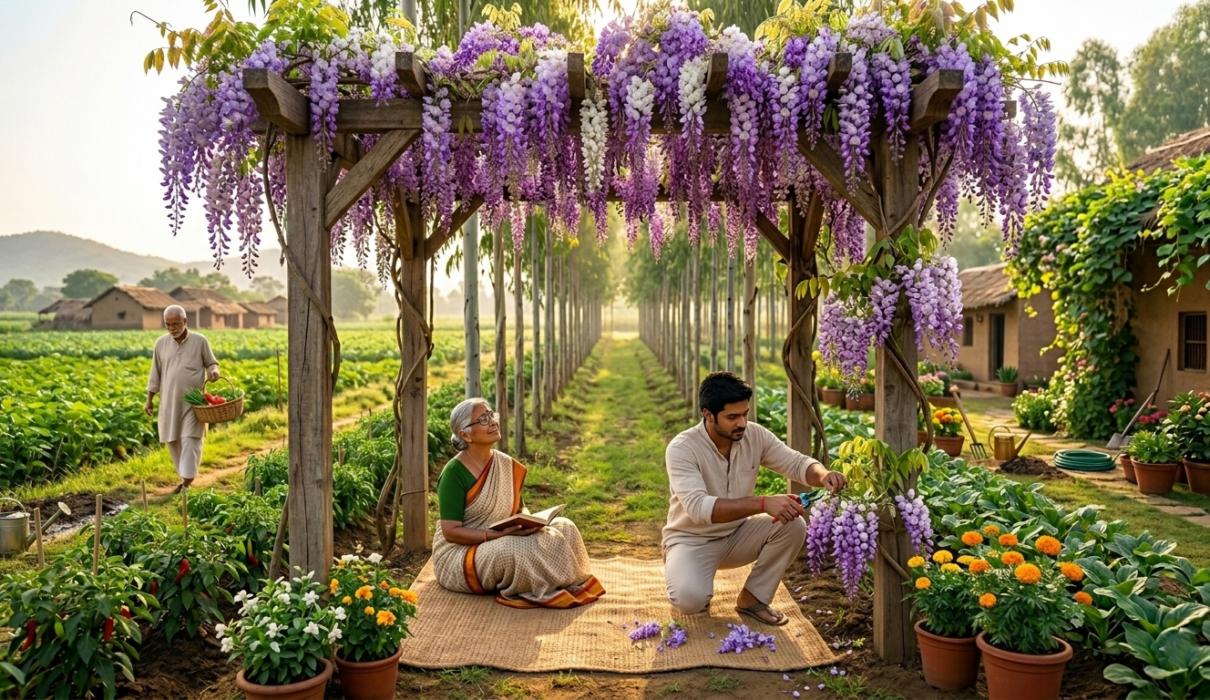
I love how my wisteria started with soft violet flowers, gradually mixing lilac and white – it felt like the sky was blooming in my garden. If you like such colorful flowers, then wisteria is a perfect choice for your garden.
Choosing the right location
I have often heard before that “put a tree anywhere, it will bloom.” Haha, I think that is not right. Wisteria needs a place in full sunlight – at least 6-8 hours a day. I chose an empty corner in my garden, where the sunlight falls directly in the morning and gets some shade in the afternoon. This tree needs support to grow – such as a pergola, fence, or trellis.
When choosing a location, I personally always think, “Does this tree have enough room to grow and spread out?” I don’t overlook that.
Soil and Fertilizer
I mixed sand and compost into my garden soil – seeing the roots sink in felt strangely satisfying, like tucking in a little green baby. I initially used an iron spade for ordinary soil in my garden and mixed in a little sand and a pesticide.
From what I’ve learned here’s what really worked for me:
If the soil is slightly alkaline, the flowers will be more abundant.
If the soil is too heavy (like large potting soil), then the chances of waterlogging may increase.
But do not give too much nitrogen , or else more leaves will grow, and flowers will not appear.
Step-by-step guide to planting wisteria
Selecting a sapling or cutting an older stock – I personally prefer to plant a sapling in a pot with a small bud, so that it can easily adapt to its new environment.
Planting a sapling in the ground: Dig a triangular hole about 60cm deep and 60cm wide, then spread the roots gently and place the sapling in the hole. Press down lightly and water thoroughly.
Apply mulch – Place dry leaves or wood chips on the ground. This helps to keep the soil cool and moist.
Watering and Care
I had to remind myself to water it daily. Miss a day, and the leaves drooped – I felt awful! I remember that I didn’t water regularly the first year, and some of the leaves dried up. So, speaking from personal experience – watering according to the exact clock is important.
Give it a good drink, but don’t overdose it – I once flooded it by accident and those poor leaves drooped miserably
In addition, special attention should be paid to the quality of the soil. Well-drained soil is best for wisteria. If the soil is heavy or sticky, mixing sand or organic fertilizer into it prevents waterlogging. Mulching helps maintain soil moisture and evens out the temperature.
Water requirements increase in summer, so a little more attention should be paid during that time, while in winter it is appropriate to reduce the amount of water. Make sure that the soil around the plant is always slightly moist, but never waterlogged.
When it comes to fertilizing, it is beneficial to provide a balanced fertilizer periodically during growth. Especially before flowering, applying phosphorus-rich fertilizer will give more beautiful flowers.
When I prune, I think of it like braiding hair – gently deciding which vine goes where, so it looks natural and alive.
Training and Pruning
Wisteria is a climber, so it needs to be trained on a support to control its direction of growth. I personally train my tree on a fence every year, so that its growth remains neat and attractive.
Speaking of pruning:
Cutting off the leaves and long vines after flowering helps to produce new branches and more flowers.
The overgrown and dry vines should be pruned in a way that the plant can put its energy into new growth.
The branches that grow inwards and those that cross one another should be pruned to ensure that they have adequate air and light.
The time for pruning is also important. In general, a little pruning in late summer and a bit more in winter will build up the plant’s structure.
As I prune my tree, I do so while keeping in mind the way in which the tree will grow. I prefer to prune my tree while keeping in mind the way in which the vines are growing and which one is stronger. This also helps to keep the plant healthy and natural.
Also, while training the vines, one should ensure that they make use of soft rope and wire so that the vines are not damaged. One should also ensure that the vines do not become too tight so that they do not impede growth.
Fertilizer and Fertilizer Problems
Phosphorus and potash are considered more useful for wisteria, as they help it bloom. I personally apply a good quality flowering fertilizer every flowering season, so that the plant gets proper nutrition.
Yes, wisteria is a bit sensitive – giving too much fertilizer will make the leaves thicker, but will produce fewer flowers. Especially giving a fertilizer that is high in nitrogen will increase the greenery, but will reduce flowering.
A few more things to pay attention to:
Giving a balanced fertilizer: Choose a fertilizer that is high in phosphorus and low in nitrogen before flowering.
Use organic fertilizer: Using compost or well-rotted manure as fertilizer improves the quality of the soil.
Avoid over-fertilizing: Giving too much fertilizer can damage the roots and cause unbalanced plant growth.
Soil testing: If possible, sometimes get the soil tested before applying fertilizer – so that you can determine which nutrients are actually needed.
How to get flowers
There are a few things to keep in mind to get wisteria flowers:
Age: The tree should be at least 3-5 years old. I also saw only leaves for the first two years, no flowers.
Sunlight: Enough direct sunlight.
Pruning: Pruning is important for producing flowers.
Months later, the first flowers opened like a little thank-you from my vine – pure magic in the garden!.
Common Mistakes and Tips
I got overexcited the first year and let the vines run wild – my garden looked like a jungle! It taught me patience (and humility).. Here’s what I learned the hard way. If you take care of these things, the plant will be healthier and will also produce beautiful flowers:
Not taking care of the soil – Giving water once or more can cause root rot. Always keep the soil well-drained and water only as needed.
Lack of proper support – A strong fence, trellis or pergola is necessary for trailing. If there is no support, the vine will not be established and flowering will be reduced.
Neglecting pruning – It is very important to cut old and uncontrolled vines. If pruning is not done, the plant will spread its energy and will produce fewer flowers.
Excessive fertilizer – Especially giving too much nitrogen will increase the leaves but reduce the flowers. Only give balanced fertilizer.
Some useful tips:
Give the plant enough sunlight – 6–8 hours of sunlight per day is ideal for wisteria.
Be patient – sometimes wisteria starts flowering well only after 2–3 years.
Regularly monitor – if the leaves turn yellow, growth stops or flowers do not appear, find out the reason in time.
I have learned one thing from my experience – if you have a little patience and constant care with wisteria, it will gradually grow very beautifully. It is natural to make mistakes in the beginning, but if you understand the plant and move forward, the result will definitely give you happiness.
Also Read This: –
- Planting Eucalyptus Trees: A Complete Guide for Farmers (Benefits, Care & Profit) – 2026
- Acer Palmatum Japanese Maple Bonsai – Complete Care Guide for Beginners – 2026
- Permaculture Garden: A Complete Beginner’s Guide to Sustainable Living at Home- 2026
- Planting a Red Oak Tree: Easy Guide, Care Tips & Benefits – 2026
- Bonsai Starter Kit for Beginners: Complete Guide to Growing Your First Bonsai at Home – 2026
My Experience
I still remember when I first planted my wisteria – those days were truly special. At first, everything seemed slow. Every day I would go to the garden to water the plant, check the condition of the leaves and wonder when it would bloom.
Over time, the vine slowly grew stronger. And then one day – after about a year – it bloomed for the first time. That moment cannot be described in words. I must have spent an hour looking at the vine full of flowers. The peace and joy I felt in it is still fresh in my mind.
With wisteria, you are not just growing a tree – you are starting a journey. A journey that teaches you the value of patience, care and time. Each new bud, each flower reminds you that nature reveals its beauty in its own time.
personal touch: For me, wisteria is no longer just a plant – it has become a quiet companion in my daily life. Whenever I feel tired, I spend some time with her… and I always feel relaxed.
Conclusion
Planting wisteria isn’t just about flowers – it’s about the quiet mornings I spend in the garden, noticing buds slowly open and feeling calm, but also about instilling a sense of peace and joy within you. I found the perfect corner, mixed the soil just right, watered carefully, and trained it like a little apprentice. Every step felt personal, not mechanical – all of these combine to create a healthy and flowering vine.
My personal experience is that when you care for a tree with love and patience, it doesn’t just grow – it gives you a lot in return. Beautiful flowers, a sweet fragrance, and a peaceful atmosphere – all of these things bring your garden to life.
Wisteria taught me to slow down, to notice every new bud and flower – it’s surprisingly calming and joyful.
If you too want to plant wisteria, follow this guide. Little by little, you will experience how this vine can make your garden not only beautiful, but also a peaceful place like heaven.