

 By
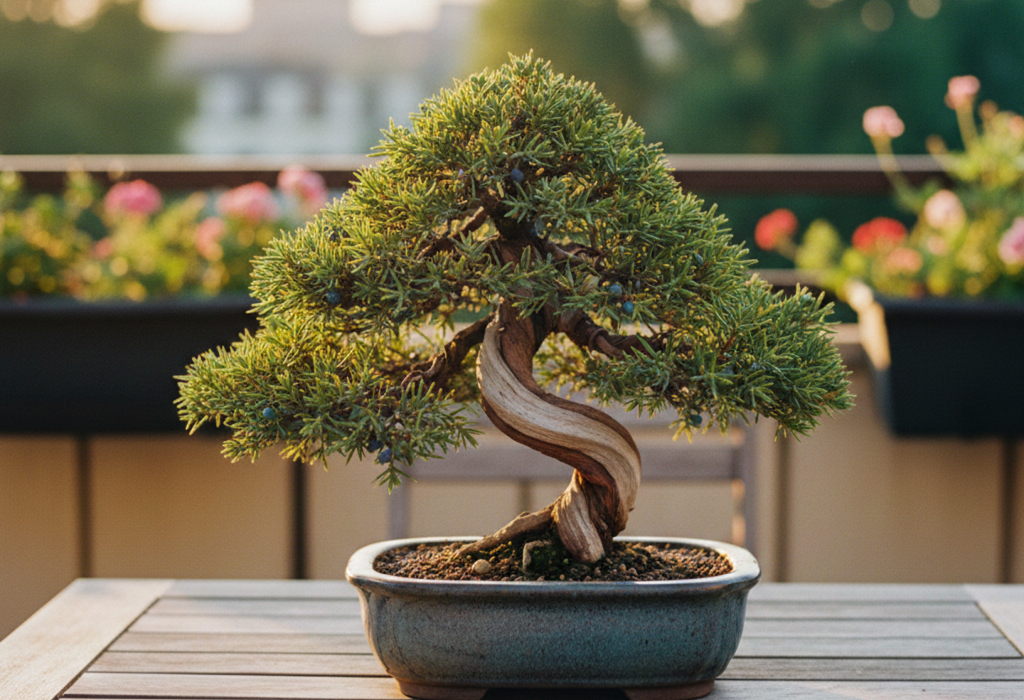
By Juniper Bonsai Care Guide starts with understanding that bonsai is more than just a tiny decorative tree. a tiny tree sitting quietly in a shallow pot, perfectly shaped and almost magical to look at. But the more time you spend around bonsai, the more you realize it’s not just a small tree. It’s patience in physical form, a slow art, and a deeply personal way to reconnect with nature.
Today, let’s slow down and talk about Juniper bonsai probably the most loved and widely grown bonsai tree across the world.
I’m writing this with readers from all around the world in mind whether you’re in Europe, America, India, or anywhere else because the love for juniper bonsai truly has no borders, so that bonsai lovers from any corner of the world can understand juniper its beauty, its care, and the emotions associated with it.
What is Juniper Bonsai care ?
Juniper is an evergreen tree, which simply means it doesn’t lose its green presence throughout the year. Its needle-like foliage, shifting from soft green to deep forest tones, gives it a texture and depth that instantly draws the eye.
Bonsai has been practiced for centuries in Japan and China, and throughout that long history, juniper has always held a special place. and juniper bonsai has been an important part of that tradition.
Today, you’ll find juniper bonsai on balconies in Italy, gardens in Japan, patios in America, and terraces in India its popularity truly spans continents. America, Europe, India, Australia because:
- It is strong
- Easy for beginners
- Can be shaped into various shapes
- Stays green all year round
Why is juniper bonsai special?
There is something quietly calming about a juniper bonsai that’s hard to explain until you sit in front of one. Its curving branches, storm-like formations, and naturally wrought forms make it a living art.
It teaches us:
- Patience
- Regular care
- Growth over time
- Great beauty in small things
For some people, bonsai begins as a hobby. For others, it becomes meditation. And for a few, it slowly turns into a way of seeing life differently, for some, meditation, and for some, a philosophy of life.
Types of Juniper Bonsai
Just like people, every juniper variety carries its own character and personality. each type of juniper has its own unique personality. Juniper is the most widely used tree in the world of bonsai because it is strong, flexible, and can be easily molded into a variety of styles. And once you start observing closely, you realize that not all junipers behave or look the same.
Let’s now take a deeper look at each popular type.
1️ Juniperus Procumbens Nana
If you’re just starting your bonsai journey, Procumbens Nana is often the most forgiving and beginner friendly companion.
This type of juniper grows low and its branches spread towards the ground. Its leaves are needle-like and have good density, which makes it look thick and plump.
Why is this type popular?
- It’s resilient enough to survive small beginner mistakes, which makes learning less stressful.
- Suitable for wiring
- Suitable for cascade and informal upright styles
In fact, many bonsai artists around the world began their journey with this very variety. Because it teaches you gradually how to prune, how to shape, and most importantly – how to be patient.
2️ Chinese Juniper
Chinese Juniper is like a canvas for bonsai artists. Its branches are more flexible and can be molded into different artistic styles.
Techniques such as “jin” and “shari” look very beautiful in this type. (Jin = dry branch, Shari = piece of dry bark)
This gives the tree an ancient, weathered appearance.
Chinese Juniper gives a more natural look as if it were a tree that has stood on a mountain for years. It is often seen at international bonsai exhibitions because it has wide possibilities for artistic expression.
3️ Japanese Shimpaku
If there is a king in the world of bonsai, it is Shimpaku.
The Japanese Shimpaku is known for its soft, scale-like leaves and beautifully curved trunk. Its art, created with bark and deadwood techniques, looks world-class.
- High-level bonsai artists prefer Shimpaku because:
- It maintains a beautiful shape over time
- It is easy to give an antique look
- It is suitable for display
Shimpaku requires a little more attention, but its beauty makes all the effort worthwhile.
How to care for juniper bonsai?
🌞 1. Sunlight
Juniper bonsai truly thrives under open skies and generous sunlight.
At least 4-6 hours of direct sunlight a day is required.
Important:
One important thing many beginners don’t realize at first juniper is not meant to live indoors permanently. It is best to keep it outdoors.
💧 2. Watering
Water before the soil is completely dry.
One of the most common beginner mistakes is loving it a little too much with water and junipers don’t appreciate that.
The pot should have good drainage.
Talk to the soil when watering.
Yes, this may sound strange but for a bonsai lover it is a relationship.
🌱 3. Soil
Good drainage is absolutely essential, because juniper roots prefer breathing space rather than sitting in wet soil. Ordinary garden soil is not enough.
The following mixture is often used:
- Academy
- Pumice
- Lava Rock
✂️ 4. Pruning
Regular pruning helps maintain its form and guides the tree toward the vision you have in mind. Removing old and unnecessary branches.
🪢 5. Wiring
Wiring is the artistic step where you gently guide the branches into a new direction.
But be careful – do not tie the wire too tightly.
🌧️ Weather and international conditions
One of the reasons juniper is so popular globally is its ability to adapt to different climates. It handles colder regions quite well, especially with a bit of winter protection. In hotter climates, however, it appreciates a little afternoon shade and careful watering.
If you are in a cold region like Europe, Canada or North America then provide protection in winter. If you are in India, the Middle East or Australia then be careful in intense summer.
🧘 Bonsai and peace of mind
Many people internationally adopt bonsai as therapy. Spending 10 minutes with a bonsai every day will give you:
- Peace of mind
- Ability to focus
- Reduction in stress
Juniper bonsai teaches you to live life not in a hurry, but in patience.
My little story – a bonsai and me
I still remember that day.
I was not in a special mood. Life seemed a little organized but chaotic. Work, responsibilities, phone, social media… everything was running fast. Inside, I felt like I was running too but I didn’t know where I was going. At the same time, a friend gifted me a small juniper bonsai. A small pot. A small tree.But it was as if someone had given me a piece of peace in my hand.
At first, I kept it like an ordinary plant. Water it in the morning, sometimes put it in the sun. That’s all. But gradually I realized that this “plant” was not ordinary.
One day I was sitting next to it. There was nothing special to do. There was just peace. I looked at its branches carefully. Small leaves. A slightly curved trunk. More density on one side. I suddenly felt this is just like me. A little unbalanced. A little curved. But alive. From that day on, I started not to “care for” it, but to “understand” it.
The first lesson in patience
When I pruned for the first time, I was a little scared. The word “cut” itself has a strange feeling. But in bonsai, cutting does not mean destroying it means giving direction to growth.
It’s the same in life, isn’t it?
Sometimes we have to cut old habits, negative thoughts, unnecessary relationships… It hurts. But then we understand only when space is freed up can new growth be possible. My juniper taught me this. Relationship with time Bonsai does not change quickly. The shape you give it today, the result may be visible months later.
In today’s world, where everything is instant message, instant food, instant success bonsai stops you. Says:
Go slowly.
I sit with my bonsai for 10-15 minutes every day. Sometimes I just look. Sometimes I touch the soil. Sometimes I look for new buds. This time became a meditation for me. I realized that peace is not outside peace is in the mind, An unfamiliar feeling. Once I went out of town for a few days. When I came back, I went straight to it. The soil was a little dry. The leaves felt a little soft.
I felt strange inside as if someone close to me was in poor health. Then I realized. This is no longer a “plant”. This is a relationship. We often consider living things to be “things”. But when you grow a bonsai, you understand the fragility of life. Bonsai grew me
Someone once said:
“I didn’t grow bonsai, bonsai grew me.” Now I understand the meaning of this sentence. My juniper has slowly taken shape over the years. But I have also changed along with it. I have become calmer. More attentive. More patient. When a problem arises, I look at its curved trunk. It is not straight but it is strong. Storms may have come. Rain may have fallen. Yet it stands.
I think
- I can stand too.
- The smallest world
- There is now a small juniper bonsai on my balcony.
- But for me it is a small forest.
- It changes seasons.
- It passes time.
- It grows.
And perhaps most importantly It reflects life. Finally If you ever buy a juniper bonsai, don’t buy it just as a hobby.
- Give it time.
- Sit with it.
- Look at it.
Maybe one day you too will say “This little tree taught me how to live.”
And from that day on, the bonsai will not just stay in a pot it will live in your heart. 🌿❤️
🌎 International community and juniper bonsai
Today, millions of people are learning about juniper bonsai on Instagram, YouTube, and various bonsai forums.
In bonsai clubs around the world:
- Workshops are held
- Exhibitions are held
- Competitions are held
This is a global family where the language may be different, but the love is the same.
🛒 How to get started?
- If you want to get started:
- Buy a healthy juniper from a nursery
- Choose the right pot
- Get the right soil
- Dedicate some time every day
- Expensive things are not necessary.
- What is needed is – emotion and patience.
⚠️ Common mistakes
- Keeping juniper indoors
- Overwatering
- Expecting instant results
- Pruning more
Bonsai is slow art and that’s exactly what makes it meaningful in a fast-moving world.
🌟 Final thought
A juniper bonsai is far more than just a decorative tree in a pot. Over time, it becomes a quiet symbol of patience, care, and the passage of time itself. Be in any corner of the world – If you have a small juniper bonsai on your balcony, in the garden or on the terrace, then you have a small forest, a small universe, a small meditation places. And maybe it can teach you the biggest lesson of life – to find great beauty in the smallest things. 🌿
Also read this :-
- Complete Guide to Growing Japanese Acer Bonsai (Care, Tips & Styles)
- What Growing a Bonsai Taught Me About Patience, Art, and Nature
- Gardening Gloves: Types, Uses, and How to Choose the Best Pair
- Backyard Farming: A Simple Guide to Growing Healthy Food at Home
- The Key to a Thriving Garden: 21 Essential Gardening Tools
FAQ…
1. Can Juniper bonsai be kept indoors?
Ans. It is not advisable to keep Juniper bonsai indoors entirely. This is an outdoor tree that requires at least 4–6 hours of direct sunlight every day. Keeping it indoors for a long time can gradually weaken it.
2. How often should you water Juniper bonsai?
Ans. Water when the soil is slightly dry on top. There is no need to water it every day. Excessive watering can cause the roots to rot, so it is important to have good drainage in the pot.
3️. What soil is suitable for Juniper bonsai?
Ans. Ordinary Garden soil is not suitable. Juniper requires well-draining soil. A mixture of Akadama, Pumice and Lava rock is usually used so that the roots get air.
4. Is Juniper bonsai suitable for beginners?
Ans. Yes, Juniper bonsai is very suitable for beginners. It is strong and can tolerate small mistakes. So it is a good option for new bonsai lovers.
5️. When to prune Juniper bonsai?
Ans. Light pruning can be done during the growing season (spring and summer). Removing dried or unnecessary branches will help maintain the shape of the tree.
6️. How to care for Juniper bonsai in winter?
Ans. Juniper can tolerate cold in cold regions, but it is better to provide some protection if there is a very heavy snowfall. Keeping the pot close to the ground provides protection to the roots.
7️. How fast does Juniper bonsai grow?
Ans. Juniper bonsai grows slowly. Bonsai is a slow art, so do not expect instant results. With regular care, its beauty increases over the years.
8. How often should a juniper bonsai be repotted?
Ans. It is usually advisable to repot once every 2–3 years. When repotting, the roots can be gently trimmed to encourage new growth.
9️. What is the lifespan of a juniper bonsai?
Ans. With proper care, a juniper bonsai can live for decades. Some bonsai even survive for generations.
10. How is a juniper bonsai helpful for meditation and peace of mind?
Ans. Spending some time with a bonsai every day calms the mind, increases concentration, and reduces stress. It is like a living meditation.